
What Was CAPACITY ‘26?
The Disability Law Tech Summit: CAPACITY ‘26 was a virtual summit for Social Security disability practitioners on Thursday, November 12, 2026, co-presented by NOSSCR and Chronicle. Six sessions ran from an opening panel to a closing one, each aimed at a different place a firm’s capacity can hide.
Will Yang of Chronicle opened the day with the idea behind it: “there are a lot of firms that actually already have more capacity than they are using, and it can be hiding in plain sight.”
Every session below has its own replay and a full recap post. Partner sessions were education, taught by the presenter, with live Q&A. The free resources from the day are on the CAPACITY ‘26 resources page.
The Day in Six Sessions: One Takeaway Each
Hire for judgment, automate what follows a written rule
Session 1: How to Grow Your Caseload Without Growing Your Payroll. Diane Haar of Hawaii Disability Legal Services, Will Viner of Viner Disability Law and Kaitlyn Newell of Carmichael Law Group run firms of very different sizes. Moderated by Will Yang, they talked through when to hire and when to automate, which work they have stopped doing by hand, and where the freed-up time goes.
Will Viner on why the audit comes before the hire: “A new hire inherits the mess, and now we have two people who are running a broken process.”
Resource: hear Diane Haar’s full story on Disability Heroes, the podcast episode behind her opening-panel firm.
Claimants finish applications when your office is closed
Session 2: Insights From 50,000+ Disability Applications on Claimant Engagement. James Vancel, co-founder and CEO of Benny, shared benchmarks from the applications his company has supported: how fast claimants respond, when they work on the application, where they get stuck and what they text about. He closed with the experiments that improved completion and data quality, and the steps for getting an SSI claim started.
On timing, James said: “They wake up in the middle of the night, they’re in pain, they’re thinking about, oh, I need this benefit, I really need to go through with it.”
The wait for a hearing is time to build an OTR request
Session 3: Winning Before the Hearing: Leveraging Tech to Build Strong OTR Requests. Nick Coleman, founder and CEO of LexMed, and Ted Norwood, Chief Legal Officer at Integrated Benefits, showed how to use the months between a reconsideration denial and the hearing notice. Nick worked through a synthetic case to find missing proof in a long record. Ted explained how his firm builds one-page medical source statement requests and decides which cases deserve an OTR.
Nick on discipline: “I don’t want anybody to take away from this that you should be following OTRs in every case. You should have sound discretion on what to do, because you don’t want to burn yourself.”
Resource: the OTR request checklist, six steps from reconsideration denial to a written request for a decision on the record.
Fix one bottleneck with AI before you start the next
Session 4: More Cases, Same Team: Using AI to Address Your Firm’s Bottlenecks. Bryan Konoski of The Federal Appeals Firm argued for finding the one bottleneck worth fixing with AI. He walked through three workflows: an AI phone system with a human warm handoff, a guided letter generator for 5-day letters and subpoena requests, and a ChatGPT or Claude assistant that answers staff training questions.
His practical plan: “You really have to pick one bottleneck and move through it. Figure out your workflow. Get that one thing you’re working on locked down, and then move on from there once it’s working properly.”
Resource: The Federal Appeals Firm’s free AI letter generator for 5-day letters and subpoena requests.
Answer the status question before the client has to call
Session 5: How to Stop Clients From Calling to Ask What Is Happening. Nikhil Pai of Chronicle and attorney Ryan Tank of Spector & Lenz traced where status calls come from and the questions clients ask most. Ryan described how a five-attorney firm cut the time its case managers spend on updates, including what it sends by text, what it still handles by phone and how often it checks in when nothing is moving.
Ryan on where his firm started: “We have two case managers who are working almost full-time just picking up these calls, and we’re a five-attorney firm.”
Resource: the one-week status call worksheet, a log of every client call for a week and what it was about.
Operations create the capacity that marketing fills
Session 6: Open Q&A: Where Firms Find Capacity They Already Have. Rachel A. Carlson of PR Legal Marketing, Bryan Konoski and Nikhil Pai joined Will Yang for the closing panel. They covered where firms hold capacity they are not using, what to check before spending the next marketing dollar, how to break the feast-or-famine cycle, and one free thing to start next Monday.
Rachel on the order of the two: “Operation creates capacity, and just marketing helps fill it.”
What the Room Told Us: Attendees Split Evenly on Their Biggest Time Sink
Five Zoom polls ran during the breaks. These are poll responses from attendees who answered, not a survey of all disability firms.
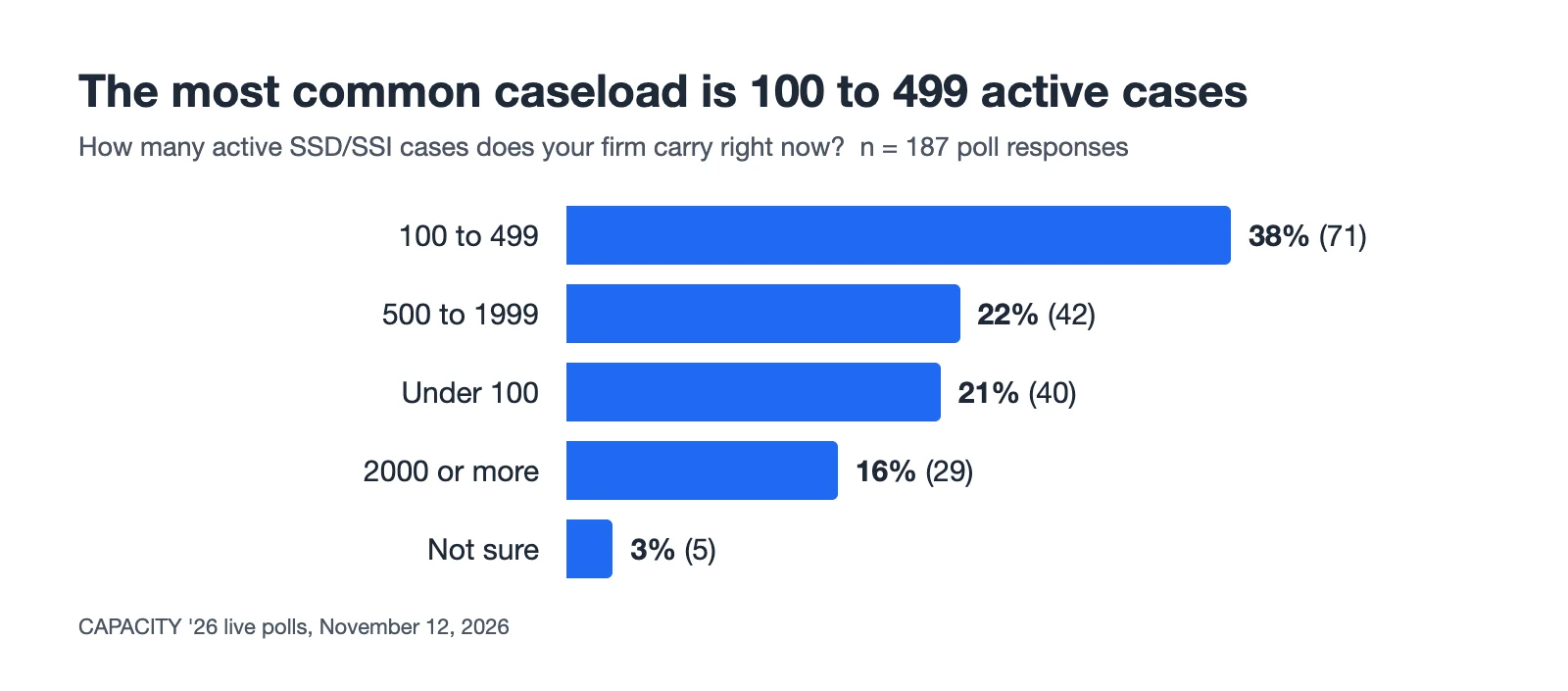
The most common caseload in the room was 100 to 499 cases
| Answer | Responses | Share |
|---|---|---|
| 100 to 499 | 71 | 38% |
| 500 to 1999 | 42 | 22% |
| Under 100 | 40 | 21% |
| 2000 or more | 29 | 16% |
| Not sure | 5 | 3% |
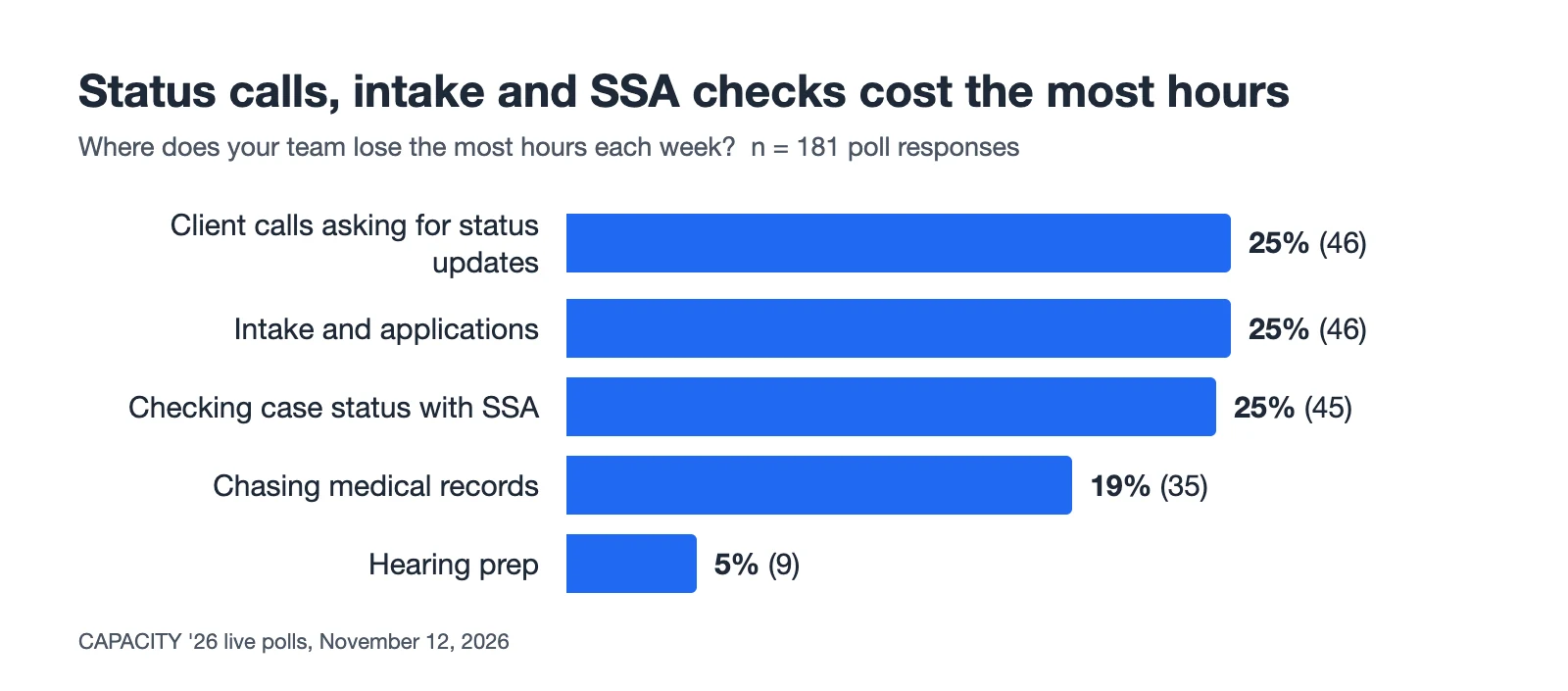
Attendees split evenly on their biggest time sink: status calls, intake and SSA checks
| Answer | Responses | Share |
|---|---|---|
| Client calls asking for status updates | 46 | 25% |
| Intake and applications | 46 | 25% |
| Checking case status with SSA | 45 | 25% |
| Chasing medical records | 35 | 19% |
| Hearing prep | 9 | 5% |
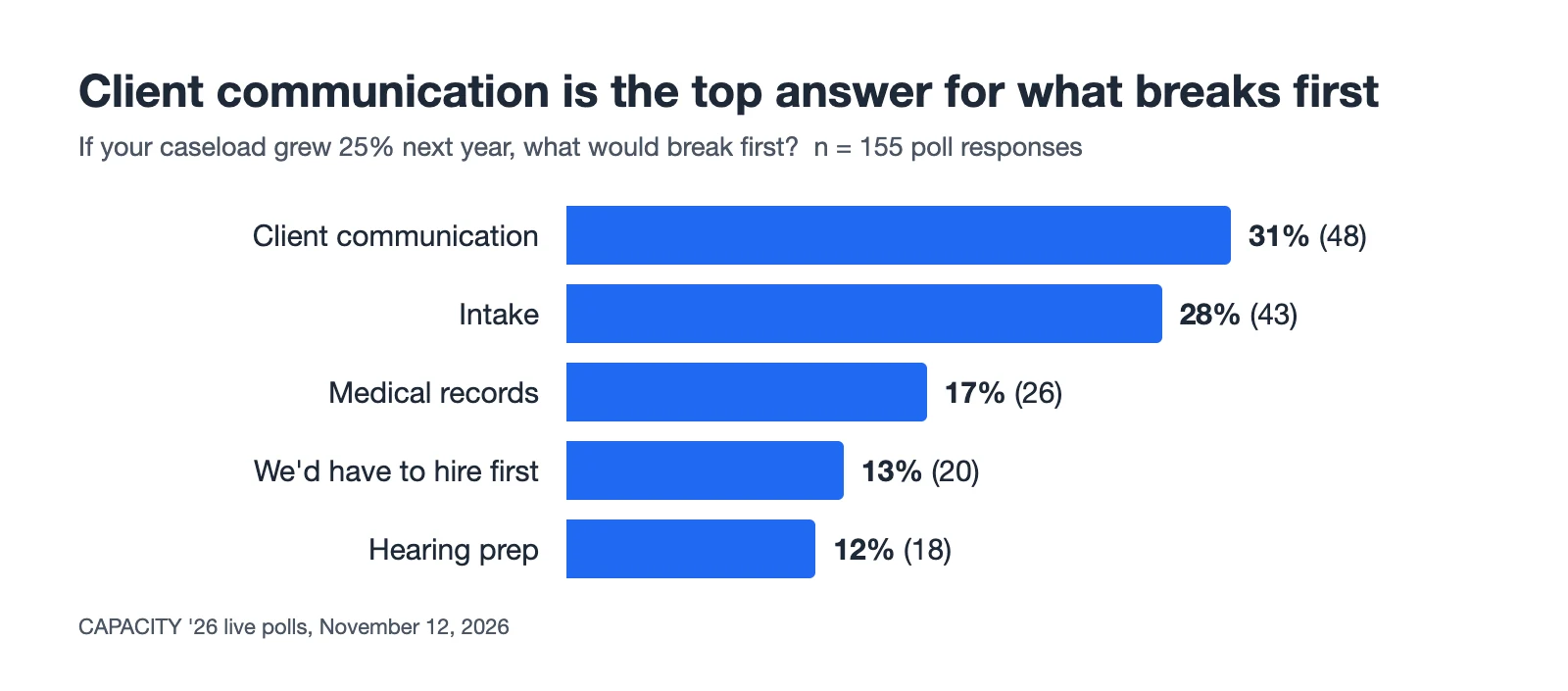
Client communication was the top answer for what breaks first at 25% more cases
| Answer | Responses | Share |
|---|---|---|
| Client communication | 48 | 31% |
| Intake | 43 | 28% |
| Medical records | 26 | 17% |
| We’d have to hire first | 20 | 13% |
| Hearing prep | 18 | 12% |
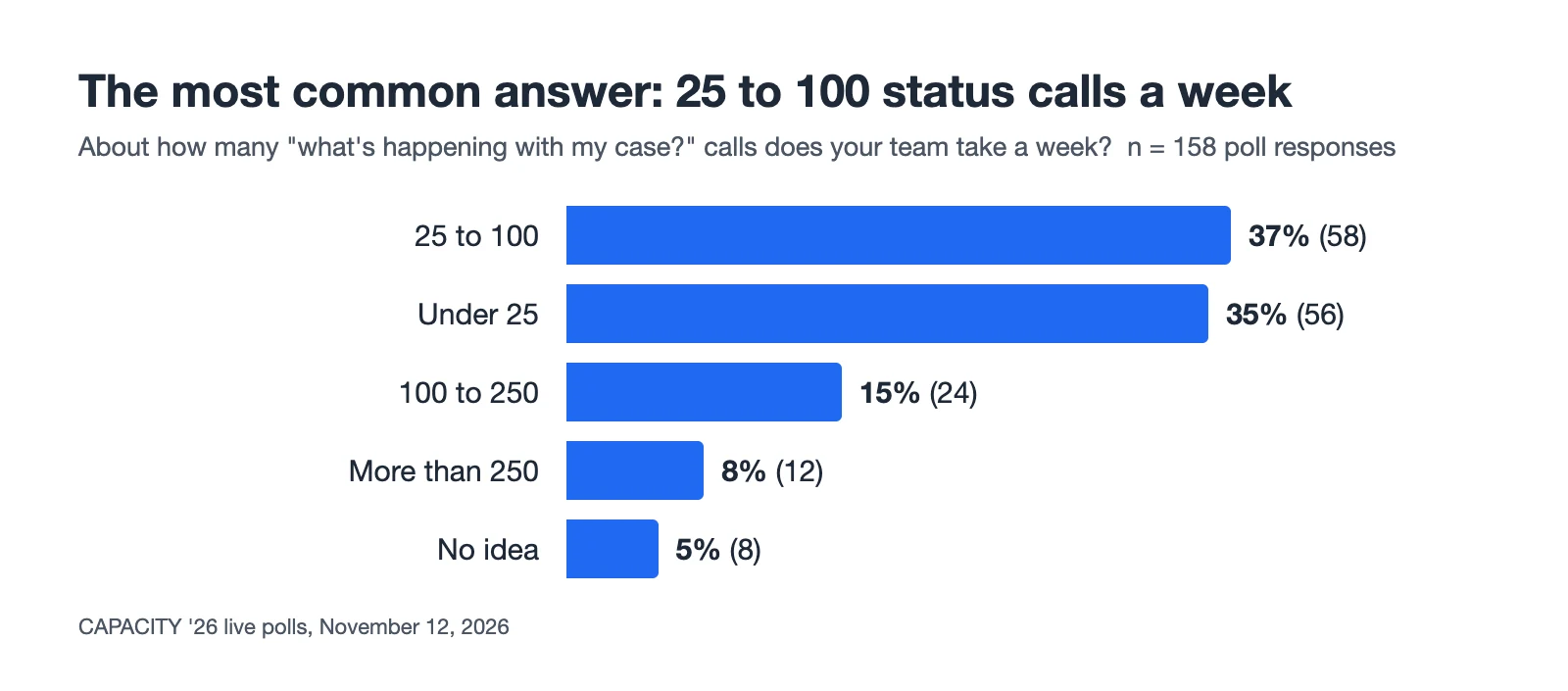
Most teams take fewer than 100 status calls a week
| Answer | Responses | Share |
|---|---|---|
| 25 to 100 | 58 | 37% |
| Under 25 | 56 | 35% |
| 100 to 250 | 24 | 15% |
| More than 250 | 12 | 8% |
| No idea | 8 | 5% |
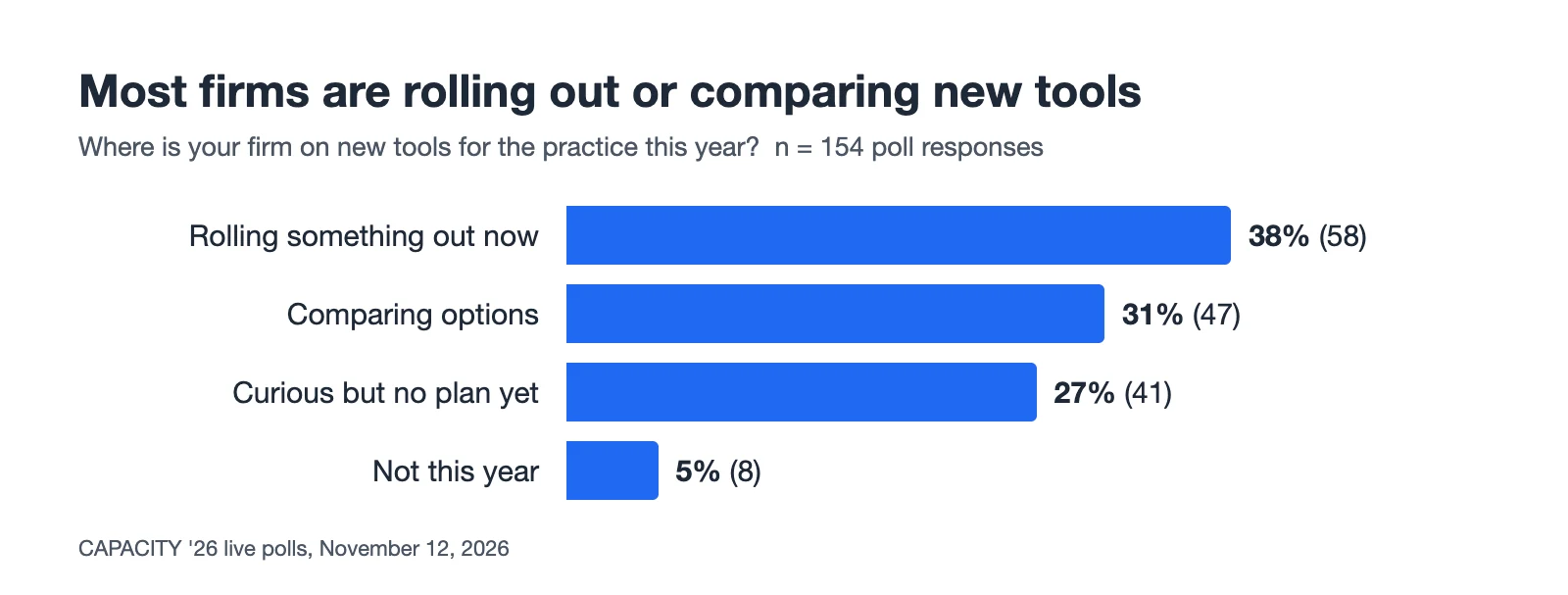
Most firms are rolling out or comparing new tools
| Answer | Responses | Share |
|---|---|---|
| Rolling something out now | 58 | 38% |
| Comparing options | 47 | 31% |
| Curious but no plan yet | 41 | 27% |
| Not this year | 8 | 5% |
Key Themes Across the Day
- Audit before you hire. The opening panel kept returning to the same order: find what is causing the backlog, then decide between a person and a system. Our guide on knowing when your disability firm is ready to hire goes deeper on that call.
- Claimants work when your office is closed. James Vancel’s benchmarks pointed at evenings, nights and weekends, which is a reason to make intake and updates available outside business hours.
- The gap before a hearing is workable time. Nick Coleman and Ted Norwood treated the months after reconsideration as the window to build a record, not wait for one.
- Fix one bottleneck at a time. Bryan Konoski’s filter held up in the closing panel: pick the stuck spot, finish it, then move on. See also how large disability firms are adopting AI.
- Answering before the call is a capacity lever. The status-call polls and Ryan Tank’s session pointed the same way. For more, read client communication in a small disability practice.
- Operations come before marketing spend. The closing panel agreed that a firm that handles more cases well has more to put into marketing. Automation benchmarks for disability firms show where to start.
About CAPACITY ‘26
CAPACITY ‘26 was a virtual summit for disability law firms on Thursday, November 12, 2026, co-presented by NOSSCR and Chronicle. NOSSCR is the National Organization of Social Security Claimants’ Representatives, the bar association for SSDI and SSI claimants’ attorneys and advocates. The replays are embedded in this post and in each session recap, and the CAPACITY ‘26 page has the agenda and the resources page has every free resource from the day.
If you want to see where your own firm’s hours go, AI tools for disability attorneys is a good next read. To talk with the Chronicle team, book a demo or contact support@chroniclelegal.com | 847-665-9612.