
Most firms that want to grow reach for more marketing first. The closing panel at CAPACITY ‘26 asked what a firm should check before that: the cases that are not moving, the outreach that stops when the office gets busy, and the work that quietly costs more than anyone has counted.
Rachel A. Carlson of PR Legal Marketing, Bryan Konoski of The Federal Appeals Firm and Nikhil Pai of Chronicle worked through the questions with Will Yang moderating, then took questions from the chat. Rachel answered from referral marketing, Bryan from federal court appeals and AI, and Nikhil from case operations.
Their session, “Open Q&A: Where Firms Find Capacity They Already Have,” closed the day, followed by Will’s wrap-up of all six sessions.
You can catch the replay here:
Panelists:
- Rachel A. Carlson, Principal, PR Legal Marketing. Rachel leads PR Legal Marketing, which builds newsletter-based referral marketing for Social Security disability attorneys. She has more than 20 years of experience serving the disability legal community.
- Bryan Konoski, Founder and Partner, The Federal Appeals Firm. His firm is a national practice representing Social Security disability claimants in federal court appeals. He is also co-founder and Chief Vision Officer of Brief Master, Inc.
- Nikhil Pai, Co-founder and CEO, Chronicle. Chronicle is ERE monitoring software built for Social Security disability firms and used by more than 180 of them. Before Chronicle, Nikhil built intake and retainer tools for lawyers at Atticus.
Moderated by Will Yang, Co-founder and Head of Growth, Chronicle. Will moderated the panel and hosted CAPACITY ‘26. He leads Chronicle’s community, partnerships and events, including the Disability Heroes podcast and Disability Peers in Practice.
Key takeaways
- The capacity is usually already in the firm. It sits in paralegal hours, cases that are waiting between stages, and relationships with past clients and referral sources.
- Count what a case costs to carry before spending on marketing. If costs rise as fast as revenue, more leads do not help.
- Outreach is the first thing to drop when the office is busy. Give it an owner and make it routine.
- A case a firm will not keep still has value. Referring it out, or taking it to federal court, can pay and can strengthen the referral relationship.
- Fix operations first, then fill the capacity with marketing. Better operations free up dollars and hours.
- Spread lead sources, and measure each one. One channel is a single point of failure.
- Technology takes work off the desk and puts some back. Each new tool needs someone watching it.
- The first steps cost nothing. An hour a week of thinking time and two short emails is enough to start.
Operation creates capacity, and just marketing helps fill it.
Rachel A. Carlson, PR Legal Marketing
A firm’s unused capacity hides in paralegal hours, stalled cases and cases it is not paid for
The panel opened with a one-sentence round: where do most disability firms have capacity they are not using? The three answers landed in three different places. They are worth keeping apart, because each points at a different fix.
Past clients and referral sources are capacity a firm already has
Rachel started with relationships. Her answer was “right in their own backyard.” She named “your existing relationships with past clients, professionals that you work with, like doctors, other attorneys.”
The common thread, in her words: “People who already know and trust your firm.” A firm does not need a new audience to find that capacity. It needs to stay in touch with the one it has.
Reducing paralegal hours is the first place to look
Bryan went to staff time. His answer was “freeing up paralegal time,” through “using AI phone systems to assist with intake.”
He came back to it when Will asked what a firm should look at before spending the next marketing dollar. “I think that the first place you should look is how to reduce paralegal hours in the office,” Bryan said, “because if you increase efficiency, then you can actually wind up, increasing your revenue by reducing costs.”
Hours spent on cases sitting between stages are unused capacity
Nikhil pointed at waiting. The unused hours, he said, are the ones a team spends on “the cases that are just sitting between stages, between processing times.”
That is a different kind of waste from a slow day. The work is real, but it happens at the wrong time, or happens again and again with nothing new to act on.
Cases at the end of the hearing process can still earn revenue
Will asked what is sitting in a firm’s caseload that the firm may not be paid for. Bryan’s answer was cases that have reached the end of the ALJ hearing and are treated as finished.
“There are firms out there that will take those dead cases and turn them into money for referral fees as well,” he said. A denied or rejected case can also go to federal court. Reaching the end of the ALJ hearing, he said, “doesn’t mean there’s… that’s the end of the case.”
Checking quiet cases on a schedule wastes time
Nikhil returned to the long waits. “Cases sit there for a while, especially if they’re a DDS, you just don’t know what’s going on,” he said.
Many firms respond with a standing rule to check every case on a schedule. His view of the cost: “Someone’s still checking in every month.” He added that the other side of a quiet case is a client who is not quiet. Clients keep seeing doctors and working, so a firm that is not reaching out is missing information.
If a firm wants to see this in its own numbers, what disability firms actually measure is a good starting point.
Count what a case costs to carry before adding volume
Nikhil’s practical advice was to put a number on carrying a case from intake to resolution, and to watch whether that number is getting cheaper or more expensive over time.
“Is it getting cheaper or more expensive?” he asked. The reason it matters: “you may be growing your revenue, but you’re growing your costs, and you’re actually making less money in the long run.”
Outreach stops when the office gets busy, so give it an owner and a routine
Will framed the second theme as feast and famine. Case flow comes in waves, so why does business development only happen when things slow down, and what breaks that cycle?
Marketing gets dropped because it is treated as something for when there is time
Rachel asked the audience to raise a hand if they jump into marketing when things slow down, then let it slide when things get busy. She called it very common.
“It’s often treated as something that you do when you have time,” she said. Her fix was to make outreach a regular part of operations.
Assign one person to own outreach
Rachel does not think a firm needs a marketing department. A smaller firm can “assign someone to be responsible for it,” she said, ideally someone with a skill or an interest in the work.
She also widened what counts as marketing. “Even the person answering the phone is part of marketing, so ask how callers found you, be helpful.” Then ask permission to use simple follow-up emails to stay in touch.
Her summary: “it shouldn’t be something that you switch on and off, it should be consistent, and that’s the key.”
Client outreach is the ball that drops first
Nikhil said the same pattern shows up on the case side. When a team gets busy with paperwork and triage, “that’s the ball that drops, right, is outreach to your clients.”
His classic example is a firm that spends heavily on marketing, then suddenly has a wave of intakes to process and stops servicing the cases it already has. The fix is a standard operating procedure that will “protect that time for outreach,” or a way to automate it. Chronicle’s one-week status call worksheet is one way to see where client calls come from.
For firms looking at the automation side, Chronicle Dispatch is Chronicle’s client communication tool.
During the day, attendees were polled: if their caseload grew 25% next year, what would break first? Client communication led.
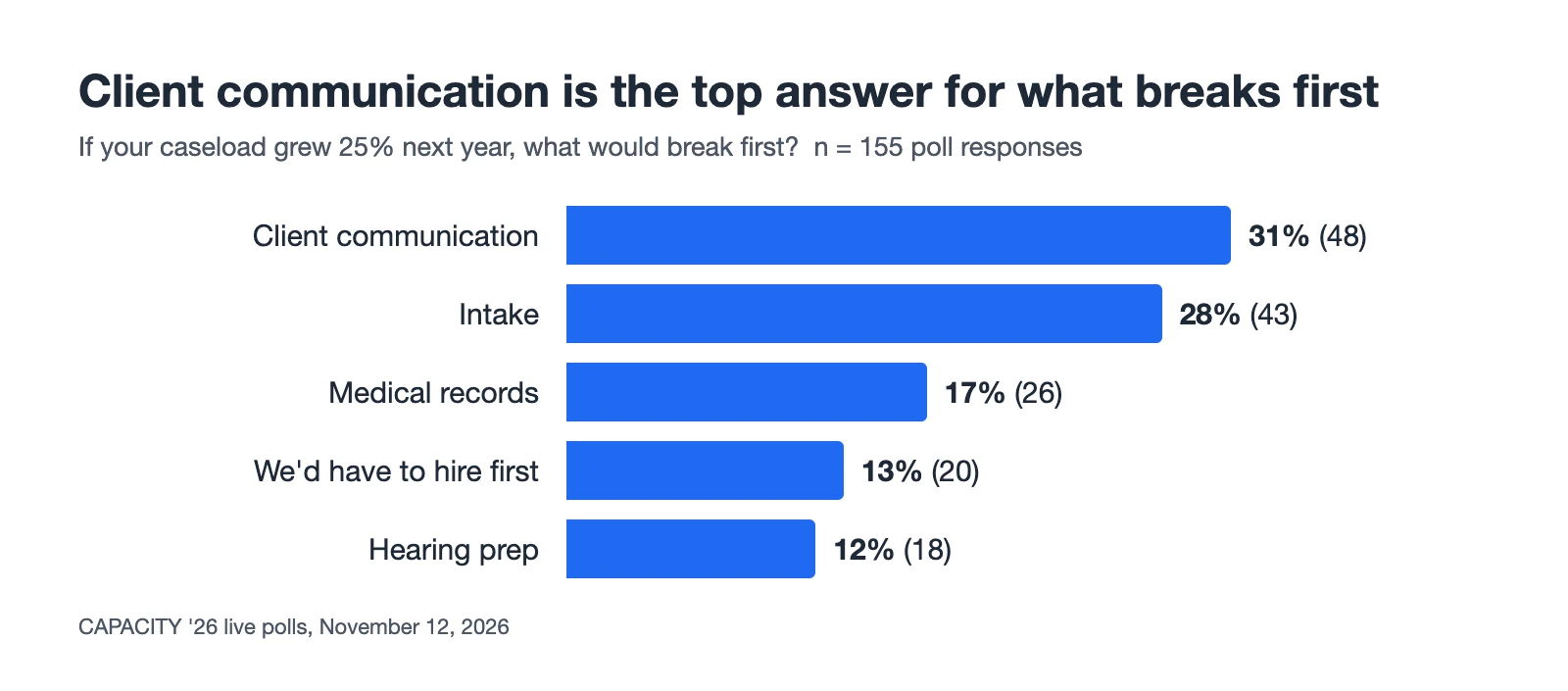
CAPACITY ‘26 live poll, November 12, 2026.
Efficiency buys the time marketing needs
Bryan tied the cycle back to efficiency. When things are hopping, he said, a firm’s efficiency is not where it wants to be, and the time deadlines from ALJs leave little room for anything else.
His answer was to improve speed first. “Then either you’re going to be able to focus more time on marketing, or you’ll have some staff members that can do so because you’ve increased that efficiency.”
Educational emails beat splashy banners
Will asked what kinds of lifecycle emails people actually engage with. Rachel’s answer was that “educational and useful, touchpoints are the most effective.”
She contrasted that with “here we are, here’s a big splashy banner, and advertising.” Her example for past clients was the newest cost-of-living adjustment: information people want to know about, so the email is not “wasting people’s time.”
She made the same point later, about why educational outreach works for disability attorneys: “it’s advertising in the guise of, education, but it’s useful, and people really appreciate that.”
Federal appeals marketing is attorney to attorney, and still educational
Bryan noted that his audience is different. “All my marketing goes to other attorneys,” he said, so his firm produces videos, content and emails about federal appeals, law changes and AI.
His one adjustment for audience: attorneys will read something complex, while emails to administrative-level clients need to be less complex “so that they actually read it and pay attention to the content.” Both of them agreed that education is the common thread.
For more on building a steady referral pipeline, see how SSD firms build consistent referral pipelines and what actually works in disability law firm marketing.
Referring out and declining cases, done well, build referral relationships
Will’s question for the third theme: how should a firm decide which cases to keep and which to send to someone else, and does referring a case out cost you the relationship?
Referring a case out can strengthen the relationship
Bryan answered from the receiving end. “When attorneys send cases to us, I don’t think it injures the relationship at all,” he said. “It, in fact, enhances it.”
His example is a client who lost a hearing and calls his office upset with their lawyer. He tells them “your lawyer cares enough about you to take the time” to send the records over. “I think that helps build trust.”
A compassionate decline protects your reputation
Rachel looked at the other side: the call a firm will not take. She said a firm can “thank the person who referred it, and when appropriate, point the caller to another resource.”
The alternative is the one-star Google review from someone whose case was never reviewed. With a compassionate explanation, she said, the review might read, “they were really helpful and compassionate, but unfortunately they couldn’t take my case.” Her verdict: “That’s a lot different than a one-star Google review.”
A lead scoring rubric lets intake agents decide
Will asked for the best way to define lead scoring criteria, a thread from the opening panel. Nikhil said the best firms he saw at Atticus had a rubric, for two reasons.
The first was to filter the cases a firm may not want. The second: “it also empowers your intake agents to actually make decisions.” Without that, an intake agent says they will hand it to the attorney and call back, and “they’ve already signed up with someone else.”
The right scoring criteria depend on what the firm is set up to service
Nikhil was explicit that scoring is partly a preference. Some firms take people over a certain age or with certain conditions, and “it really comes down to what are you set up to service.”
Rachel added a specialty angle. A firm may have “a reputation within your community for taking the really tough mental health cases.” If so, she said, it can aim its marketing at that work and at psychologists and psychiatrists for referrals.
AI can run the first screen against criteria you set
Bryan described the intake step he uses. Once an AI phone system and agent have gathered the information, a firm can run it through its own criteria with a tool like ChatGPT or Claude. “You can get an immediate answer based on your criteria as to whether it’s a case that you would accept.”
The point was volume. A firm getting many calls can screen quickly against criteria it has already decided on.
Spend the next dollar on operations first, then fill the capacity with marketing
For the fourth theme, Will set a trade-off: a firm has budget for exactly one thing next year. Does it go to generating demand, or to the operations underneath it?
Operations come first because marketing spend can be dialed up and down
All three panelists put operations ahead of marketing. Nikhil said it first: “it’s always operations.”
His reasoning is about speed of adjustment. “Marketing spend is a thing you can dial up and dial down as you need.” Operations take longer to pay back, so a firm should start early.
Better efficiency raises the share of cases a firm can take on
Bryan agreed, and added the arithmetic. Whatever case volume is coming in, once efficiency improves, “you could find that you have, increased the percentage of cases that you wind up being able to take on.”
He said that holds however a firm gets there, AI included. For the growth side of the same trade-off, see how high-volume disability firms scale without chaos and the opening panel recap, growing your caseload without growing your payroll.
Operations creates capacity and marketing fills it
Rachel put the relationship between the two in one line: “Operation creates capacity, and just marketing helps fill it.”
She added that better efficiency in the back office “frees up more dollars for marketing.” The two are not competing for the same budget as much as feeding each other.
Excellent client service is the first source of demand
Will asked how a firm creates the demand to fill the capacity it has built. Nikhil answered with the client experience. “If you give excellent client service, your clients will refer you to other people.”
Rachel kept the thread going after the case ends. “Don’t just let them win the case and then drop off, communicate with them, and use, education and useful information, too.” She also named birthday cards and holiday greetings as simple ways to stay in touch.
Spread lead sources and measure each one
Will asked how important it is to diversify where cases come from. Rachel said “very important, don’t put all your eggs in one basket.”
Her list was pay-per-click, SEO and a referral effort that is not digital, such as talks at libraries. Then measure each one. If a channel is working, she said, try not to drop it without finding out whether it can be tweaked. “Not all one program fits for all firms,” she said. “Try a bunch, and don’t give up too soon.”
Relying on pay-per-click alone can raise cost per lead over time
Nikhil added a warning about relying on one channel. In his view, a firm that only buys paid ads can see its costs rise as better-funded companies bid in the same area.
The result, he said: “You’ll see your cost per lead go up and up over time as these companies are well capitalized.” He pointed to other streams of leads as the hedge.
Technology takes work off the desk and puts some back
Will asked where technology has genuinely taken work off a firm’s desk, and where it has quietly added work. The answers were candid, and Rachel pushed back on Bryan on one point.
AI phone systems can clear an intake bottleneck
Bryan said AI phone systems made a significant efficiency difference at his firm. The gain was in intake and information gathering that the firm had a backlog on.
He said it helped without increasing staff, and that it improved efficiency on certain letters and time-extension motions. For briefing, the picture was different.
Verification is a new job that AI creates
For federal briefing, Bryan said the firm has to worry about Rule 11 and its ethics obligations. “No matter how good the AI is that you’re working with, there’s always going to be hallucinations.”
So the firm added work. “We did have to hire new employees for verification checks.” He described a role that did not exist before: “This is a function of paralegal that never existed before, that now exists because of AI.”
Some callers hang up on machines, so monitor AI intake
Rachel agreed with the value of AI at intake but pushed back. If a firm uses AI as an answering service, she said, it may spend more time chasing callers who say, “I don’t want to talk to a machine.”
Her advice was to monitor those calls carefully and call people back, because “you don’t want to lose those leads at all.” She added, “real human empathy, I think, still matters.”
SSA technology helps firms and confuses clients
Nikhil said the long arc of SSA technology has helped firms understand what is happening on a case, from paper files to the electronic records that firms check today. The newer problem is on the client side.
He said clients are getting reached out to and told to do things by the SSA. “As great as it is that the SSA is adding more technology to help your clients, it does cause confusion.” A firm has to get ahead of it as the representative.
AI search is changing how people find attorneys
An attendee asked in the chat for best practices on SEO for disability practices. Rachel said she does not do SEO, but she is watching AI search. Her point: “people are using the AI tools to ask questions about disability.”
For her, the implication is that “helpful website content is becoming even more important.” Keywords that work for a Google search will differ from what matters for AI search.
AI rewards content that reads like real expertise
On content, Rachel said AI “is smart,” and “you’re looking for content that really does read like you know what you’re talking about.” Will added a moderator’s view from a decade in SEO.
Commodity content, such as a definition of disability law, used to be enough to get a firm on the map. What matters now, Will said, “is what is uniquely your expertise on the topic.”
Start next Monday with a plan, a view of your cases and two free emails
Will’s closing question: for a firm with no budget or no spare hours, what is one thing it can start next Monday that costs nothing? Each panelist gave a different, concrete answer.
Write a plan for 2027
Rachel’s first answer was “a good old-fashioned plan.” She asked firms to “sit down and take the time to figure out what your firm wants to do in 2027, both in terms of operations and also in terms of marketing.”
The plan needs real choices in it: whether the firm wants to grow, or to slow down because the owner is retiring. Then decide which products and services go with that direction.
Make sure the firm can see its cases, so AI is not as slow as the mail
Nikhil’s 2027 focus was observability. “In order for your AI to be effective is observability.” A firm needs to be able to see where each case stands, up to date from the SSA.
The risk of not doing so: “your AI is going to be as slow as the mail as well, and you’re not going to get those efficiency gains.” As the SSA adds portals, he said, a firm needs to be pulling that data in.
Set up AI tools yourself on a small budget
Bryan’s answer was practical and cheap. “You can absolutely work on setting up your AI systems. I’ve done a lot of it from my kitchen table.”
He said letter generators, chronologies and phone systems can all be set up that way. His firm offers a free AI letter generator. For how smaller practices use AI day to day, see AI in a small disability practice. “You don’t need a massive budget to be able to accomplish these things.”
Block an hour a week to work on the business
Nikhil’s no-cost suggestion was time. He recommended “taking an hour a week, just essentially finding some time to do deep thought.”
A practitioner can get so caught up in filing and hearings that they stop operating the business. His reminder: “I’m the business owner, I need to, build my business as much as I build my practice.”
Email past clients and the doctors you work with
Rachel called her answer cheating, because it is two things. First: “Pull up your past client list,” and “send a short, friendly email with the new COLA information,” with a gentle reminder that the client can refer friends, family or neighbors.
Second: “Pull up any doctors that you work with that are in your cases,” and send a friendly note of thanks for past referrals. She estimated it would take about an hour. For more low-cost ideas, see cost-effective ways to grow your disability practice. Rachel’s firm, PR Legal Marketing, builds the newsletter-based referral marketing she describes.
The whole day pointed at the same thing: capacity a firm already has
After the panel, Will recapped the full day for anyone who joined partway through.
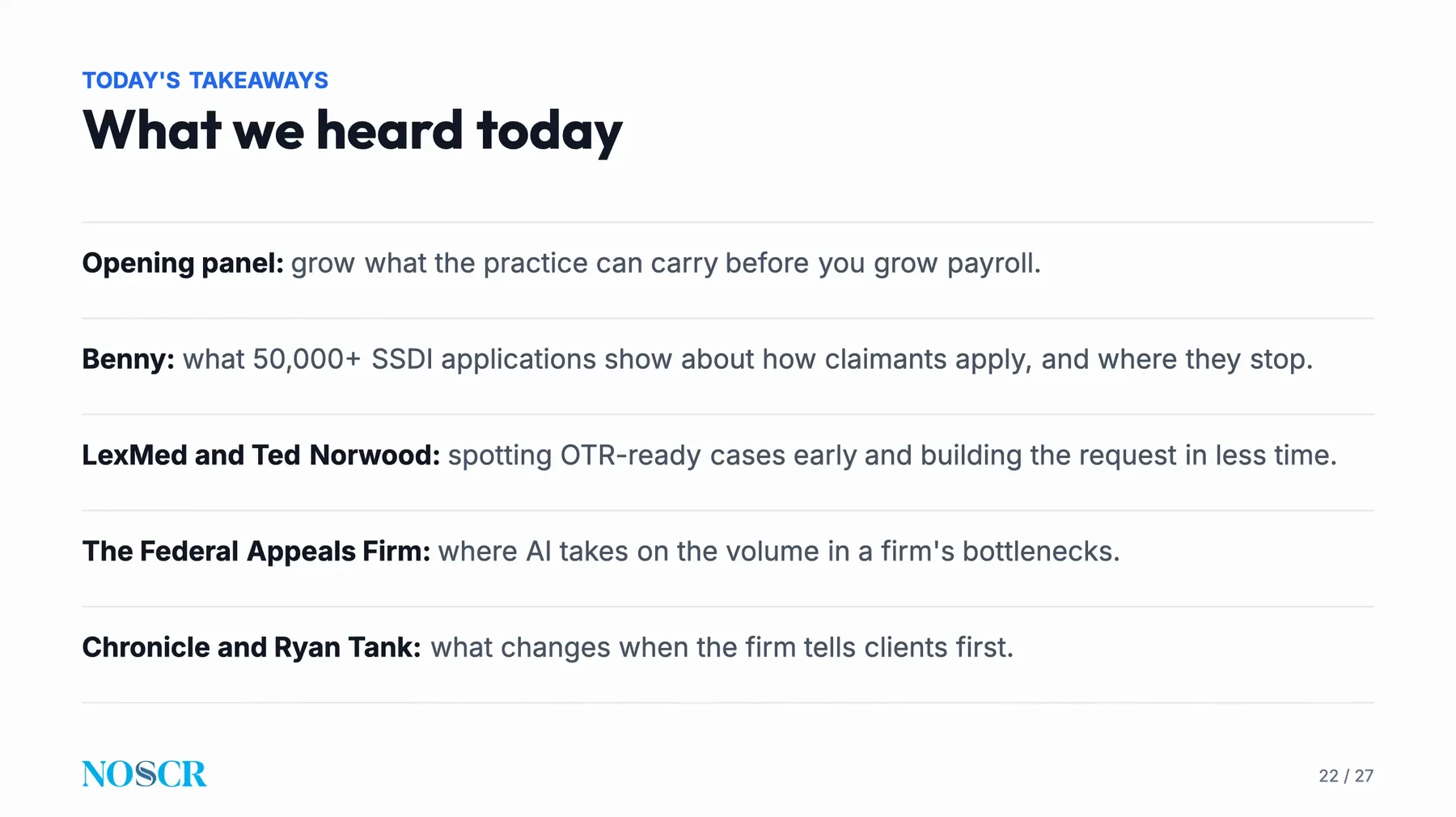
The closing slide of the day: one takeaway for each session.
Six sessions asked one question: what can a firm do about change
The summit ran from a welcome through six sessions on disability law and technology. The thread through all of them was what is changing at different firms and what a firm can do about it.
For more on how the other sessions covered this ground, see how Chronicle approaches stopping client status calls and using AI to get more cases through the same team.
Practitioners and claimant data showed where firms stall
The opening panel brought three practitioners who described what they are doing differently at their firms, and how they think about the trade-off between hiring another person and building and improving their systems.
The second session looked at what a platform sees across a large volume of claimants: how they actually apply, and where they stop.
Earlier OTR requests and AI at the bottleneck save time
A LexMed session covered spotting OTR-ready cases earlier so a firm can build those requests in less time and get ahead of the hearing.
Bryan’s own session covered where AI can take volume off a firm’s bottlenecks.
Proactive client communication replaces reactive scrambling
The Chronicle session, with Ryan Tank of Spector & Lenz, covered what changes when a firm is proactive in client communications instead of reactive. This panel covered what to think about heading into next year, and core operational improvements.
Today’s phrase: your capacity changes their lives
Will closed with the phrase of the day: “your capacity changes their lives.” The point, in his words, was that “when we’re able to unlock your firm’s capacity and what it already has, and also thinking about how to grow its capacity, that’s really where all the improvements can really come across the firm.”
Frequently Asked Questions
What should a firm check before spending more on marketing?
The panel’s answer was operations. Look at paralegal hours, cases that are waiting between stages, and the cost of carrying a case. If costs rise as fast as revenue, more leads will not help.
Should a firm refer out cases it will not keep?
Bryan’s experience is that it strengthens the relationship. A client who lands with a federal appeals firm hears that their lawyer cared enough to send the records. Denied or rejected cases can also be referred for a fee or taken to federal court.
How should a firm handle a call it does not want to take?
Rachel said to thank the person who referred it, and when appropriate to point the caller to another resource. A compassionate explanation can show up later in a Google review.
Are there suggestions for SEO for disability practices?
An attendee asked this in the chat. Rachel said search is changing quickly and people are using AI tools to ask disability questions, so helpful website content matters more. Nikhil said real video content helps. Will’s view: content that shows your own expertise matters more than commodity content.
How does each firm create demand, in percentages?
An attendee asked each panelist for their own mix of internal demand generation, external demand generation, affiliates and referrals. None of the panelists gave percentages. Bryan said his model is outside that frame. Rachel pointed to educational outreach to referral sources, past clients and the community. Nikhil answered with operational efficiency rather than percentages.
What is one free thing a firm can start next Monday?
The panel gave four. Write a plan for 2027. Set up an AI tool or phone system yourself. Block an hour a week to think about the business. Send short emails to past clients and to doctors you work with.
Resources from this session
- PR Legal Marketing, Rachel A. Carlson’s firm.
- A free AI letter generator from The Federal Appeals Firm.
- Chronicle’s one-week status call worksheet.
- Every resource from CAPACITY ‘26, in one place.
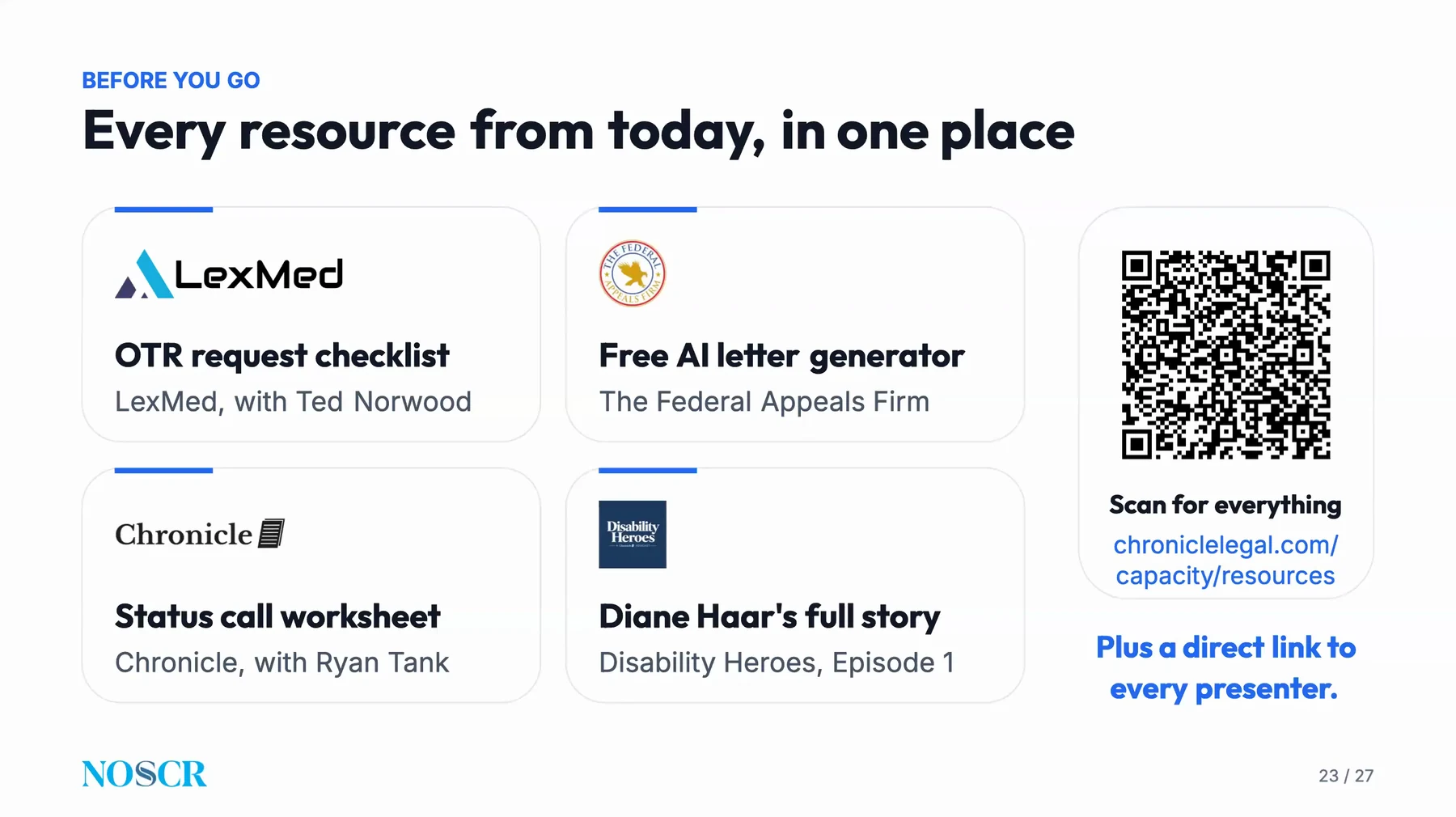
The resources slide Will showed at the end of the day.
Watch the Full Replay
About CAPACITY ‘26
CAPACITY ‘26 was the Disability Law Tech Summit, a virtual event co-presented by NOSSCR and Chronicle on Thursday, November 12, 2026. It brought practitioners and technology partners together for sessions on growing capacity in a disability firm. See the summit page for the full agenda and resources, and the CAPACITY ‘26 hub post for all six replays.
Chronicle is ERE monitoring software built for Social Security disability firms, and it checks the ERE and e-file daily for each monitored case. To see how it works, book a demo. Questions? Reach us at support@chroniclelegal.com or 847-665-9612.
Full Session Transcript
The transcript below has been lightly edited for clarity and readability.
Introductions
Will Yang: I’m very excited to get things wrapped up here with our closing panel. Congratulations, everybody, we’ve made it to the last session of the day. This is our panel on where firms find capacity that they already have. Very excited to present our three speakers for today.
The first and foremost, we have Rachel Carlson, who is Principal of PR Legal Marketing. She helps Social Security Disability firms build stronger referral relationships through educational content and consistent, meaningful outreach. With more than 20 years of experience serving the disability legal community, Rachel believes that effective marketing starts with providing value, building trust, and staying connected.
Next, we have Bryan Konoski. As if you’re just joining us, Bryan is the founder and partner of The Federal Appeals Firm, national practice representing Social Security Disability claimants in federal court appeals. He’s also co-founder and chief vision officer of Brief Master, Inc., where he developed Brief Master, an AI platform focused exclusively on federal appellate intelligence. Drawing on his experience integrating AI into his own practice, Bryan will share practical ways that attorneys can reduce bottlenecks, support their staff, and handle more cases without expanding their teams.
And to round out our panel, he just spoke, but to bring him back, Nikhil Pai, co-founder and CEO of Chronicle, ERE monitoring software built only for Social Security Disability firms, and used by more than 180 of them. Before that, he built intake and retainer tools for lawyers at Atticus, and spent 7 years building software for specialists at Hearth.
Panel discussion
Will Yang: With that, we are going to go ahead and stop this slide share here, and kick us off with the first question of today’s panel. To open up this panel, would love to hear from everybody doing a quick roundabout of, in one sentence, where do folks think most disability firms have capacity that they are currently not using?
Rachel A. Carlson: I can jump in. I would say right in their own backyard. Your existing relationships with past clients, professionals that you work with, like doctors, other attorneys. People who already know and trust your firm.
Bryan Konoski: And I would say that in freeing up paralegal time, that could be through using AI phone systems to assist with intake, and also making sure that you can handle or send out cases that you’re not handling after a case is denied.
Nikhil Pai: Yeah, in our view, it is the hours your teams spend keeping up with cases that aren’t moving, so the cases that are just sitting between stages, between processing times, and you’re just waiting for the mail to drop 10 to-dos for you. But you could have done them earlier, and you’ve just been sitting around waiting.
Will Yang: Awesome. Well, the next question that I have for folks here is, I’m curious, in this first theme, let’s talk about before we go ahead and spend the next marketing dollar. Let’s say a firm tells you all that they want to grow. Before they go ahead and spend another dollar on marketing, what’s the first thing that they should look at? And if, Bryan, you can speak closer to your microphone, some people are struggling to hear you right now.
Bryan Konoski: Not a problem. Yeah, I get that complaint a lot on my microphone. Sorry about that. I’ll jump in on that.
I think that the first place you should look is how to reduce paralegal hours in the office, because if you increase efficiency, then you can actually wind up, increasing your revenue by reducing costs. First place, like we were talking about earlier, AI phone systems, or workflows with letter generator, or workflows with medical record chronologies. And then from there, you’re gonna look to see out of all the cases that you have, whether those cases that you would consider dead cases, whether you’ve denied them, rejected them, or whether those could be sent out for anything else, whether it’s federal court, or just to be referred for a participation fee on cases that you no longer want.
Nikhil Pai: Just to build on that very summary, I would say, look at the cost of carrying a case. Can you say, when I bring on this case, how much it cost me to service it for the 18 to 24 months it will take to finish this case? And also, how has that changed over time? Is it getting cheaper or more expensive?
Because that will help you understand, to Bryan’s point, how are your operations, and are they efficient? Because if you are spending money in marketing, and you rise, you need to hire more and more staff, and you’re getting over your skis, you may be growing your revenue, but you’re growing your costs, and you’re actually making less money in the long run.
Rachel A. Carlson: And I would just add, I would ask what you have already tried, what worked, and how you measured it. I had a client frustrated with purchase leads that weren’t exclusive, so if they didn’t respond quickly enough, another attorney made the contact. That doesn’t mean the leads weren’t bad, but knowing what you’re buying, and what your team needs to do, and what results are realistic. Some tactics produce quick opportunities, referral relationships take time, so I think there’s a difference between tactics and having a strategy.
Will Yang: If you were to take a firm’s caseload as it is today, what’s in there that the firm may not be getting paid for?
Bryan Konoski: I’ll chime in. Cases that are inside your caseload where attorneys are not getting paid for are cases that are not going up, let’s say, for Appeals counsel or federal appeal. Or cases that are dead cases, either they’re being rejected, they’ve been denied, those can be outsourced, whether for federal court, or there are firms out there that will take those dead cases and turn them into money for referral fees as well. You have to look at your caseload as a whole. Just because it’s a case you’re no longer interested in, or you think that it’s reached the end of its life cycle through ALJ hearing, doesn’t mean there’s… that’s the end of the case. You can actually generate more revenue from those cases that have reached the end of the ALJ hearing lifecycle.
Nikhil Pai: Yeah, and to follow up on that, similar idea is the quiet stretches between the cases. Reiterating, cases sit there for a while, especially if they’re a DDS, you just don’t know what’s going on. And a couple things happen, especially the ones that get really stuck in those longer processes. I hear a lot of firms have SOPs where they say, hey, we’re gonna check on every case every 30 days.
Well, if you’re stacking on those cases and you don’t know what’s going on, guess what? Someone’s still checking in every month. And that’s a lot of wasted time. You want to make sure that you are getting real-time information as much as possible.
The other side of this is, if it’s quiet for you, guess what? Your client’s probably still doing things. They’re seeing doctors, or they may be working. If you’re not having some sort of system that automatically reaches out to them, like Dispatch, to know what’s happening with your clients, once again, your team is doing work that is not meaningful, and you’re losing value there, on those wide stretches.
Rachel A. Carlson: Yeah, and I would just add, from a marketing perspective, what you’re not getting paid for and finding those insufficiencies frees up people’s time to have better communications with prospective clients and current clients, and I’m a big proponent of good communication and building those relationships early on.
Will Yang: The next area that I want to explore is feast versus famine. When we think about breaking the feast versus famine cycle, case flow can come in waves, and we’re curious to explore what exactly makes it steady. The first question for you all in this area, maybe, Rachel, you can lead this section, is, why does business development only happen when things get slow, and what actually breaks that cycle for firms, from your experience?
Rachel A. Carlson: Yeah, that’s a great question. Raise your little hand if you really jump onto marketing when things slow down, and then it slides off when things get busy. It’s very, very common to do, so it’s often treated as something that you do when you have time. I would say make outreach a regular part of operations, assign someone to be responsible for it.
Some larger firms have whole departments, and if you’re not that type of law firm, you can assign someone who may have a skill or an interest in it, but even the person answering the phone is part of marketing, so ask how callers found you, be helpful. And maybe ask permission to use simple follow-up emails to stay in touch. I would say, it shouldn’t be something that you switch on and off, it should be consistent, and that’s the key.
Bryan Konoski: And I agree with that. I also think that a lot has to do with efficiencies. A lot of the topic we’re dealing with here today is how to improve efficiency. When things are busy, and things are hopping, your efficiency isn’t completely on par with what you want it to be.
You’re busy doing work that requires time commitment. You have to turn those cases into money, you have to get them wins for your clients, and you have time deadlines set by ALJs for upcoming hearings and deadlines to get medical records in. But if you implement artificial intelligence, and again, coming back to improving efficiency, improving speed, and you focus on areas where you can improve that efficiency and speed, then either you’re going to be able to focus more time on marketing, or you’ll have some staff members that can do so because you’ve increased that efficiency. Again, I think implementation of artificial intelligence and the various programs that you can utilize is extremely important and helpful in that regard.
Nikhil Pai: And for us, what we see is what usually stops when the team gets busy, or doing paperwork, or triaging problems, is client outreach. And it goes back to, even if you guys are working, your clients are probably doing things. That’s the ball that drops, right, is outreach to your clients. And especially, say, the classic example, you spend a lot on marketing, that’s your start of your fee cycle, and then suddenly you’re doing a bunch of intakes.
And then you’re processing those intakes and applications, and you’re no longer servicing the cases you already have, and they’re pending. That’s where you’ll have to make those standard operating procedures and protect that time for outreach, or find ways to automate it, because that can really help your cases move forward, and really break that cycle so you’re being more efficient with the cases you have.
A great example story we have from one of our customers, Dembo Law, led by Stacey Dembo, is they use Dispatch to automate CE outreach. And because that’s automated, they were able to catch when a client couldn’t make a CE, get it rescheduled, and get all that work done before the letter even came in the mail. And because that’s automated, they’re able to keep the cases moving faster, rather than having to scramble when the CE is missed, and now the case is going to take a month longer.
Will Yang: I’m curious for maybe Rachel and Bryan, when you talk about the lifecycle emails that you’re sending folks, are there specific examples that you find people engage more with versus others? What sort of tips or advice would you give in terms of meaningful touchpoints on that side?
Rachel A. Carlson: Yeah, my thoughts are that educational and useful, touchpoints are the most effective. Not just, here we are, here’s a big splashy banner, and advertising, but I’m about education. For example, if you’re reaching out to past clients, you might pick a topic like the newest COLA increase. It’s information that is providing things that people want to know about, so useful, and it also is helpful. That’s one way to think about how you’re using your touchpoints, that you’re not wasting people’s time.
Bryan Konoski: Well, from my perspective, things are a little bit different for us, because we handle federal, so it’s more of a business-to-business type of interaction, because all my marketing goes to other attorneys. We’re pretty much heavy into education-based marketing, in a sense. We produce videos or content or emails that are relevant, whether it’s about federal appeals specifically, or law changes, or about artificial intelligence, because we’re heavy into that at this point, and pass that information along to attorneys. But education-based marketing.
I agree with Rachel for the administrative side as well, that’s extremely important, but I think that the difference is the complication and complexity of the emails. So if I’m sending it to attorneys, I think it could be complex, attorneys will read it, whereas I think it has to be a little less complex, at least in my experience, when it comes to administrative-level clients so that they actually read it and pay attention to the content. But education-based is surely a way to go.
Will Yang: And then the next question I want to explore is, how should a firm decide which cases to keep and which ones to send to somebody else? Does referring a case out cost you the relationship, or does it help you build it?
Bryan Konoski: For us, I think when attorneys send cases to us, I don’t think it injures the relationship at all. It, in fact, enhances it. As one example, if a client is sent to us by an attorney, and the client calls us up complaining, because this sometimes happens. They lost their hearing, they’re going to reach out to us, they’re complaining, my lawyer lost my hearing, I’m very upset with my lawyer.
And we’ll explain to them, listen, your lawyer cares enough about you to take the time, to send us an email to get the records together, send it over to us, so that we can take a look at it and give you a last shot and a bite at the apple to try to get this case back into an ALJ’s hands for a re-evaluation. We tell them, your lawyer cares about you, and I think that helps build trust, more so than just having the client call up and complain. Who you’re working with matters in that regard, because that can help build trust with the client.
Rachel A. Carlson: Yeah, to add on to that, from the other side of it, if you are taking a call, someone’s explaining their case to you, and it isn’t a good fit, and you don’t want to take it on, you can thank the person who referred it, and when appropriate, point the caller to another resource. And what I think of is all those one-star Google reviews that you see, where someone says, they would not take my case, and they were very rude, and yada yada yada, and the attorney hasn’t even had a chance to do anything. It just wasn’t a good fit, or it wasn’t even a case that would come close to getting a disability benefit.
On those calls, always that compassionate explanation, to Bryan’s point, in saying, we do care. That can leave a very different impression. So the Google review might say, they were really helpful and compassionate, but unfortunately they couldn’t take my case. That’s a lot different than a one-star Google review.
Nikhil Pai: Yeah, and I will say, this is not as much in my wheelhouse, but always going back to the operations perspective, you always want to, once again, think about the cost of carrying a case. So if you know that number, you can efficiently lead score a little bit more. When you take those calls, you should have a checklist of what is the value of this case to me, how much it will cost me to carry. If you know it’s a more complex case, that cost will be a little bit higher, and then you can be a little bit more scrupulous about which cases you’re taking on, and that way you’re avoiding the cost of taking a case that’s ultimately going to lose you money.
I know that’s a little bit more cutthroat, but always important to take that business perspective also when you’re looking at the various types of cases you might be receiving.
Will Yang: From that standpoint, lead scoring was something that was brought up in our opening panel from Will Viner. I’m curious if any of you folks have any thoughts in terms of what you’ve seen works best for defining the criteria for different lead scoring? It’s a very foundational marketing thread, so curious for the panelists’ thoughts on that side of what you’ve heard from different firms.
Nikhil Pai: At least from my days at Atticus, the best firms had a lead scoring rubric. There were two reasons for this. One was to make sure you could filter the cases that you may or may not want. But separately, it also empowers your intake agents to actually make decisions.
Where a lot of leads are lost, your intake agent takes down all that information and says, I’m going to hand this to the attorney, and we’ll call you back. Well, guess what? They’ve already signed up with someone else. It’s always important to be able to filter, but also make decisions and empower people to make decisions.
And then when it comes to lead scoring, it’s somewhat preferential. It depends on the firm. Some firms say, you know what, I’m going to take people over 55, certain medical conditions. It really comes down to what are you set up to service. But knowing, once again, your cost to carry a case, depending on is it mental, the age range, the education, if you can kind of do the math, figure those things out, you can build a really robust intake lead scores, that way you know which ones you actually want to pursue and sign.
Rachel A. Carlson: And I want to add on to what Nikhil said as well, that it does depend on what your firm maybe specialize, and maybe you have a reputation within your community for taking the really tough mental health cases. So if that’s the case, then maybe you target your marketing towards the mental health, and you try to drum up referrals, and with psychologists, psychiatrists. It really does depend. You might have a specialty, or you might say, we’ll take anything. Just defining and figuring out what your law firm strategy is for the cases that you want to take really helps guide you in developing those marketing goals.
Bryan Konoski: And I guess as a spin-off from what I was discussing earlier with the AI phone systems, if you choose to use an AI phone system and an AI agent, once the AI gathers the information, and you can then run it through your system, whether using ChatGPT or Claude, that can score it. You can get an immediate answer based on your criteria as to whether it’s a case that you would accept or decline, and run through the high volume of cases that you’re getting in pretty quick fashion.
Will Yang: Shifting gears to our last theme before we open up to some Q&A, and if folks do have questions, feel free to start typing those in. But the next area that I want to explore is where the next dollar should go.
Every firm has to make trade-offs when they’re growing. The firms have budgets for exactly one thing next year. Does it go to generating demand, or to the operations underneath it? What trade-offs should firms be weighing when asked this question?
Nikhil Pai: From our side, it’s always operations. Marketing spend is a thing you can dial up and dial down as you need. Operations takes a little bit longer to kind of cook once you start spending those dollars. So it’s something where you want to be able to start putting money into operations, making it more efficient, setting yourself up for that marketing spend.
My rule of thumb is you want to be able to say, what is your cost per case? When you add a case, how much does it take to service? And that way, you can start iterating on that, buying more technology, hiring more people as you need, so that way, when you spend that marketing dollar, it is most efficiently spent.
We actually have a firm, Desert Disability, that we work with. They went from 120 cases per case manager to 200. So if you think about it, if you set that foundation up, and then you start bringing more cases, you can really grow your revenue without growing your costs.
Bryan Konoski: Operations, I would agree, because whatever case volume you have coming in, if you improve efficiency, however you do that, inclusive through incorporating artificial intelligence, once that efficiency increases, you could find that you have, increased the percentage of cases that you wind up being able to take on and evaluate based on just the case volume that you have coming in as it is.
Rachel A. Carlson: And I agree with both Bryan and Nikhil, and also, keep in mind that the better efficiency that you have with your operating backside, then that frees up more dollars for marketing. Operation creates capacity, and just marketing helps fill it.
Will Yang: One of the themes for today has obviously been technology, the impact of technology on disability law. Where have you all seen technology genuinely take work off of a firm’s desk, and at the same time, where do you all see it’s quietly potentially added more work for firms?
Nikhil Pai: Where things have really improved, and this goes back to the long history of the SSA, is just understanding, like, understanding what’s going on with the case. It used to be paper files, or you had to go into the OHO or the field office to actually go scan and look at pieces of paper and get all that evidence together. Then they started mailing out CDs, and now they do everything through the mail, and then they added the ERE, so being able to actually have constant checking of the ERE is where we’ve seen technology really leveraged. That’s what we focus on at Chronicle, is getting people real-time case data so they understand what’s happening at the SSA.
Rather than just saying, I’m going to review this file two weeks before the hearing, and I might not check on it any other time, having those constant checks means you’re always on top of it, and when it comes time to review, you can cut down a lot of that time. We work with a firm, Magnolia Disability, out of Louisiana, and their daily case reviews went from 2 to 3 hours down to 5 minutes, because they’re immediately seeing the new information rather than having to hunt and peck.
I will say where things are starting to hurt is the SSA is starting to turn technology on for the clients. You have the My SSA portal, and that’s causing a lot of confusion. Your clients are getting reached out and told to do things by the SSA, and as your representative, you might want to do that yourself, and now the SSA is causing confusion. As great as it is that the SSA is adding more technology to help your clients, it does cause confusion, something you have to also, once again, try to get ahead of as much as possible as their representative.
Bryan Konoski: I think on our end, I talked a little bit earlier about how AI phone systems increase significant efficiency, helped us clear up a bottleneck of in forma pauperis information gathering that we were unable to do, and we had a backlog of 70 and cleared it up in 2 weeks without increasing staff. It increased efficiency on certain letters, certain time extension motions, but where it did not…
We developed the Brief Master, and the Brief Master is exceptionally helpful in conjunction with all of our other artificial tools that we use for briefing in assisting us in enhancing our advocacy. But because we have to worry about Rule 11 and ensuring that we comply with our ethics, we had to make sure that all the briefs do not have hallucinations, because no matter how good the AI is that you’re working with, there’s always going to be hallucinations.
On the flip side, although we didn’t have to hire new employees for phone systems, we did have to hire new employees for verification checks. We have a whole paralegal team, so we have four paralegals that are dedicated strictly to hallucination checks. They’re part of our AI governance and verification team, which you know how there’s been lots of news about how AI is going to create new job titles and new job functions. This is a function of paralegal that never existed before, that now exists because of AI. So it did reduce some efficiencies there, and we needed to hire paralegals to ensure our ethical compliance under Rule 11.
Rachel A. Carlson: Yeah, and I would just add, and slightly a little bit disagree with Bryan, is that if you are using AI as an answering intake service, you may spend more time chasing callers, because the AI service, people aren’t responding, and they’re hanging up, saying, I don’t want to talk to a machine. That’s something you have to just monitor very carefully, like having a team that is monitoring those calls. If a potential client hangs up because they don’t want to talk to a machine, then you’ve got to call them back, and wheel them back into your queue, because you don’t want to lose those leads at all.
And just keep in mind that people that are calling are dealing with illness and financial stress and uncertainty, and real human empathy, I think, still matters. And then another major development with AI technology is changing how people are finding attorneys. That’s a whole other webinar, but people are using the AI tools to ask questions about disability. Helpful website content is becoming even more important. As the AI technology evolves, just keep in mind all the ways it’s changing your business, not just operational capacity, but also marketing capacity as well.
Will Yang: Oh, go ahead.
Nikhil Pai: Thank you. To build a little bit on Rachel, you have to always remember, this is a full cycle. When you add technology, if it helps on your operations, it will give a better client experience that leads to more referrals. Those referrals will come in as new leads, and you always have to remember, client service does impact your top of the funnel as well.
Will Yang: And that naturally led to what, Rachel, you just mentioned. An attendee in the chat had a question, which was, any suggestions in terms of best practices for SEO or search engine optimization for disability practices? What do any folks have to say about that?
Rachel A. Carlson: Well, I don’t do SEO. I’m just starting to look at AI searches and ChatGPT ads, so stay tuned, but what I’m reading, and literally just yesterday, there was an article in the Washington Post, and I can maybe put that link in, but it’s changing, and it’s changing very, very rapidly. So the keywords for SEO, for Google searches are going to be different for AI searches or information.
It’s not my expertise, but I am noticing how it is changing so rapidly. It is mind-boggling. I would say just keep an eye on it and watch for how this is going to impact each industry, because I know that ChatGPT ads, they are not allowed for healthcare yet, they just opened up to attorneys, and so it’s literally changing, I would say by the week.
Nikhil Pai: I will say something we’ve seen on our side, especially when we think about marketing Chronicle and the work Will is actually doing for Chronicle, is video is very important. So the more video can be used, not AI slop video, where you just have AI voiceover, real content with your face, you’re doing it, tends to help a lot with SEO and agent engine optimization as well. And there’s a lot of firms that are doing podcasts, and there’s video production podcasts for that as well, to assist with that process.
Rachel A. Carlson: Right, and AI is intelligence, and so the keywords, when you read a website and it has all the keywords and it really doesn’t make sense, AI is smart. You’re looking for content that really does read like you know what you’re talking about, and it is valuable information, so that content is really going to be key moving forward.
Will Yang: Yeah, I would just add in, as a moderator now speaking on this topic, just because I spent a greater part of a decade in SEO first in my career, it really comes down to what is the difference between commodity and non-commodity content? It used to be that you could just make commodity content, which would be like, what is disability law, or something like that? And that would be sufficient for getting you on the map, but what’s really changing now with whether they want to call it AEO or SEO or whatever it turns into, is what is uniquely your expertise on the topic, and is this something that the crawlers that are these AI agents essentially crawling your site can learn new things about the space that you have expertise in?
That’s why we’re seeing a lot of those disability attorneys that are investing in video and whatnot really pop up in their local markets, is because they’re talking about the decades of expertise that they have and sharing what they know and whatnot. Definitely would encourage folks to look on that side, and one of the easiest ways you can do that as well is hopping on a podcast to share your story, and we have a way that you can do that, too. You’re welcome to reach out to us, and we can make that easy for you, too.
But another question that I have for folks here is, looking ahead, if we fast forward to 2027, and we look back a year from now, what do you think would make 2027 a great year for a firm beyond just growing more cases?
Bryan Konoski: I think that full implementation of artificial intelligence as best as you possibly can is really mandatory nowadays. What I see is firms that are implementing artificial intelligence are excelling in a variety of areas, whether it’s through marketing or efficiencies. And again, I don’t sell any AI programs at this point, so I gain nothing. This is not a sales pitch. I’m just saying how it is: it will enhance your practice, and I think it’s extraordinarily important for everybody to get involved with building AI systems within their practice, or purchasing programs that are out there that have artificial intelligence as part of those programs.
Nikhil Pai: I think, to that point, AI is super important, but in order for your AI to be effective is observability. In 2027, I would focus on, do you have case observability? Can you quickly know at an instant what is going on with each case up to date from the SSA? Because if you can’t do that, your AI is going to be as slow as the mail as well, and you’re not going to get those efficiency gains.
And especially as the SSA is launching new portals, they have the ERE, but all the field office data is currently seeing the AARPS. They’re launching AROS that will have more information. If you aren’t hooking those systems and ingesting that data, so that way your AI or your case management or your staff know what’s in there, you’re really already behind everyone else.
Rachel A. Carlson: And I’m just going to add, a good old-fashioned plan. I saw briefly that 38% of people are going to try something new in 2027 from an operational standpoint. Sit down and take the time to figure out what your firm wants to do in 2027, both in terms of operations and also in terms of marketing.
Even just a guide for what does 2027 look like? What are your goals? What changes do you see? Just sitting down in this next month or so, and coming up with a plan that really speaks to what your goals are and what your firm wants to do.
Do you want to grow exponentially? Do you want to slow down because you’re retiring? And then decide what products, services go along with where you want to go with your firm.
Will Yang: The question I wanted to explore as well is, firms invest a lot in creating the capacity to handle more cases. How should they think about creating the demand to fill that capacity?
Nikhil Pai: Okay, number one way we always think about it is client service. If you give excellent client service, your clients will refer you to other people. If you have great operations, make sure those operations are not just efficient, but they’re amazing for your clients, they feel like they’re being taken care of, they never get caught off guard, and that will turn into new demand that will create that virtuous cycle.
Rachel A. Carlson: Yeah, and reaching out to those clients that you have served so well with your excellent client services. Don’t just let them win the case and then drop off, communicate with them, and use, education and useful information, too. And birthday cards and holiday greetings. Anything to reach out to those past clients that had a good experience with you is a great way to build capacity.
Bryan Konoski: I agree with everybody else, so I’m not gonna add too much else there.
Will Yang: How important is it for a growing firm to diversify where their cases are coming from?
Rachel A. Carlson: Oh, I will say, very important, don’t put all your eggs in one basket. If you are just doing pay-per-click, and things are rapidly shifting in the way people are searching for disability attorneys, that could really throw you off. Now more than ever, you just really need to diversify.
Try pay-per-click, try SEO, and try your own professional referral resource reach that is not digital. Something that is on the ground, like giving speeches or talks at libraries. So all the different approaches will helpfully backfill when one approach is falling off. And then also really measure how those are working for you.
If one approach is working for the first 6 months, try not to drop off. Find out if you can tweak it, so don’t waste your initial investment in it. But I would say do try quite a few different options, just to see what’s working for your firm and what’s working for your geographical area, because it’s really hard, not all one program fits for all firms. Yeah, try a bunch, and don’t give up too soon.
Nikhil Pai: And actually, to build on this, and this is a subtle push for Rachel services, which is, […] if you are only doing the pay-per-click game, you are going to slowly get priced out, because […] there’s several other venture capital-backed firms that are essentially just spending millions of dollars a month on paid ads, trying to sop up the entire market. So if you don’t have other streams of leads that are not just programmatic paid ads, you’ll see your cost per lead go up and up over time as these companies are well capitalized with millions of dollars, start paying for ads in your geographies.
Will Yang: Someone had a question if each of you can provide how your firm creates demand in terms of percentage of internal demand gen, external demand gen, affiliates or lead gen, and referrals. I guess the simplified version of this is, how does your firm help them grow, in a quantified nature?
Bryan Konoski: This is probably better for Rachel, because our business model is not anything similar to administrative side, and we don’t do administrative side, so it’s a little bit outside my wheelhouse to give too much insight on that.
Rachel A. Carlson: I would say that the approach that I like, and that I think is most effective for disability attorneys specifically, is educational outreach. And why I think that’s important is that it’s advertising in the guise of, education, but it’s useful, and people really appreciate that. I had one attorney who did a talk, and a social worker came up to him and thanked him for his newsletter, because she said that it helped explain the nuances of disability. The people that need disability are people that really need help, and so it’s something where education adds value, and it’s compassionate, and it’s helpful.
I’m just a big proponent of using education is a way to reach out. Referral sources, professionals, past clients, people in the community, government agencies. You really start to build your reputation, the trust, which, again, as we go into this brave new world of AI, that’s gonna be more and more important, in my opinion, to just really have that personal touch.
Will Yang: Nikhil, do you want to close that out? Just in general.
Nikhil Pai: Yeah, I guess in general, looking outside of just ad spend, Chronicle helps grow your business, essentially, by being more efficient with the case managers you have, the staff you have, with the time you have, by essentially letting you know what’s going on with your cases. If you can see a CE’s coming up 10 days in advance, what could you do with that information? Back to the story I told, can you reach out to that client, reschedule it, so that way they don’t miss their CE and you lose time there?
Same for medical records requested. If the SSA is struggling to get records, you want to see that, and you want to be able to help triage it, otherwise you’re going to sit there for 6 months at DDS. Visibility and observability always adds to your operational efficiency that helps you grow your business, ultimately.
Will Yang: In closing, I’d love for folks to answer this question, which is, for someone that’s watching that runs a firm with either no budget or no spare hours, what’s one thing they can start next Monday that costs nothing?
Bryan Konoski: You can absolutely work on setting up your AI systems. I’ve done a lot of it from my kitchen table. Just because we’ve implemented it in a lot of different ways at our practice now doesn’t mean that I didn’t do a lot of that myself. Setting up letter generators, or trying to figure out how to use it for chronologies, or so many other ways. Phone systems can be done at your kitchen table, so you don’t need a massive budget to be able to accomplish these things.
Nikhil Pai: Yeah, my recommendation, and it kind of goes to getting that time that we’re going to talk about, is essentially taking an hour a week, just essentially finding some time to do deep thought. Especially as a practitioner, you easily get caught up in the day-to-day minutiae of getting things done, filing paper, doing hearings, and you’re essentially the one doing all the work rather than operating your business. You need to be able to take that step back and be like, oh, I’m the business owner, I need to, build my business as much as I build my practice. Taking an hour a week to just think, what could I do?
Are some of Bryan’s ideas something I want to pursue? Do I want to use this hour to do them? Or do I want to think about the marketing spend? But just essentially taking that hour to take a step back from the legal side of things, to actually think about how can I improve my business? And that hour a week will do, you know, a ton for you.
Rachel A. Carlson: And I’m gonna cheat a little bit. I’m gonna give you two things that you can do, and it will take about an hour on Monday, but shouldn’t cost anything.
Pull up your past client list. And look for the last two years of cases won. And send a short, friendly email with the new COLA information, and a gentle reminder that you can help people that they know, friends, family, neighbors, if they have any, someone that they would like to refer.
And then also do the same. Pull up any doctors that you work with that are in your cases. That might take a little bit more time, but people that have you worked with on a case getting medical records from, or mental health records, and shoot them a friendly email as well, and just say, hey, here’s some information about the cost of living adjustment, and thank you so much for your past referrals, and we’re always available to answer any questions that you have. So, two suggestions, maybe an hour, depending on how efficient you are to get those names out in those emails.
Will Yang: And in closing, what is the best way for folks to get in touch with you all if they want to ask additional questions?
Bryan Konoski: Well, for me, it’s pretty simple. Just send us an email at appeals@thefederalappealsfirm.com. It’s pretty simple, so just send us an email.
Nikhil Pai: nikhil@chroniclelegal.com or chroniclelegal.com is our website, where you can always learn about Chronicle and reach me.
Rachel A. Carlson: And you can reach me email, I just posted it there in the chat, and then website, prlegalmarketing.com.
Will Yang: Awesome, and with that concludes our panel here. We’re gonna start wrapping up the day, but thank you so much to Bryan, Rachel, as well as Nikhil for being on this panel.
Rachel A. Carlson: Thank you.
Nikhil Pai: Thank you, thanks for hosting, Will.
Closing remarks
Will Yang: We have made it to the end! We’ve done 6 sessions! Amazing. Five hours of content in the context of disability law and technology and what’s changing.
What did we learn today? Well, I want to recap at a high level some of the things that you may have been on this journey with us for, and in the case, again, where you missed any earlier portion of it, feel free to check out the recording when we start publishing those.
But we really opened up today talking about what exactly is changing in different firms. We saw from different practitioners, from Diane Haar, from Will Viner, as well as Kaitlyn Newell, exactly what they’re doing differently at their firms, and how they think about the trade-off between hiring another person versus building and improving their systems. We also went into what Benny is seeing across more than 50,000 SSI or SSDI applications, in terms of key things to know about how claimants are actually applying, and where they stop.
And then we took the journey down to the LexMed corner with Ted Norwood from Integrated Benefits on how we could go about spotting OTR-ready cases earlier to build those requests in less time to get ahead of things there. Before then, Bryan from The Federal Appeals Firm talked about where AI can really take the volume in a firm’s bottlenecks. And then we wrapped up with Chronicle and Ryan Tank, sharing what changes when a firm is able to be more proactive in client communications versus reactive.
And then we just talked with this panel in terms of specifically what are some of the key things that you should start thinking about as you head into the next year, and just in general, core operational improvements. In the case where you want additional resources or any of the resources from today, I’m going to leave this slide up for a little bit, but every single resource from today is in that QR code.
If you prefer typing, it’s chroniclelegal.com slash capacity dash resources. For LexMed, it will include the OTR request checklist. For The Federal Appeals Firm, it’s gonna be the free AI letter generator. For Chronicle, it’s gonna be the workshop on the status call worksheet.
And then for anything else in terms of the resources, you’ll see access to the additional stories from Diane’s story, from the opening panel, in case you want to learn more about how she got to where she got with her firm. But feel free to reach out on that. You’ll also get a follow-up email with this link as well.
Today’s phrase was, your capacity changes their lives. Because ultimately, what we wanted to talk about today was how when we’re able to unlock your firm’s capacity and what it already has, and also thinking about how to grow its capacity, that’s really where all the improvements can really come across the firm, not only within the firm, but also externally, and servicing clients and client advocacy.
Thank you so much for joining us. This will be posted online in just a few days. Please do tell us how we did, and we hope you all have a great rest of your day. If you are looking to reach out or look at any of the resources, just check out that link, and otherwise, thank you so much, everybody. Have a great rest of your day.
Nikhil Pai: Thanks, everyone.