
After a hearing request is filed, most files go quiet. Nobody opens them again until the hearing notice arrives, and by then the time to develop the record is gone. An on-the-record (OTR) request is one way to use that quiet stretch: build the case early enough that an ALJ can decide it without a hearing.
On November 12, 2026, Nick Coleman, founder and CEO of LexMed, and Ted Norwood, Chief Legal Officer at Integrated Benefits, took that question on at CAPACITY ‘26. Nick covered how to screen a denial for approval routes and find the missing proof. Ted covered how his firm turns that into an OTR request and decides which cases deserve one. The session ran 44 minutes and ended with a live Q&A.
Their session, “Winning Before the Hearing: Leveraging Tech to Build Strong OTR Requests,” was part of CAPACITY ‘26, the Disability Law Tech Summit co-presented by NOSSCR and Chronicle.
You can catch the replay here:
Speakers:
- Nick Coleman: Founder and CEO, LexMed. A disability attorney who spent over a decade representing claimants at hearings and in federal court across four states.
- Ted Norwood: Chief Legal Officer, Integrated Benefits. Has represented Social Security disability claimants in every state.
Hosted by Will Yang, Co-founder and Head of Growth, Chronicle. Will hosted and moderated this session, reading the audience questions. He leads community, partnerships and events at Chronicle, including the Disability Heroes podcast.
Key Takeaways
- The quiet stretch after the hearing request is the opportunity. Files that nobody reopens until the hearing notice are files where the record never got developed. Reviewing a denial early turns gaps into requests.
- A missing medical source statement can be the missing piece. Nick’s worked example hinged on one treating source whose opinion was missing. Finding that gap months out is what makes an early request possible.
- A shorter form gets signed. Ted sends doctors a one-page statement that carries the supporting record references, instead of a long checklist, so the doctor answers a few directed questions and signs.
- File on the strong cases, not every case. Ted looks for cases that are clean on the grid and need no vocational expert, and Nick agreed that discretion matters. Sending weak requests wastes time.
- A good OTR brief doubles as the pre-hearing brief. Ted’s point: the work is the same, just moved earlier.
Files Go Quiet After the Hearing Request, and That Quiet Is the Opportunity
Nick opened with the stretch of the case that, in his words, “most of us really don’t work”: the months between the reconsideration denial and the hearing notice. He described the pattern from his own volume practice.
we file the hearing request, and nobody opens the file again until the hearing notice shows up.
Nick Coleman, LexMed
A late approval is a claimant who waits longer
Nick framed the delay as a claimant problem as much as a workflow one: “it’s not just the impact on the firm, it’s the impact on the claimants.” An earlier approval is a client who is paid sooner.
Hearing work and perfectionism crowd out early review
Ted’s explanation was practical. Hearing work always crowds out early review.
I used to trek around the country doing hearings. And you’re putting everything you can into your hearings.
Ted Norwood, Integrated Benefits
Nick named a second cause, perfectionism: “decision paralysis, which I’m very prone to.” His version of it: “I might have something that’s almost finished, and it just sits on my desk.”
Early review has to be cheap enough to actually happen
Nick put the problem this way, and it is the same time squeeze the opening panel took on in how to grow your caseload without growing payroll: “I don’t have time, or I’m not going to prioritize digging into a 3,000-page record 8 months before the hearing.” The answer from both speakers was to make the early review cheap enough, or delegable enough to staff, that it happens at all.
Read the Denial Like the ALJ, Then Screen Every Approval Route
Nick built his talk around a routine. The steps began: “Read the denial like the ALJ. We’ll screen every approval route, connect the evidence over time, develop the missing proof.” His slide laid out all six.
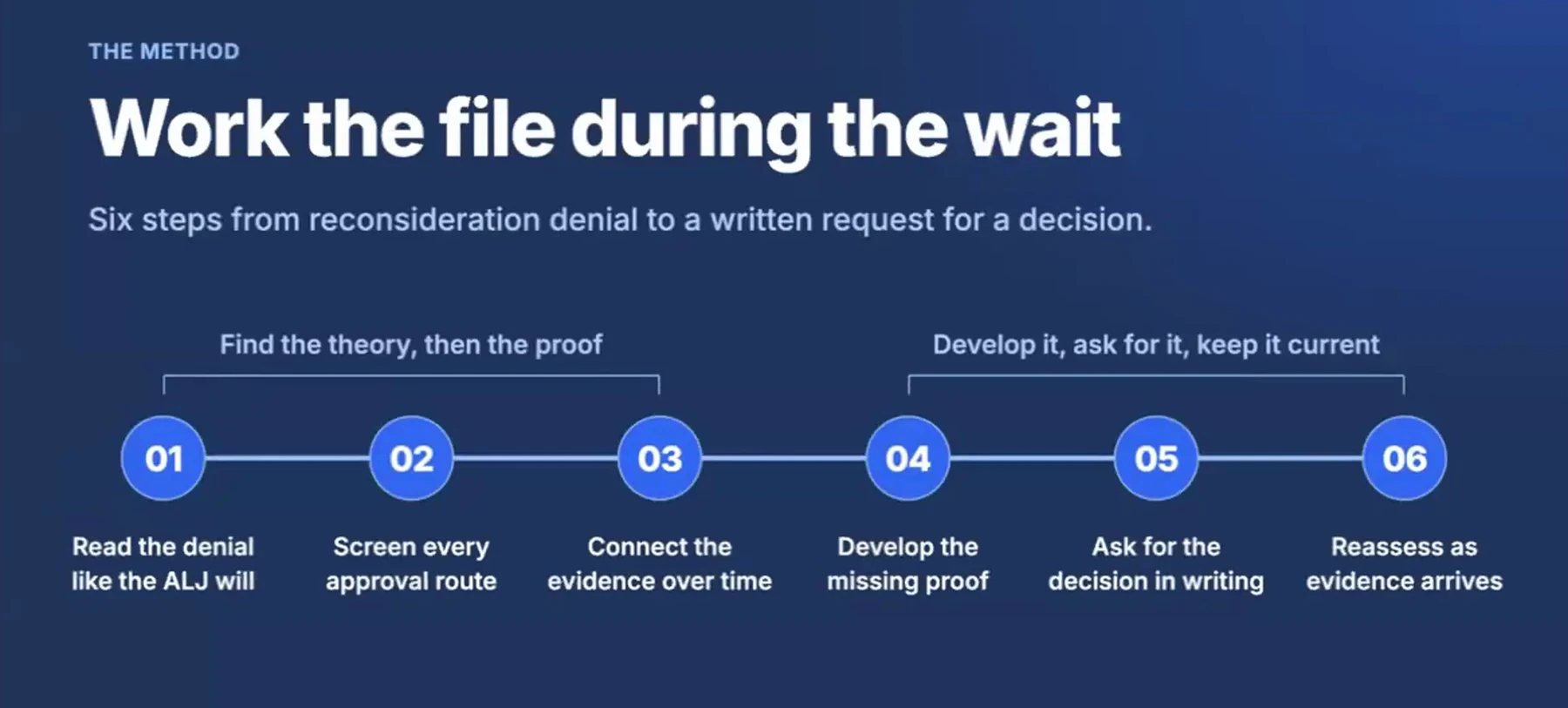
Nick’s six-step routine, from his CAPACITY ‘26 slide: read the denial, screen every approval route, connect the evidence over time, develop the missing proof, ask for the decision in writing, and reassess as evidence arrives.
LexMed has published this routine as a six-step OTR request checklist (PDF) for attendees.
Three routes that a busy file review skips
The routes Nick listed are the ones a busy file review skips:
- Grid rules after an age change, when the claimant has moved into a new age category since the denial.
- Listings that are easy to miss in a very large ERE.
- Gaps in the record, especially a medical source statement that was never requested.
In Nick’s example, a missing treating opinion was the gap to close
Nick walked through a synthetic case for a claimant named Maria Vasquez. The case needed to show she was limited to less than sedentary work, and her orthopedic surgeon, Dr. Morrison, was the key treating source. The method was the lesson:
- Isolate one treating source’s records.
- Pull every date of service with exam findings, such as reduced grip strength, that match the limitations in the opinion.
- Check whether the opinion itself exists, and if it does not, treat that as the thing to go get.
In the example the review flagged that Dr. Morrison’s opinion was missing. For the underlying technique, see our walkthrough of medical chronologies step by step. Getting it, Nick said, is what lets you “get an OTR in earlier in the case life cycle.”
Re-run the review after the hearing request and again before the hearing
For cases where an OTR is not warranted, Nick said firms revisit the file after the hearing request. The questions are the same ones that matter at the hearing: did the medical source statement come back, is it adequate, do new tests or a new prescription change the picture. He suggested a final pass about a month before the hearing so that at least a pre-hearing brief goes in.
A One-Page Medical Source Statement Is the Form a Doctor Will Sign
This was Ted’s core contribution. His starting point is why the statement matters at all.
You have to give the judge something to hang their hat on when they make these determinations that are going to win your cases.
Ted Norwood, Integrated Benefits
Long checklist forms stall in the doctor’s office
Ted’s problem with the long checklist forms many firms use is simple. “Doctors see, like, a 6-page form, they’re not gonna wanna do it.” Long forms invite skipped items.
One page of record references and a few directed questions gets answered
What his firm sends instead is one page, or one page front and back, that carries the relevant medical record references and asks a few directed questions. The doctor can acknowledge the records and sign quickly. Ted added a second benefit: if the statement is later attacked for not citing the record, the references are already on the page.
Ted said his office has trained an AI to read the record and generate the statement. For background on that kind of review, see how AI is changing medical record review for disability law. He sends it to the client, who takes it to the doctor, and the signed statement comes back. He said that has let them get more on-the-record decisions.
Labeling the form Disability Insurance may get more doctors to complete it
Near the end of Q&A, Ted answered attendees who said doctors in their area will not fill out these forms. His tip:
At the top of the form, don’t put that it’s for Social Security. Just put Disability Insurance
Ted Norwood, Integrated Benefits
His reasoning: “Doctors are much more inclined to fill those out, because they’re usually mostly okay with filling things out for non-insurance company purposes, or no, I’m sorry, non-Social Security purposes, but Social Security weirds them out.” He said it can increase your odds. One attendee wrote in the chat afterward that some providers still refuse, so treat it as a tactic to try, not a guarantee.
File an OTR Only on the Cases That Are Clearly Merited
Both speakers pushed back on the idea of filing on everything.
Weak cases are hearing cases, not OTR cases
Ted: “You only want to send an OTR request if it’s merited.” The weak ones are not worth the time: “those are not great OTR cases. Those are hearing cases.” Cases that depend on vocational expert testimony fall on that side of the line.
A good candidate has clean grid logic and no need for a vocational expert
Ted described the cases he wants as ones where the logic is clean: a favorable age, no need for a vocational expert, and a DDS decision that is hard to defend on its face. He gave the example of a DDS finding that a claimant’s mental impairment was non-severe despite a work history that ended because of it and lots of specialist treatment. These need a complete record. If it has gone out of date, he said, keep completing it.
Discretion protects the requests that matter
Nick agreed and added the reason: “You should have sound discretion on what to do, because you don’t want to burn yourself, right?” And on volume: “if you just start sending in garbage, then it’s just kind of crying wolf, right?”
The work is not wasted if the ALJ says no
The case for filing is that the work is not wasted. As he put it: “a good OTR brief, done a while before the hearing, that’ll kind of serve as your pre-hearing brief.”
Send the OTR as Soon as the Case Is Supported
Ted’s answer was as early as the case is ready: “I like to get an OTR in as soon as it’s supported.” In his office that means a review a couple of months after the case reaches the hearing office, before the hearing is scheduled. If the hearing is already set, the earlier everything is in, the better, and he noted that many judges check the file about two weeks and again about a week out, though each has a pattern.
Nick had the same instinct from his own practice. When he saw a case worth an OTR he filed right away, “just the earliest I could if it was worthy of one.”
Five Changes Any Firm Can Make Without New Software
Taken together, the session points to five changes:
- Put a review on the calendar after the hearing request, so the quiet stretch has an owner.
- Decide your OTR criteria in advance. Clean grid logic, no vocational expert, a complete record.
- Replace the long form with a one-page statement that lists the record references the doctor should review.
- Write the OTR brief as if it were the pre-hearing brief, since it may end up as one.
- Keep the discretion. A short list of strong requests beats a long list of weak ones.
For more on the surrounding workflow, see our guides to hearing prep for disability attorneys and pre-hearing brief software, plus the recap of Chronicle’s earlier LexMed session on hearing prep. If the real obstacle is staff capacity, the Federal Appeals Firm session on AI and firm bottlenecks covers it from another angle.
Frequently Asked Questions
Why do so many firms file an OTR two weeks before the hearing, or not at all?
Ted’s answer was time. Hearings and client calls take everything a practitioner has, so early digging loses. Nick added decision paralysis and the pull to polish work that then never leaves the desk.
How do you pick which cases get an OTR request?
File only when the case is merited. Ted prefers clean grid cases that do not need a vocational expert, and treats weaker cases as hearing cases. Nick warned that filing indiscriminately makes it look like crying wolf.
When should the OTR go in?
As soon as the case is supported, which for Ted’s office means a review a couple of months after it reaches the hearing office. Nick files immediately when a case is worthy. If the hearing is already scheduled, earlier is still better.
What if doctors will not fill out the medical source statement?
Ted suggested sending the form with the claimant and labeling it “Disability Insurance” rather than Social Security, since doctors are more willing to complete non-Social Security forms. One attendee noted that some providers still refuse.
Can the OTR brief double as the pre-hearing brief?
According to Ted, yes. A good OTR brief written well before the hearing can serve as the pre-hearing brief, shifting the brief-writing earlier in the process.
Watch the Full Replay
Resources From This Session
- LexMed’s OTR request checklist (PDF): six steps from reconsideration denial to a written request for a decision on the record.
- Resources from every CAPACITY ‘26 session are on the CAPACITY ‘26 resources page.
About CAPACITY ‘26
CAPACITY ‘26, the Disability Law Tech Summit, was a virtual event on Thursday, November 12, 2026, co-presented by NOSSCR and Chronicle. Read the full summit recap or visit chroniclelegal.com/capacity for the other sessions. Follow Chronicle on LinkedIn for recaps and new dates. Questions? Reach us at support@chroniclelegal.com or 847-665-9612. To talk with the Chronicle team, book a demo.
Full Session Transcript
The transcript below has been lightly edited for clarity and readability.
Introductions
Will Yang: This next session is going to be how to go about winning before the hearing, leveraging technology to build strong OTR requests. Really excited to bring on these two panelists. First, we have Nick Coleman, the founder and CEO of LexMed, AI built specifically by a disability attorney for disability attorneys. He spent over a decade representing claimants at hearings and in federal court across four states, with more than a thousand hearings behind him, and he argued and won Koch v. Kijakazi, a published Eighth Circuit reversal. He’s rated AV preeminent by Martindale-Hubbell and serves on the Arkansas Bar’s AI Task Force.
He started LexMed because attorneys already know what to look for in a file. What they don’t have is the time to look. So today, more than 100 firms use it.
And he’s joined by Ted Norwood, who is the Chief Legal Officer at Integrated Benefits. Integrated Benefits has represented Social Security Disability claimants in every single state. He’s a graduate of St. Louis University and the University of Missouri Columbia School of Law.
Nick and Ted, welcome. Feel free to take it away.
Presentation
Nick Coleman: Thanks, Will. Really excited about getting to present today, and present with my good friend, Ted. Today, we’re going to be talking about the stretch of the case that most of us really don’t work. And it’s those months between the reconsideration denial and the hearing notice. And hopefully, by the end of the day, we can present some ideas on how you can leverage technology to hopefully get some cases approved earlier than what you would usually do with your normal processes and your normal workflow.
And we’re gonna go through it with a synthetic case with Maria Vasquez, and go through some tools that we’ve built, and how you can leverage medical chronology and some analysis tools to really help you get insights into your case. And I’ll hand you over to Ted, and he’ll talk about how he’s using these tools in his own practice to really help streamline workflows between that reconsideration and hearing notice to get in OTR requests where you normally wouldn’t do it before.
Like Will said, I was in a volume practice for years. A lot of the tools that I’m building today through LexMed are built out of frustrations as an associate attorney. It’s like, why does it have to be this way?
One thing that we’re seeing with the tools that we’re offering now is that attorneys have more time to do things that weren’t done before, and that’s getting in OTR requests. We’re hearing that OHO offices are more keen to work with attorneys now, especially if they can get them a well-developed brief that really outlines the medical evidence, supporting opinions to get those cases approved months before the hearing. And is that what you’re understanding too, Ted?
Ted Norwood: Yes.
Nick Coleman: The results you’re seeing with your own practice?
Ted Norwood: Yes, I think the agency is open again to OTRs. OTRs used to be really commonplace. Then they went into a less favored status with the agency. And at the last NOSSCR conference, actually, some of us even spoke with the head of Disability Adjudication and indicated, like, hey, we’re sending you briefs, could you make sure that they’re being read, and we’ll try to make sure they’re good, and this could be a way that we could improve the process for everyone.
Nick Coleman: Yep. Today, what we hope you’ll leave with is finding a stronger path to approval earlier, whether that’s by being able to identify appropriate grid rules when there’s been an age change that you might not have seen before, looking at listings that you might have missed in a 5,000-page ERE, and even if there’s not things that are immediately visible in some of the analysis tools right after reconsideration, are there gaps in the record, such as missing medical source statements that you need, that will help you get that W, and get that W earlier? That’s one thing that Ted’s gonna cover in his talk today: being able to use these tools to spot where there might be a gaping hole in getting a specialist medical source statement, and being able to use these tools to create kind of a bespoke MSS to really get the answers that you need to get you the supportability consistency arguments to support those opinions, so when you send in that OTR, the ALJ can’t really say no to it. Is that kind of what you’re saying to Ted with your practice of being able to use these tools and kind of build these questionnaires that really hit on supportability consistency factors?
Ted Norwood: Yes, although, I mean, an ALJ, they can say no to anything they want to.
Nick Coleman: Yeah, they can. Makes it more difficult. We’re hoping today you’ll leave with these three points.
And the problem, what we’re seeing, is really: we file the hearing request, and nobody opens the file again until the hearing notice shows up. And that’s really just what happened when I did a volume practice. You’ve got so much going on. Oftentimes you’re not getting in the information that’s needed 2 or 3 weeks before the hearing.
And looking at the numbers, it’s not just the impact on the firm, it’s the impact on the claimants. And some of the data that Social Security’s released is just on not getting in these OTRs quicker, just the simple impact of how it’s impacting people with terminal conditions. I think this study came out in 2020 that people are having to file bankruptcy because decisions aren’t being made quickly when they can be, especially now with the technology that we’re going to be going through today, and showing you how to screen cases and pick up information that you might have missed, so you can possibly get in that OTR request months before the hearing.
Oftentimes it’s 270 days before you get a hearing, so there’s a long gap, so everybody knows, of opportunity to get the record developed: getting medical source statements you need, looking and identifying patterns from the record to see if there’s potential listings, changes, and age categories. All of these things that occur over a year period, things that you can pick up, but often we’re not doing, just because we’re so busy. Today, we’re going to look at how we can use these tools to, one, look for OTRs, but if you don’t get an OTR, what can you do to kind of help reallocate your resources so you can really put in a strong case at the hearing? And then, lastly, he’s like, hey, do I have a case post-reconsideration that, really, I don’t think we can move forward with.
Ultimately, we want to see how we can use these tools to allocate resources post-reconsideration to help you get an OTR, and if you can’t get OTR, what you can do to get that record developed, so hopefully give you a better chance of winning at the hearing. And then, if there are cases that you just have no theory, it really is going nowhere right after reconsideration. Getting out of those cases, so that you can put resources in the cases that you’re actually gonna win.
Gonna go through. Let me pull this up real quick. Here’s the routine with the six steps that we’re gonna go through today.
Read the denial like the ALJ. We’ll screen every approval route, connect the evidence over time, develop the missing proof. And ask for the decision in writing. You get the OTR in. And we’ll go through some of these tools today.
Today we’re going to go through a case with Maria Vasquez, where we’re able to leverage some of the new tools that LexMed’s released with our medical chronologies. The way that we’re kind of looking at medical chronologies differently is being able to categorize the exhibits and the types of service, so that you can really pinpoint the records that you’re really wanting to look at. And it’s more deterministic and accurate than even using a chatbot, because you’re able to specify in the record exactly what you want to see, to support your theories. We’ll go through this.
I’ve got the video showing you how we’re able to break down an ERE. We call them medical chronologies, but it’s really kind of an x-ray of the ERE, the way a practitioner is going to look at it. And in this case, we’re able to filter out to Dr. Morrison, Ms. Vasquez’s orthopedic surgeon, and look for any examples of exhibited weakness and grip strength, because in this case, we need to establish that she’s less than sedentary.
In this example, we’re pulling all the examples of where she might have exhibited reduced grip strength, any type of impairments in her upper extremity, and try to isolate those to support Dr. Morrison’s opinion. And that’s just one use case, and we’re limited on time today.
But if you check out the scan code, we’ve got several different examples of how you can leverage our filter views to look at, for instance, with Dr. Morrison, where you can see Dr. Morrison’s medical source statement, and isolate the views where you have all the dates of service of Dr. Morrison to help support your supportability consistency argument. You can isolate it to Dr. Morrison’s opinion, and then pull up all of her dates of service, where there’s gonna have physical examinations that are actually corroborating the limitations within the medical source statement, which Ted was going to go through on one of the medical source statements he’s created with our program, a little bit later.
After you use our medical chronology system, we have a tool called ChartVision that actually gives you kind of the good, the bad, the ugly in the case, and also identifies potential listings that can be met, also looks at opportunities to get medical source statements where there might be gaps, also looks at even equivalents, looking at the special SSRs, where there might be cases where migraine severity is equal to a listing, even looking at fibromyalgia, those types of things. In this particular example, we’re trying to overcome a light RFC provided by a state agency, and seeing if there’s opportunities to overcome that with other objective findings that contradict those findings.
We’re going back to talking about Dr. Morrison’s medical opinion. ChartVision saw that there was a missing opinion, so what we’re looking for is the missing proof, and then going to finding out what can we do to pull the relevant findings from ChartVision to create a medical source statement. And that’s where we’re helping to develop the missing proof, and then ultimately, if we can get this medical source statement from Dr. Morrison, we can get an OTR in earlier in the case life cycle. Ted, I’m gonna hand it over to you to kind of hit on the points of what you’re getting right now from these tools, and what’s changed before and after, as far as how you’re able to get the record developed with your on-the-record request.
Ted Norwood: Okay, thanks, Nick. I’m excited to explain this, because I suspect that what we’ve gone through is pretty similar to what everyone else goes through. You mentioned at the beginning, you request the hearing, and then there’s a gap.
Right now the gap is 270 days. I don’t know how many older attorneys or longer practicing people are here who remember when that used to be, like, 500 days. So 270 is about where the agency wants it. They’ve told us that, and they’re trying to keep it probably in there, maybe even a little shorter. And we need some time, because we do need to develop these cases.
But it’s really easy when you’re handling a bunch of cases, because you’ve got hearings, and post-hearing, and hearing prep, and clients calling you about decisions and appeals to fall behind on prepping a case that you’re not going to have to appear in front of for several months. Oh, I see someone in the chat remembers.
Nick Coleman: Because we’re all great at procrastinating, right?
Ted Norwood: Yeah, well, we are. We’re also lawyers or reps, and we all kind of get distracted, and you need downtime, too. You can’t actually go non-stop. For one, there’s a lot of shared trauma in what we do, and that will catch up to you.
But the key to really developing something successful is to get on those earlier. And we went through so many over the years, methods of trying to do it. And since implementing LexMed, it’s easier than ever, because we can get these files in and get an evaluation that makes it quick.
Time is extremely valuable and rare resource for us. So you can come in quick and see what’s missing, see what you have, see what’s going on in the case. The same thing we used to get, you used to have to go look at the A section, see what the agency said. You can pull all that stuff out really quick in LexMed.
We like to take those, get that ChartVision, so like, okay, we need this. It’s easy to get your requests, either outline them, get them to the claimants. Sometimes we’ll order them, sometimes we’ll say, look, if you’re interested in trying to get this moved faster, help us get these a little faster.
And when you see a case that is something that can be done on the record, you want to knock those out. Getting a case awarded quicker, it’s great for your clients. They’re dying to get those records, as Nick said literally earlier.
Nick Coleman: And it’s ultimately about reallocating resources, too, right? Because if you’re able to knock out the gimmies, I know they’re not really gimmies, but if there’s some that really can get approval on.
Ted Norwood: Some actually are gimmies, because you go in, you roll into the hearing, and the judge is like, oh, I looked at this, and this is a pretty easy one to award, right? So, let’s go ahead, I’ll just pay this. And you’re like, cool, I had to set aside an hour for this, I spent however much time talking to my client, getting all these records, you could have just called. So finding what you can get awarded is really important.
Now, getting an award, you gotta have a great medical record. You gotta have probably a medical source statement. Medical source statements are really valuable. You have to give the judge something to hang their hat on when they make these determinations that are going to win your cases. Now, to really be good for an OTR, having a good age is important.
And having a case where they’re not going to really need a vocational expert for, something where they can be like, yeah, this is obviously not going to be transferable skills, or something like that. I’m behind in keeping up with the video, but you identify the case, you get the records. If you’re asking for one on the record, you gotta have the record complete. If it falls too out of date, keep completing it.
What we use LexMed for is I take the medical chronology, and I use that to identify good medical records, and then use those medical records to incorporate them into my medical source statement. I suspect a lot of you, if you’re getting medical source statements, which you should, are still using the old Bush book, which I think now we should really call, like, the Marcus book, because Meredith Marcus is doing it now. But the Marcus statements? Her statements are great, but they’re check forms, which you gotta use check forms, but they’re long.
Doctors see, like, a 6-page form, they’re not gonna wanna do it. There’s gonna be lots of skips and stuff like that. What we like to do is get one page, or one page in a back, that has medical records in it, asks a few directed questions, and the doctor can do it quickly and sign off. And having the medical record references in it for the doctor to review lets the doctor acknowledge those in the statement, and helps for any possible appeals where you run into issues where they say, well, they didn’t cite anything in the record, or they didn’t show how this was consistent with the record.
So that makes those a really big, stronger statement. You can build those out yourself. Hopefully, Nick’s gonna have an available tool where it can build them for you. At our office, I’ve trained an AI where it can read the record and generate the statement.
And that works great, because you get that in there from LexMed into the AI, and it’ll generate the statement, and then I’m sending it to my clients to take to their doctors. They’re getting it back, and we’re able to get more on-the-record decisions.
Nick Coleman: I kind of went ahead of you, Ted, on the video. This is kind of what we’re trying to showcase: with our ChartVision tool, what we can do is, it will tell you, kind of flag to say, hey, we need to get a medical source statement to Dr. Morrison. We know that, and then we can help build out these bespoke medical source statement questionnaires, where we include the objective findings. We’re essentially copy and paste it into your forms, so that the doctor has everything they need to know to answer these questions. And is that the way you’ve really started trying to transformed how you’ve been doing these, Ted?
Ted Norwood: Yeah, that’s exactly it. When they change the medical source statement rules, we had to change what we do to keep up. And this is the best way to do it.
That ChartVision, what it does, it tells you what you need, tells you what source you should get it from. It makes it quick for you. If you’re the attorney doing it, or if you have a staff person doing it, makes it easier and fast for you to go in there and be like, oh, this is what this case needs. And this is what we get. You get it filed, you get it submitted, you can use the brief writing in LexMed to send it in, and you get one of these phone calls from an attorney advisor.
Nick Coleman: Which is a great call to get. Yeah.
Ted Norwood: Either that. Sometimes you get that, or sometimes the hearing gets scheduled, sometimes it’ll even get scheduled early, and then a couple weeks, you’ll be looking on it like it’s time to order the records, and all of a sudden, it’s in decision writing. And you can call your client and be like, hey, looks like they were paying this case, we’ll wait a little bit and confirm. Whenever a case gets paid, it’s never too late, it’s always good, but…
Nick Coleman: The one thing you brought up, Ted, is about whether you or your staff are looking at these and doing periodic reviews of the case, and kind of what ChartVision does, and the way that attorneys are leveraging this tool now. What we’re seeing is that the firms are reviewing their cases at reconsideration, and they’re able to look and say, hey, look, it’s giving me the strengths and weaknesses of this case, also the record and development opportunities, and helping them build the case way earlier than they would have, and diving deeper into the weeds of the case without actually having to do it.
Because that’s the problem: I don’t have time, or I’m not going to prioritize digging into a 3,000-page record 8 months before the hearing. It just don’t really work that way. What this tool does is it uncovers things that we would miss or probably never look for in the first place. Or if you signed it to staff, at least it’s giving the staff the flags and the call to action and what they need to do to help build that record, whether it’s for OTR or getting everything set up for the hearing.
And what’s happening is if an OTR is not warranted, after the request for a hearing, they’ll run ChartVision again after the request for hearing to see what development’s needed at that stage. Have we gotten the medical source statement back from Dr. Morrison? Is it inadequate? Do we need to get another opinion?
Have there been additional diagnostic tests that establish nerve root compression that weren’t there before? Do they have a new prescription for a cane? Now, do they actually meet listing 1.15, where they didn’t before? It’s hard to piece all of these things, especially some of these nuanced listings. It’s very hard to piece all of these things together, and that’s what our system does. And all the way through, up to right before the hearing, so that you run it again a month before the hearing, all the updates to the case, it’s gonna flag it and tell you what’s there and what isn’t, and so that you can get at least a pre-hearing brief in before, because oftentimes we’re so busy, we don’t even have the opportunity to get a pre-hearing brief.
Ted Norwood: And I always tell people, remember, a good OTR brief, done a while before the hearing, that’ll kind of serve as your pre-hearing brief. You’re just shifting your brief writing from a couple weeks before the hearing to earlier in the process, which is hard to do, but once you do it, it’s incredible, the benefits you’ll get.
Nick Coleman: Yeah. Ultimately, we want to be able to see these tools and use these tools so that we can honestly be the super advocate for every one of our clients. And it’s hard to do that all the time, because we’re constantly shuffling, prioritizing, but that’s the way these tools can be used, and you’re really giving your clients a better opportunity, whether to get a case approved early, or get it approved shortly after the hearing, or if you can’t get it approved then, at least having the record well developed, so you can set this up for appeal.
Ted Norwood: Yeah, absolutely.
Nick Coleman: The big three things to take back to your firm with our talk today is: screen your denials, and turn gaps into requests. And when appropriate, get that OTR in. And I think that with these tools, you really can identify cases where it is appropriate to do so, more so than you were doing before, because you just didn’t have the time in the day to do the digging that these tools allow you.
And then, like I said in my earlier slides, there’s so many different use cases and opportunities to show how, with our filtered views, not just with our ChartVision product, but to actually see how you want to see the record: looking at gaps in treatment, isolating credibility issues, all types of things, the way a practitioner looks at an ERE. Alright, any questions?
Audience Q&A
Will Yang: Awesome. With that, we’ve got a couple questions to kick us off. The first question is, how are firms approaching the client acquisition side of growth? Curious how practitioners are balancing increased claimant volume with intake capacity, qualification, and conversion to signed cases. And do these supports that you share today integrate with different CRMs?
Ted Norwood: That might be a question for the Benny guy.
Nick Coleman: I can… I think we might…
Ted Norwood: But I think you could use LexMed with any CRM, but…
Will Yang: It said it in the context of LexMed, so I guess I’m looking for a LexMed-specific response.
Nick Coleman: I think we kind of see ourselves as being able to help you prioritize your cases really post-initial and reconsideration. If you want to look at this as, like, a triage opportunity of how you handle leads, oftentimes you’ve already got all these cases in your funnel, and you’re on your docket, and the way we’ve seen firms use this is looking at opportunities to, if necessary, cut the cord with some cases so you can put resources into cases that are actually going to win. For the people that don’t have a well-developed case now, you can tell them and advise them on what they need to do to possibly refile a claim. Because sometimes there’s just cases that come out post-reconsideration that really have no chance. I think that’s kind of a roundabout way of how our firms are using us as far as triaging cases that they’ve already taken on, after the initial reconsideration stage.
Will Yang: Another question is, if an OTR can end a case months early, why do so many of us file it two weeks before the hearing, or not at all?
Ted Norwood: Because of time.
Nick Coleman: Yeah.
Ted Norwood: You’re busy. I used to trek around the country doing hearings. And you’re putting everything you can into your hearings. How many people go to a hearing and always feel like there wasn’t something else they could have done? There’s always a little more you could have done, and so you’re dealing with that, you’re dealing with talking with clients constantly, then taking the time to go dig in earlier.
It is hard. That’s why having a tool like ChartVision that can help your staff do it with you, bring things to you quicker, it makes it more valuable.
Nick Coleman: Yeah, and I think one thing that was on one of our slides is decision paralysis, which I’m very prone to. There’s a little bit of perfectionism. I want to make sure everything’s right, but then when you’re trying to deal with a heavy caseload, I might have something that’s almost finished, and it just sits on my desk, because I’ve gotten 10 cases that I’ve got hearings for in the next week. I’m just not getting it out.
I think with these products, it really helps just get things out the door that work getting out before. I know it was something that happened with me when I was in a large volume practice, but just going back to what Ted said, there’s only so much time in the day, and I think that’s one thing with these tools, is that it really does give you more time in the day so that you can be that super advocate for all of your clients.
Will Yang: Another question is, when you can’t do this on every single file, how do you pick which cases should get an OTR request?
Ted Norwood: Well, that’s easy. You only want to send an OTR request if it’s merited. Don’t waste the time sending an OTR request if the case isn’t strong enough, if they’re going to look at it and say, no, I can’t find that because I’m gonna need vocational expert testimony, definitely, to get it awarded. If it’s a weaker case, or you see the flaws in it, those are not great OTR cases. Those are hearing cases.
And it’s okay to acknowledge that and treat them as such, but your grid cases, when a case comes out of the DDS, and they’re like, oh, this person’s limited to, they can do their sedentary past work that’s super skilled. Their mental’s non-severe, and you’re like, they left work because of mental, and they’re in lots of specialist treatment. How did you possibly say this was non-severe? Those are great ones, because it easily fits into a grid listing, things like that.
Things where you can get very clear decisions that are lined up. These have to be kind of the cream of the crop if you want them to succeed. And then also, someone asked in the chat earlier about, how do you get them to look at it?
And it used to be you would call up OHO and be like, hey, I’m checking on this. Now, when you submit it through Chronicle, and you label it as an OTR, Social Security says that that’s being flagged and sent to an attorney to be reviewed. Yeah, hard to say how well they’re gonna do that. I mean, I am not the one who’s never missed anything, and therefore I will not be throwing stones.
But you can always follow up if it’s good, but you do want it to make sure these are good cases. Like, hey, this is a good argument for an OTR. That way, when you contact them, they’re like, oh, okay, well, let me take a look at it. If you’re doing it on every case, they’re gonna be like…
Nick Coleman: Yeah, I don’t want anybody to take away from this that you should be following OTRs in every case. You should have sound discretion on what to do, because you don’t want to burn yourself, right? You gotta look at this at a macro level. If you’re just throwing up a bunch of garbage, you’re gonna end up hurting your credibility with the adjudicator. You need to make good discretion as far as how you handle these cases.
The thing is there’s a lot of cream of the crop cases that I feel should be that are meritorious for OTRs, and so that’s what we’re saying: this just gives you an opportunity to get the cases that are worthy, get those submissions in early. But you ultimately need to make good, sound, discretional calls on whether you submit these or not, because if you just start sending in garbage, then it’s just kind of crying wolf, right?
Will Yang: An attendee asked the question: the LexMed pre-hearing briefs seem to limit supporting citations to one exhibit page in the record only. Why is that? Why doesn’t the PHB cite to the record more comprehensively?
Nick Coleman: We do a mixture, and we’ve been still working on that, because we sometimes do page ranges and pinpoint cites. We’re always tweaking our system, so what we have this week, if that’s a case that you ran last week, I know it’s something we’ve been working on to improve. Right now, we’re actively working on actually being able to do string cites instead of pin citations, but drop us a line if there’s a case that you’re seeing that in, and we can look at it and see if there’s something that we can tweak to improve that experience.
Ted Norwood: And if you’re looking for more citations, I really recommend something I like to do, which is I pull excerpts from the medical chronology. Sometimes I’ll pull the whole medical chronology and submit that to a judge, like, hey, here’s medical in order, but you can also put it using the filter like Nick talked about. You can say, look, here’s the rheumatologist notes. Here’s the therapist notes, the psychiatrist notes, the podiatrist notes, whatever.
And you can structure how you submit those to structure how you’re presenting it to the judge, and then get all their stuff. I tend to believe, most of the time, judges, they’re going to double-check. They’re gonna look in the record before they just go with what you say in a pre-hearing brief. So it’s okay to just go ahead and make that easy for them.
Nick Coleman: And on our multiple sites, both in our ChartVision product and a feature that we’re about to drop now, it’s gonna just include all the abnormal findings. It includes string cites for every severe impairment. So if they’re not elaborate enough within the pre-hearing brief, as it stands, you can pull those over into the brief.
Will Yang: Another question is, when do you like to have an OTR sent to the ALJ? How much time before the hearing?
Ted Norwood: I like to get an OTR in as soon as it’s supported, so it can be a couple months after it’s gotten to the hearing office, before it’s even scheduled. We try to do a review at that point. That’s our process in our office, and we’re a larger office than a lot of places, that we’ve started moving to that, so you’re looking at being ready.
If you want it to get awarded, and the hearing’s already been scheduled, the earlier you can get everything in, the better. If you can get it in a few weeks before, that helps. If you have experience with judges, you can kind of learn how often they look at things. Lots of judges like to take a little review about 2 weeks before the hearing, and then they come back and check on it again a week before, but they all have different patterns. You just kinda gotta see.
Will Yang: The next… Oh, go ahead.
Nick Coleman: I was agreeing with Ted. When I was in volume practice, when I saw something that was worthy of getting OTR, I got in immediately. I don’t know if there’s a specific time frame, just the earliest I could if it was worthy of one.
Will Yang: An attendee was asking, at this point, probably a point of clarification for you, Nick, but what’s the specific name of the tool that services the medical chronology from LexMed’s products?
Nick Coleman: Medical chronology. We have medical chronology, then we have features built into it, like our filtered view, abnormal findings, and then we have our downstream products. You’ve got ChartVision, which is the analysis layer kind of strapped onto the medical chronology, and then we have our pre-hearing brief product, and then our hearing playbook, which is, like, ChartVision in a what I call from law school a skinny, like a one-pager, kind of a cheat sheet.
Will Yang: Nice. We still have more questions, but Nick, if you want to put the next slide where you have the contact info and everything else for folks, that would be helpful as well. Awesome.
The next question is from an attendee. She tried your medical chronology recently. There was a file, it was 1,200 pages, with 500 pages of medical chronologies. The MedChron came back at about 47 pages of very dense pages. Curious if the medical chronology can be simplified into an easier spreadsheet-type table or style.
Nick Coleman: Yeah, that’s the thing: everybody’s got their idea of what they want in the medical chronology, and that’s what we’ve added the filter views for, so that you can isolate the things that you want to see. You can essentially make it the way that you want it with that, and I’ve got a bunch of tips. I’ve got videos up here, filter views on our YouTube channel that show you how to do this, and so however you want to see it, essentially, is how you can export it and download it, or just view it within the platform. But if there’s issues with it, too verbose still, and there’s still problems, please send us a line, because we want to make it work for you.
Will Yang: Another question, from an attendee, is: are any of the panelists having any success in providing case summaries, OTR-like requests, at the IA or recon levels?
Ted Norwood: But we don’t regularly do that. So, different people work those state agency levels differently. But we don’t send big summaries to them. So, we try to maybe get some opinion, but that’s about it.
Nick Coleman: I had a customer of ours that found a Compassionate Allowance case that they picked up right after initial, after it was denied, that was able to get that in to DDS and get it approved.
Will Yang: An attendee asked, do you typically turn any OTR you file into your PHM?
Ted Norwood: PHM.
Will Yang: Yeah, they typed PHM.
Ted Norwood: PHM means pre-hearing brief, right?
Will Yang: Yeah, pre-hearing memo.
Nick Coleman: Depends on the facts of the case.
Ted Norwood: Oh, pre-hearing memo. Okay, yeah, sorry.
Nick Coleman: Go ahead, dude.
Ted Norwood: I would assume you can always add. One of the advantages of getting this stuff done early: if you get your medical source statement earlier, and it’s not that great, or you need a little bit more, you can always go back and say, hey, by the way, you said this, I was wondering, could you explain this a little bit more for us? But it’s kind of the same thing with the pre-hearing brief.
If that didn’t resonate with the judge, you might be looking at a judge who isn’t seeing the case the same way you see it. I know it’s hard to believe that they’re out there, but they are. And you can kinda tack a little bit onto maybe a more favorable approach.
Will Yang: Let’s see. Another question is, does MSS analysis go beyond assessing consistency and supportability factors? Does it have capability to assess the other factors and compare and contrast these factors with unfavorable consultative exam findings?
Nick Coleman: Yeah, it’ll hit on, if there’s particularly relevant ones outside of the consistency supportability, it will. It also does an analysis on undermining DDS opinions.
Will Yang: Alright, awesome. Well, with that, we are at…
Ted Norwood: Will, can I make one more quick point?
Will Yang: Of course.
Ted Norwood: Okay. I saw some questions about resistance from doctors, and I will give you guys my doctor getting to fill out your form tip. Send it with the claimant. At the top of the form, don’t put that it’s for Social Security. Just put Disability Insurance, because most of my clients are applying for Social Security Disability Insurance.
Doctors are much more inclined to fill those out, because they’re usually mostly okay with filling things out for non-insurance company purposes, or no, I’m sorry, non-Social Security purposes, but Social Security weirds them out. If you don’t put the Social Security stuff on there, they’ll probably increase your odds.
Closing remarks
Will Yang: Alright. Awesome. Well, with that in closing, thank you so much, Ted and Nick, for the time today. If you want an extra resource, there is a resource on the screen there, and it’ll also be shared in the resources page later.
Nick Coleman: Thank you, and if you guys have any questions about the filter views, I’ve got the YouTube page up there, and if you’re interested in checking us out, schedule a demo. It’s gotta link up. Thanks, guys.