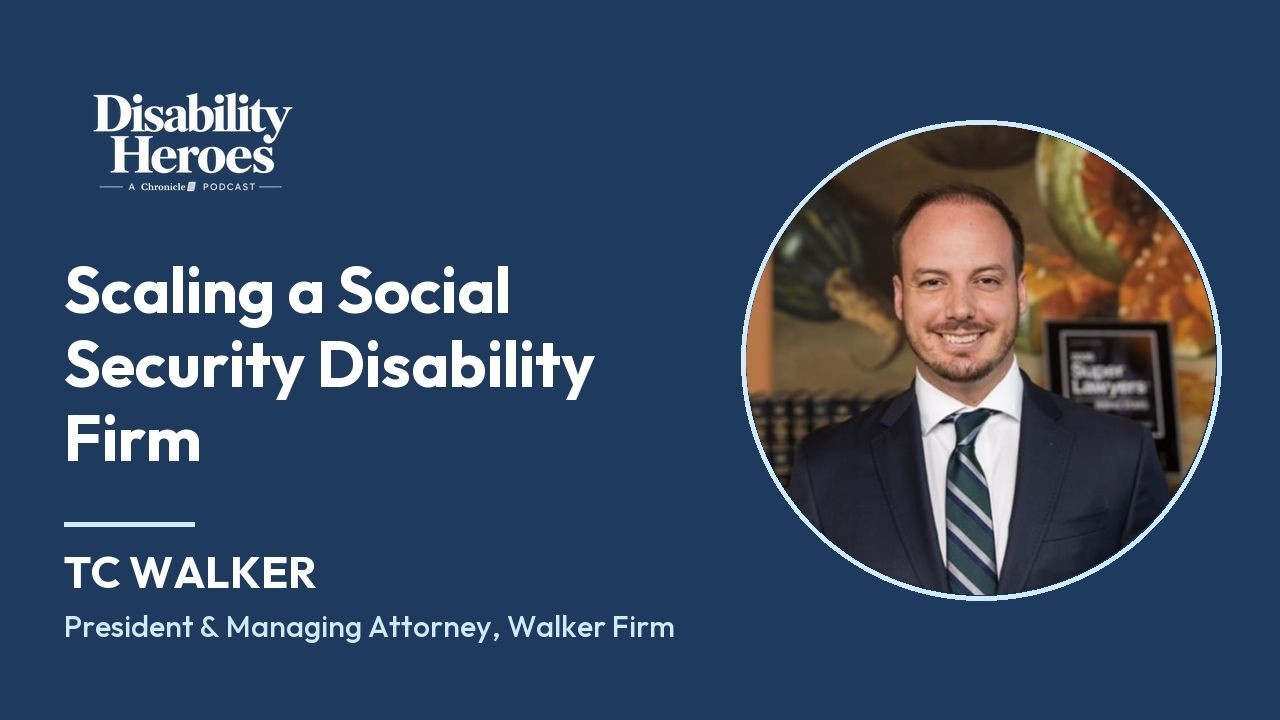
About this episode
TC Walker came out of law school pointed at personal injury. Then he ran the numbers on starting a PI firm and went looking for a practice area where his skills would transfer.
He talks about how he compressed the seven years his mentor told him he would need before opening a firm, what happens at a hearing when the interpreter gives the judge one sentence and the client said four, why he spends money at the initial and reconsideration levels when waiting longer would pay him more, and what his first fee was after he had spent everything getting the firm off the ground.
TC Walker is president and managing attorney of Walker Firm in Hermosa Beach, California. Reach him at tc@walkerfirm.com.
In this conversation:
- He Engineered His Own Competence: from personal injury to disability, and condensing a seven-year path to opening a firm
- The Standard: the firm's values, serving Spanish-speaking claimants, and what gets lost in a hearing interpreter's summary
- Building the Machine: the first fee, training, KPIs, technology, and a firm built to outlast its founder
- Lightning round
"I don't want to be the person that the firm is determined on."
"I don't really see a finish line."
This conversation was lightly edited for clarity and never for message.
TC's firm: Walker Firm
Read the full transcriptTC Walker and Will Yang, with timestamps
TC Walker00:00
there's a really like horrible stigma around the contingency fee attorneys like there's this idea that the attorney wants the case to get delayed so that their back pay ends up being more. I've spoken with attorneys who who feel like that. That's a thing. But That's so against what we believe as a law firm for what our responsibility is for our clients and so we spend a lot of energy and a lot of resources making sure we're supporting clients at the initial and reconsideration level so that we get favorable results as early as possible Chronicle has actually been really good at helping us
Will Yang00:56
My guest today is TC Walker, who runs a social security disability practice in Hermosa Beach, California. He came out of law school pointed at personal injury, But he ran the numbers on starting a PI firm and decided to look for another practice area where the skills would transfer. In this conversation, we get into how he compressed the seven years that his mentor told him he'd need before opening a firm, what happens at a hearing when the interpreter gives the judge one sentence back and the client said four, and why he spends money at the initial and recon levels when waiting longer would pay him. Also tell you what his first fee was eight or nine months into running his practice, after he'd spent everything he had getting the firm off the ground.
Stick around till the end to hear about what he wants the firm to be doing long after he's gone.
Will Yang01:40
Awesome. Well, TC, so excited to have you on the show today. You run one of the fastest
TC Walker01:43
Sure.
Will Yang01:44
growing firms on the West Coast. I'm curious though to if you could take us back to the start of your practice in terms of the origin story of how you got into this line of work.
TC Walker01:54
Thanks, Will. Yeah, happy to be on. I mean so when I graduated law school I was really focused on personal injury. I had the opportunity to work at some of the best law firms in Los Angeles, and was really happy helping people in the personal injury space get get best recovery that we could get. And I felt really good about that and I was really excited to be helping people in that way. I had always known that I wanted to open up my own law firm and I think for the longest time I always thought that would be a personal entry law firm. But when it came to, deciding to op to open up a practice, I was looking up the numbers for how I would start up a personal injury law firm and really saw it as a very intimidating market to get into. And so I like did some research, you know, I felt like I was really strong attorney on the personal injury litigation side and was looking for things that had some transferable skills. That's a social security term. And you know, I was looking at work comp and, you I thought social security disability seemed like to be something I could pick up and learn. And so When we started the law firm, that's what we were gonna focus on was workers' comp and social security. And so, we started doing some advertising and found such an overwhelming need for people looking for representatives in the social security space. And from there we really made the decision that there's so many people that need help. We're gonna focus on helping as many people as we can. That's what we've been doing for the past four and half years.
Will Yang03:19
So as you were exploring the different areas of either workers' comp and, you know, social security work, what made it clear to you that social security work was a better fit for your personality and like the sort of practice that you wanted to run on that side?
TC Walker03:33
I don't know when that became clear, specifically. I I know when we got our first Social Security award for a client that we had represented at the hearing level. The amount of gratitude and just appreciation from the clients was so much more than what I'd ever gotten from, you know, representing a client in a personal injury a matter or anything else. And so I'd say that's one of the big really big parts is how much people appreciate the work that we do.
And so think that's that end up that ends up being my biggest draw.
Will Yang04:05
Yeah, that sense. And you'd mentioned earlier that you always knew that you wanted to start your own firm. Where did that come from? Were you always someone that was very entrepreneurial? Did you have, you know, people in your family that had already started their own businesses? Or where do you think that origin, original thought came from?
TC Walker04:20
Yeah, so I've been around the legal industry for my entire life. My mom founded Walker Advertising, which owns the brand Zol Steven Switzen when it ended the law two. About eight years before I was born. And so as a kid I'd always been growing up, around legal advertising, being very aware of what personal injury was, what workers compensation was, and you know, really how important it is to give people access to legal services because people don't know like legal systems, right? They're complicated, they are, that's why attorneys ex exist. But, you know, people don't know how to navigate them and people don't know what the issues are. And so it had always been something that was very clear to me that I wanted to work in the legal space and When I went to college I majored in marketing, ended up deciding to become a lawyer, went to law school and yeah, so it it had always been a part of my life and it's always been something that I knew that I wanted to do.
Will Yang05:12
Did you know that you wanted to be a lawyer as well? Because you you know, you started out in marketing and then you became a lawyer though. So what was the transition point where, you decided to be a lawyer in the journey, or was it always kind of in the cards that you'd follow the this respective pathway of like marketing first because you had that legal marketing background of having grown up around it and then wanting to serve others, being an attorney?
TC Walker05:33
Yeah. I'd say it was probably something that was kinda marinating in the back. You know wanting to become an attorney?
I definitely had ideas that I wanted to be an attorney, but it wasn't something that I'd committed to until like my fourth year, like when I graduated college. And I like to be honest, part of that decision I think was me not wanting to go get a real job. So having three more years of education and learning what I wanted to do. But I'd say Like I really fell in love with law school. I really enjoyed applying myself in my 1L year. And then when I started doing attorney work or law clerk work, at the first law firm that I worked for, I mean that's when I really, really fell in love with being an attorney and you know, the nuances of law and how facts can be applied and everything like that. And I mean just really helping people recover. To the best that that that they can. And yeah, I mean since then I've been I've been hooked.
Will Yang06:27
Yeah. And from that standpoint, so you have this opportunity to work at some of the best law firms, you're gaining a bunch of experience. How did you know when it was time to form your own practice? Because that's not something that everyone would have the confidence to go out and do so early in their careers. I'd say that you've started a firm pretty early in your career, and that's not a pathway that everyone takes. And then transitioning to them being ready to take on, you know, and opening your own firm.
TC Walker06:52
Yeah. I mean so it had always been kind of my plan to open up a firm. I remember when I was law clerking one summer, I went and grabbed some beers after work with one of my mentors and he was telling me that like after seven years of being an attorney, you know, you know everything you need in order to open up a firm. And he was thinking about kinda going up and opening up his own practice. You know, he had heard that around the industry and kind of the premise was you don't know everything you need to know, but you know how to figure it out at that point. And so like I had taken that information in, and then you know, also read the tipping point, which is the idea that after ten thousand hours of purposeful practice, you know, you end up becoming an expert essentially at something. And so I'd mapped out, you know, how much I was working and how much more I could work, and figured out like I figured. But if I just worked as much as I could, as hard as I could, for as long as I could, I could condense you that seven year pathway into a shorter time period. And so that's what I did. And I I I mean I loved it. I've worked really hard. I spent a lot of hours working. And you know, I think that gave me the confidence of you know, being really confident in how I was able to handle myself as an attorney and you know, give me the confidence that I'd be able to figure out any other things that I needed to figure out.
Will Yang08:17
what does it mean for you to run your practice the right way? Like how do you think about how Walker firm should operate and what standard are you holding you, yourself and your team to?
TC Walker08:27
I mean so what we talk about all the time is our mission and values, right? And so our mission is to help as many people as we can as we can get disability benefits that they're that we believe that they're entitled to. And then our value are teamwork persistence integrity ties in which is this idea of continuous improvement at all levels and advocacy. And like the two ones that I think stand out the most for me for you know what we're always trying to do is always improve and you know always be focused on what we can do to get the client the best result. And so, you know, this year the main thing that we're focusing on is improving our practices at the initial and reconsideration stages, because we really want to get clients a favorable result as quickly as possible. I mean there's a really like horrible stigma around the contingency fee attorneys where like there's this idea that you know the attorney wants the case to get delayed so that their back pay ends up being more. And I mean I've I've spoken with attorneys who who feel like that. And you know, that's a thing. But That's like so against what we believe as a law firm for what our responsibility is for our clients and you know, what we want to be is the best advocates we can be for their clients and for our clients. And so we spend a lot of energy and a lot of resources making sure we're supporting clients at the initial and reconsideration level so that we get favorable results as early as possible and Yeah, Chronicle has actually been really good at helping us track what our win rates are at an initial and recon. So we're when we're implementing new tools or new systems in order to help our clients, we're able to see kind of how that impacts our win rate at the initial and reconsideration levels, you know, as early as six to eight months down the road, but you know, really after a year is when you kinda are able to see more of a win rate. And so, you know, we focus on making sure that we're doing all the work history reports with the clients and, you know, making sure that we're asking them the right questions, and not letting them get away with describing their construction job as, you know, a ten pound lifting job, which Social Security then denies them for being able to return to work, being able to return to even with their conditions.
Will Yang10:50
As you were forming the firm, you know, my understanding from doing a little bit of research is that the firm operates a Spanish language DBA brand called Casa de la Justicia. And I'm curious if you can walk me through, you know, what was the decision behind this in terms of the founding vision? How did you discover the market need that you had? Because you you mentioned that you started first by exploring both workers' comp and disability. Yeah, what did that look like?
TC Walker11:13
I mean really we're just looking to help as many people as we can get access to disability benefits. In general the Spanish speaking community is very underserved and in a market like Social Security Disability where the market is already underserved, there's a lot of need for help. And so Yeah, that's kinda what we ended up focusing on.
Will Yang11:32
When you started focusing on serving the Latino disability community, I'm curious about if the that led to any changes in terms of how you actually did the work. So whether that was on the hearing, the intake, or the client relationship side. Yeah, curious about what you've kind of had to adapt to meet the needs of what your clients are expecting from you at that point.
TC Walker11:53
Yeah, it's hard to say how we adapted because we had like started like that. But I mean for sure everybody in our office speaks Spanish. Intake, case manager, legal assistant. Whenever we have non Spanish speaking attorneys, you know, we need to have interpreters who are generally the case managers on the call to help.
And so like we've always been geared towards it. It's actually kind of adapting to English only clients. That's a little bit more of what we're focusing on now. 'cause like because our most of our marketing materials are Spanish directed, I mean most most of our materials for clients are also in Spanish. And so now we're working on, you know, making sure that our greeting message has like an English option for when English clients call, English speaking clients call. Same thing with our client service line. You know, that we're answering the phone in English because we're so used to answering and serving Spanish like Spanish speaking clients.
Will Yang12:45
When it comes to serving the Latino disability community specifically, what does the system consistently get wrong about these claimants that you've noticed? Is there a bias that shows up in terms of ALJ hearings or in D D S decisions? Or is it more of a gap around what you were mentioning earlier on the access first and foremost?
TC Walker13:04
Yeah, I mean I think access, like the forms, you know, they're mo most of them just come in English. Sometimes they have Spanish forms. But you know, like the two forms that come up in every case, the function report and work history report, and both those come in English only. And so I guess in terms of adapting, like we tried a bunch of different things like having a Spanish work history version, like report that we would send to the clients to help gather information. And same thing with the function. But yeah, like they need help with all those documents because social security doesn't provide Spanish resources. And I mean, you can fill it out in Spanish and they're supposed to translate it, but There's tons of holes in the system, so that doesn't always happen and I mean it does end up harming their case sometimes.
Will Yang13:46
Mm-hmm. When it came to developing that process and system where you tested out the forms that needed to be in Spanish to get that information, what sort of process did you take in terms of figuring out like the best way to get that information, you know, from from the folks that you were serving?
TC Walker14:02
Yeah. I mean so you know, when we started it was we didn't know how to do anything the right way. So we just had a really big philosophy of trying things. Right? And so we'd try just doing them over the phone. You know, people would practice with that and they'd get faster. We tried mailing it to them, we tried, you know, adding it to our welcome packet when we sent out the c client or welcome letter. You know, we tried doing form links. We we just tried as many things as we could to see how we could get that information in as seamless of a way. And so I'd say that's what it was. Just like being really open to the idea of trying really anything that could work. Yeah. Kind of back to your question though about bias. I don't think it's necessarily bias, but where Spanish speakers get harmed a lot is at the ALJ hearings. So I I don't know what requirements Social Security has for interpreters, from Spanish to English, but There's a lot of really poor interpretation that happens at the hearing level. And you know, when a client's trying to explain to the judge all these conditions that affect him, you know, the client may be rambling on for a couple sentences about how his back pain like affects him and The interpreter might just come back with, yeah, the client says it's backwards. And like miss the whole like details, which which really is where you know, I think clients are able to tell their story best and and and a lot of that gets lost in the in the interpretation.
Will Yang15:28
How do you support them in those moments? Like what exactly do you do?
TC Walker15:32
I mean so I speak Spanish and so when I'm representing a client that's Spanish speaking at the hearing, I'm always listening to what they're saying in Spanish and making sure that I'm taking notes and if the interpreter misses something I either will correct the interpreter or ask the interpreter directly if they understood that the client said the things that I marked as important, or I'll re ask it.
And yeah. Sometimes, you know, that frustrate judges, but you know, I think it's important that the client's able to tell their story effectively and yeah, not get shortchanged by by the interpreter being lazy sometimes. And sometimes they're really good, right? I'm not saying they're all as bad.
Will Yang16:11
When you think about that journey of becoming a business owner and owning a law firm as well, where do you feel you invest like the appropriate amount of time? And where do you feel like you don't invest enough time or you wish that you spent more time in investing in the business?
TC Walker16:27
Yeah. I mean I'd say kinda taking it back a little bit, you know, when I was getting ready to start a law firm I was really confident in my ability to be a good attorney. And then kinda end up hiring people and managing people and what like I very quickly realized is that wasn't attorney work, right? Like that was you know, like business like business goals that I didn't have. And so, you know, I spent a lot of time and energy as we were building the law firm and growing it, trying to become as like as good of a business person as I could become. So I hired business coaches and joined masterminds and made it a point to like reach out to as many people as I could. And I saw people doing things that I liked how they were doing it, what or what they were saying. And I was really fortunate where, you know and I think this is representative of if the legal community as a whole that represent people and consumers, the consumer side, is that like we really are interested in helping people and that means helping other business owners too. And so I was able to get a lot of feedback and a lot of really support and encouragement from other business owners who'd kinda Give me reassurances that I wasn't, you know, making every bad decision possible and that maybe I was making some good decisions.
Will Yang17:40
Do you remember like one or two of those questions you were asking them in those moments to to just like calm your, you know, your first time owning anxiety?
TC Walker17:48
Yeah. I mean the thing that I was most freaked out about was, am I going to get paid? Right, 'cause I mean I kinda tried to do the math on when I expected fees, you know, I thought filing an initial application we'd been about thirty percent and that would come in six to eight months. And like I remember my first fee came in probably like eight or nine months after we had opened and Like I'd never spent money like that, right? Like money on advertising, money on Lidify, money on you know, all these different tools, money on payroll. And you know, my bank account was just draining and draining and draining and we finally got our first peat like first fee and it was three hundred and sixty five dollars. I was like, holy crap. If if this is like what it is, like I am I am so screen. And you know, so like reaching out for different like what do you get paid at every different level, like how long does it take on average? But yeah, I mean that was my thing I was just I like losing sleep on every single night. Until possible
Will Yang18:49
What were they telling you at that time? Were they like, yeah, we've been there. We also got the three hundred and sixty five dollar.
TC Walker18:53
Yeah, I mean everything was kinda like, it's fine, like sounds like you're doing good, like you'll be fine. And I mean I was just like so worried about you know, like our resources, right? So like our like how much time does it take a case manager to file an application? Like what are the other things that they need to be doing?
How many cases can they handle like responsibly with what like just everything? Like as many questions as I could ever come up with. And people were really forthcoming with information. So I was like really grateful for that. And yeah, have been able to meet some really great members in the community just by reaching out and yeah, it's been it's been a really cool relationship so far.
Will Yang19:29
Quick word from our sponsor. This episode is brought to you by Chronicle. Chronicle monitors more than 235,000 Social Security disability cases and more than eleven point seven million SSA documents. It checks the ERE and e file daily for every monitored case. So what changed overnight is waiting for your team instead of buried behind a login.
More than one hundred fifty disability firms use Chronicle and it runs alongside whatever case management system you already use rather than replacing it. You can learn more at www dot chronicolegal. Com. All right, now back to our episode with T C.
Will Yang20:00
Mm-hmm. What I'm curious about is, you know, you've always struck me in our conversations as someone who's very good at building processes for people to get consistent results. And I think this is a common challenge point for for folks that grow is, you know, as you start adding hundreds of cases, certain things break in folks' systems. And you guys have successfully scaled to several thousand cases at this point. I'm curious which points when you reflect on the journey to get to where you are at today, What have been the major unlocks for your team when it comes to building these processes that have allowed you to still maintain the same quality bar of, you know, how you work with every single client?
TC Walker20:38
Yeah, so I'd say it took having really good team at the beginning to start, and really empowering the team to bring ideas together so that we could get good results from the onset. You know, like from like leadership's perspective, you know, the willingness to encourage everybody to bring ideas and and implement them. At the same time, when we started, we were building out Litify, which is a case management system, and kind of customizing it to how we thought we wanted to see it, if we ended up making changes and like iterating and iterating. And yeah, it was a really big process to figure out how like on a base level we wanted to do things. And I'd say that's kind of what we did the entire year, which is kind of get a basic roadmap together. Like initially, you know, I had all these ideas of all these things that that we wanted to do on every case, but then you kind of get to the reality of you know, this idea on every case is going to take 10,000 hours and we just can't do that.
And so, you know, figure out how to be more efficient, figure out how to streamline workflows, and you know, spent a really long time focusing on where case managers are spending their time. How intake was handling calls and helping them helping develop the tools or gather the tools so that everybody could do their jobs more effectively and and more efficiently. And so yeah, I'd say that was a really big thing early on.
Will Yang21:59
Take me tactily into that point, right? So there might be somebody listening that's also thinking about this for their team. When you're saying that you were understanding those workflows, what exactly were you doing at those points to get the most clarity in terms of what was needed for the firm?
TC Walker22:13
I'd say it was less time me just sitting next to people and kind of observing and more, you know, seeing how different case managers might apply different things. And then figuring out which one gets the best results and getting really specific and granular about how those best results come about. And then building processes from there.
Yeah. 'cause the people that are I mean like case managers, legal assistance intake, I they know what the higher performers on your team know like the answers. And so figuring out how to get those answers to everybody and streamline workflow so that it's easy for people to do that. Listening to what p different people are saying from different parts of the firm about what their pain points are and, you know, making sure our communication is streamlined and fluid throughout. Because, you know, we have a lot of clients now and we have a lot of team members, you know, big thing that we were doing, I guess two years ago, was just making sure that everybody like every client knew that anytime they called into their firm like into this firm that they'd be able to get accurate and reliable information. And it took a lot of training and it took a lot of, you know, process development and retraining and like recreating process development to to get there. And Yeah, now I think our clients are a lot happier because they're able to get quick answers. And you know, I think we set good expectations now for for what what's gonna happen.
Will Yang23:36
how do you manage that at that scale? Like what advice would you give to somebody who's running a practice that maybe is at a smaller level and they're thinking about how to continue up leveling their operations or systems 'cause it seems like you now are in a much different place where it's a well oiled machine and at the same time you're still able to serve your clients to the mission and values of the organization.
TC Walker23:56
Yeah, I mean it's it's a machine. You know, there's different parts that need more oil sometimes than than others, but yeah, in general like I think we do a really great job serving clients and helping them get the like the disability benefits that they're seeking. For People that are looking to to do that, I mean, for sure taking time to be really clear about what your extended operating procedures are, making sure that those are written down and clear. And what's been one of the biggest things for for for why we've been able to grow is spending a lot of time and energy into training the different positions so that they know what the expectations are, they know how the role functions and you know, aren't just thrown into the mix without sufficient training. You know, I'd worked at two different law firms before starting my own and it was you know, you show up the first day and you have the ground running, right? It's like, all right, you know, help me draft this letter, respond to discovery, you know, draft this motion. You know, there's some tablets in the file figure it out. Or something like that. Like really very minimal. Like onboarding and I mean that was fine. I I I like that. But when it come when it came to our firm, I mean that's that's how it started out, right? It's like come in, hit the ground running. It's like great, here's your first day, here's a phone, you know, if you're taking calls. And like that was hard. And it took It took some learning where you know we had people that were doing things not the right way. And you know, it took figuring out that people were doing things not the right way to figure out how we could make sure that that doesn't happen by you know creating systems, processes and checks and balances, to make sure those things aren't happening, right? And so making sure that your case management system can can grow with you and you know, make sure you're trying to track both sides of the good and the bad. Right, and making sure that you're keeping track of all these different KPIs or key performance indicators so So that you can see when things aren't adding up. And like it would be great if you had case managers that never lost contact with any clients. But like really what you have to look for when you have that situation where, you know, your normal disengage rate is you know ten, twenty, thirty, fifty, fifty percent, like whatever it is. And then you have a case manager that has zero, I mean, that means there's something wrong with that metric, right? You can see what your averages are across the firm and pick out the different anomalies, and generally those are gonna be the most obvious indicators that that that per that that performer is doing something or reporting something incorrectly. Or I mean or there's a superstar, right? But I'd say generally it's you know, probably not repor not reporting things the right way.
Will Yang26:30
On the point of the KPIs, you clearly have a a a a strong understanding of what the benchmarks are for your firm today. How long did that realistically take for you to figure out what those baselines were? Like what sample sizes were you looking at? Were you thinking about pulling this back from like your marketing days where you're thinking about like figuring out the metrics? Or was this something where your mentors and the peers that you had reached out to, they were just giving you some ballpark guidance so that you kind of knew where to calibrate towards. Like how did you develop the taste of the KPI, so to speak, is really what I'm asking here.
TC Walker27:00
Yeah, my essay was from like the different like business coaching mastermind, different mentors. Was like kinda like where that idea came from. And then you know, we'd have ideas of what we'd think the KPIs should be. We'd set those as standards and I mean kind of the interesting thing about KPIs is generally whatever you set people are generally able to achieve. I mean obviously be realistic but Making sure that people know what you're tracking and like what the expectation is and being transparent about that really helps manage a lot of the KPIs on on their own. And so I mean something that we do is like every different role has a different set of KPIs and we have those KPIs displayed on their homepage when they log into our CRM. And so when you log in and there's these like red numbers that are flashing at not flashing, but like we call red numbers, you know, they're right in their face and they know what they need to need to be focusing on and working on. Where yeah, and so Yeah, in terms of like building them and figuring out what's what, I I think it is pretty hard to set like initial expectations. But the more you can track the better because then you're able to look back at kind of what your standard is as a firm and figure out kind of where where things should be. And then I mean help like talking to different people. Like I said, everybody's been like generally really willing to share numbers. You know, which is you know great to see like how firms do certain things.
But I mean it then you can figure out how to get whatever your number is and you know, figure out or decide is that acceptable for your firm or is that something that you want to be different about your firm? And then you channel resources to help improve that if that's what you want to do. But it's all about like what you're focusing on, because you only have like you only have so many resources and when you're focusing on KPIs You can get that KPI, but sometimes that means that's at the detriment of something else. So making sure that is
Will Yang28:55
That sense.
TC Walker28:56
there.
Will Yang28:56
I'm I'm curious, like there's one missing piece right now, I feel like, in this story, which is you have the point where you're waiting for that first fee to show up and then you're at thousands of cases. In the in between, what was that progression like for you? And how did you set the goals for the firm over time as you really started ramping up?
TC Walker29:13
Yeah, I mean so when we made the decision to go all disability, we wanted to grow quickly. As we were going through that, I mean there were times where, you know, we just weren't able to handle the clients like after they'd come in. So there was half a year where we like had to severely reduce our marketing, and just like kind of focus all our resources into like developing our case manager practice so that we could adequately handle these different cases. And I mean we didn't start with Chronicle until a little more recently. But I mean that's why like tracking what we call matters not pending, which are cases that are not on the ICRC list or hearings or appeals list from SSA, was so important. And so, I mean, we were downloading that from Litify on a weekly basis and matching it to the client's socials on our CRM and just like tracking it that way which is horrible. But at least it gave us insight into like which are the cases that are like that we're not actually representing, right? And so what's different from what we think is happening from what well what SSA thinks is happening, which is you know, that we're not the representative, which is a problem. And so yeah, I mean it was a It was well read, I don't know I don't know what say. There were a lot of things, there were a lot of it was hard, it was scary, took a lot of figuring out, a lot of building, and a really great team to help kinda bring it all together.
Will Yang30:29
you have to deal with a lot of turnover in the team during this time period? Was there volatility or was it something where you were able to keep folks kind
TC Walker30:35
Yeah.
Will Yang30:36
of through a lot of these chapters?
TC Walker30:38
So for sure, people that didn't like change hated it. And you know, we had people leave for that, we had people leave for you know, lots of different reasons for changes that were happening within the firm. And I mean That's actually when we adopted Kaizen as one of our core values is, you know, we're always gonna be changing, we're always gonna be trying new things. And, you know, sometimes it'll require a little bit more work, sometimes you know, sometimes it won't work, right? Sometimes we'll try and spend all this time and energy and like whatever it is on this idea and it's bad idea. But that doesn't mean it's not something that we want to try to try to improve. And so we really focus on that during our interview process. We really let people know that things may change. And you know, remind them that it's not because we're just trying to make everybody do more work. It's because we're trying to deliver the result that we're promising to clients, which is that we're going to do our best to you know make sure that they can get disability benefits. We can't guarantee
Will Yang31:34
Mm-hmm.
TC Walker31:35
it obviously, but we want to make sure that we're doing as much as we can to to support them there.
Will Yang31:40
It sounds like there was this moment where technology became a big unlock for you guys in terms of being able to support the volume that you're supporting now. What would you say were some of those unlocks or how you navigated that during that process as the owner in terms of figuring out like where the bottlenecks were and whatnot? Yeah, take me back to like the major tech unlocks and just the way that you think about technology at the firm for a disability practice specifically and the work itself.
TC Walker32:07
Yeah. I mean so for sure in terms of like tracking and reporting, absolutely essential. I mean you can't manage a caseload with paper files at the volume that we're doing. I mean I don't know how you do that. I mean obviously obviously like people were able to do it before. I just I just don't know how you would do that.
But really like, you know, identifying like what are the most important things that case managers need to be doing or you know, what are the most important things that need to happen in their case, and make sure we're tracking those and putting that in front of everybody and especially the person that's responsible for it.
You know, making sure that they're that there's no way for them to miss it because it's the first thing that they see when they log into their computer. This is something that needs to get done and it's overdue. Yeah, and then I mean, you know, there were a lot of decisions about do we spend money here or there to try to, you know, improve client communication or you know, get in like better information into like our reporting and you know, really just focusing on like what is gonna be the best for the client and like not being afraid to spend money in like in those places. Like I think it's payback dividends.
Yeah. And so whenever anybody's evaluating anything that has like a dollar amount attached to it, it's always like, is this gonna help our clients win more cases faster? And as long as the answer is yes, like I think it's a good idea. So yeah, I mean chronicle I think is a really good example.
I mean just because we've been able to get lit like our Litify matters matched with the chronicle client records. Yeah. And then additionally like resources to help client communications. We use case status, which like gives clients a like an application portal login where they can kind of see what the different stages are. At a grand level. You know, we try to make client videos as much as possible so that we can send them to them and like, okay, this is what a consultative exam is. This is what to expect at the hearing. Yeah, and like yeah, figure out where the pain points are. I mean, there's very little we can do about the bottleneck of social security, but focusing on the things that you can fix.
You know, if you can use technology to help reduce those pain points, it's it's a no brainer. But like taking one step at a time.
Will Yang34:09
And I think an important
TC Walker34:11
You can definitely have too many tech projects going at the same time and then none of them end up working like the way you want to, and that's that's a problem too. Like you want to implement things so that they are implemented consistently.
Will Yang34:23
And I feel like the one context story that the audience might not know is that you actually tried to build an ERE-to-Litify bridge by yourself a little
TC Walker34:31
Show.
Will Yang34:31
bit before Chronicle. And I'm curious at that point in time, you know, when you think about when you decide to try to build something yourself versus outsource it, you know, why did you keep trying at that time? Was it mostly in that process of just trying to understand how what was actually necessary to solve the problem set or What was your philosophy at that point?
TC Walker34:50
Yeah, I mean it was just such an obvious need for for us that we needed to get like a clean one to one mark for are our cases processing the way that we think they are? And yes, we spent a lot of time trying to figure out how to you know, integrate with other providers and you know, it sucks when you have to abandon all this work because you've been working on it for so long, but you know if there's an obvious solution if there's a solution that works and it's there, you know, that's gonna generally be better than trying to make something work that doesn't work.
Will Yang35:19
When you have gotten to this place where the systems are now in a pretty good place and you're thinking about the improvements to the system, one of the things that, you know, I know you've been exploring is like the automation roadmap. So for example, making sure that there's a case where there's text to clients when documents hit the ERE or like proactive notifications for CEs.
When you are thinking about those sorts of projects for the firm, what are you actually trying to achieve when it comes to how you want your clients to feel in those moments?
TC Walker35:49
I mean so the biggest thing that I want to convey to clients is you know confidence that we're handling their case and we're on top of what we need to be doing. And so I'd say right now what we're really focused on is Yeah. I mean making sure that we're getting clients all the updates that they need and that we're monitoring that our team members are doing everything that they're supposed to, so that things don't slip through the cracks. Right, there's technology is not as easy, I think, as as I'd like it to be. I'm sure a lot of people feel like that. I mean as systems grow, like those smaller bugs get bigger and bigger. And you know, as much as our systems are designed to integrate with one an one another, there's always exceptions that seem to happen. And so, you know, making sure that you're monitoring for those and you know staying on top of that, but also not letting that create fear to slow like slow yourself down from creating new processes that are gonna ultimately help clients. And then I mean I hadn't been a business owner prior to starting a law firm. But I mean the guiding light is always like our mission values and like what is going to get the client the result that we want, which is to get their like their back pay as quickly as possible and and maximized, right? 'cause the sooner we can do that, you know, the happier the client and then we can focus our energy and resources on helping the next client.
Will Yang37:10
one question I have about the future of the firm and then we can start wrapping up with the lightning round, which is, you know, you're probably several decades out from the point where a lot of disability attorneys would start to think about what happens when they stop. So I'm curious, what do you think about what Walk like or do you think about like what Walker firm is going to look like in ten years or twenty years? Are you building something that you want to hand off or is this a founder's firm?
TC Walker37:37
well what's a founder's firm?
Will Yang37:39
It's like those firms that they just keep on they either keep it in the family and they keep on running it from that side or yeah, so like I guess are you are you building this to be something that you hand off to somebody else or there's a s six six or it's something where sometimes with founders, you know, they wrap it they wrap it up with that firm and kind of doesn't have a continuation point after that.
TC Walker37:58
Okay. Yeah, I mean so I'd definitely like the firm to be around for like long after I'm dead. And I try to make that like a point to everybody in the firm is that I don't want to be the person that the firm is determined on. Like like the survival of the firm isn't determined on like me being here. You know, I wanna create a culture for you know, wanting get the best results for the client, wanting to improve as much as we can every day. And Yeah, just want to continue to do that as much as we can for as long as we can. You know, I think that kinda attitude fits really well with Social Security because like because of how social security disability works, the fee caps, you know, low fees compared to other areas of law, you know, social security disability is all about efficiency. And so Like I think like the Kaizen mindset and social security disability and then like our firm all interact really well in that kinda bottleneck that we're all in. 'cause the more efficient, like faster, better we can do things. Like the more we'll be able to grow and the more clients will be able to help and yeah, I mean That's the goal, just help as many people as we can and you know, where it's you know, interesting to zoom out and like look at numbers. Something that it's like really important not to forget is that Each of those numbers represents a client that is, you know, according to them, disabled and unable to work. And I mean that's a really, really hard position to be in and causes a lot of stress. You know, it's a really, really, really hard place to be. And so making sure that you're caring for the individual as well without, you know treating them just as as a number all the time. And so
Will Yang39:30
Mm-hmm.
TC Walker39:31
kind of instilling the culture of like, we are the client's advocate, we are fighting for them, is really important and not something that I think can be forgotten. And so yeah, I definitely want the firm to be around for a long time. You know, we want to grow. You know, to be as big as we can and be as good as we can. But not let our you know, focus on numbers, lose sight of getting the best results for the client because I think we do a really, really good job at that. And like I'm really, really proud of you know, all the re all the reviews that we get, all the like NPS scores that we get from the clients, the the messages the clients send us when we get a favorable result.
Yeah Keep focusing on that first before you know, just deciding to get massive.
Will Yang40:14
Mm-hmm. What do you what what what what do you define? You said to get as big and as good as as, you know, you all can. What would winning look like for disability claimants 10 years from now if you could define it? Is it some sort of big hairy audacious goal that you guys have internally? Is it, you know, just continuing to see more of like the existing flywheel come back where you get all those positive reviews and people sharing how their lives are changed? How do you define like that?
I guess the pursuit of excellence is really what you're talking about here.
TC Walker40:43
Yeah. So that's a hard question for me to answer. I'm definitely a lot more focused on what our short term goals are, which is getting all of our numbers to be better, right? So improve our win rates everywhere. You know, improve our conversion on clients when they call in. You know. Make our retention numbers stronger, reduce our disengage rate. I mean there's there's a million different things that we're working on improving. And I mean our core like focus right now is structure, making sure that all the different departments are well managed, well supervised, well trained, and working the same way across the firm. You know, all while making incremental improvements to see if we're gonna like end up improving or, you know, if that wasn't a good idea. And so yeah, I don't I don't really see a finish line.
But I think there's a lot of things that we can do to get better and that's that's what I wanna do.
Will Yang41:30
Yeah, I actually really love that. I think it speaks to the classic, it's about the process and enjoying the process and the results follow from that. But you're really in flow in terms of just like wanting to optimize every little problem there. And I love that. As we start to wrap up in the lightning round, this is just gonna be some quick hitting questions here. The first question that I have for you is what is the SSA form that you hate the most?
TC Walker41:54
I'd say the function form, mm, just because it takes such a long time to fill out.
Will Yang41:57
is there anything that something is or is there something that a client said in a hearing that you'll never forget?
TC Walker42:03
Shh.
I mean
Will Yang42:07
Or best win, maybe best win that you've ever had in one sentence.
TC Walker42:11
Yeah, so I like my first win, I think is gonna be the most memorable for me memorable for me. And that's just 'cause you know, I wasn't really sure what I was doing. I was trying to, you know, be confident for the client, and like act like I knew what was going on. And Yeah, like and and ending up like getting a a favorable decision and you know, I was lucky enough where it was an under it was an under fifty case which are usually harder. But like the only hypothetical that the judge gave all resulted in no jobs. And I was like, Okay, so we won, right? Like I was thinking to myself. And Yeah, kinda wrapping up with the client, saying like, all right, like chill out. You know, you don't need to you don't need to like worry like it'll be a couple of weeks, but we'll let you know. You know, feeling really good about that. Yeah, I mean like a lot of funny things that I think clients say sometimes at hearings.
But yeah, trying to make sure that they understand that their case is being handled appropriately. And then yeah, I really like going in person to hearings as much as I do not want to go in person to hearings because of how much time it takes. You know, I think from a advocate's perspective, I think we're at a big disadvantage. Because we were not able to be reviewing the record as quickly or have access to SkillTran
Will Yang43:23
Mm-hmm.
TC Walker43:23
or Drop Browser Pro when the vocational expert is testifying. But you know, going in person, wearing a suit, acting like a lawyer, it is something that makes me feel happy, especially after a case that you know, like we did did a good job on or One that no, I think we should win. It's it's a really good feeling.
Will Yang43:42
Yeah, that makes sense. That must have been such a good confidence builder too, that first win, and then it just snowballed from there into every other case after that. Speaking of s you know, some some tools that you just mentioned, skill train and whatnot, what are some of your favorite disability tech tools?
TC Walker43:54
I mean I think Chronicle's my favorite for sure. The access between like being able to see and report on in our CRM you know what's going on in the case, making sure that that matches with what social security thin is happening in the case that we can either try to correct the issue or correct our system internally so you know we're accurate in what's going on. I mean I think that's the biggest piece. And you know as far as what disability representatives can do for clients when they're representing them at the early initial and reconsideration levels. That ERE access is the biggest advantage that we have as representatives. Especially now that we have the DDE section where it has social securities analysis for why they denied the case.
I mean, you get such little information from when you get a denial letter. But when you actually are able to get the DDE request, it's really clear what needs to be worked on and developed.
Will Yang44:48
And then the last question I have for you is what is one thing about disability law that you think would surprise a total outsider?
TC Walker44:55
that it's all I mean, I think social security is such a crazy area of law at the administrative level because we're all operating in this world that's like not even real. We use the Dictionary of Occupational Titles, which is something that describes jobs fifty years ago that is very, very different from how jobs are perform now. But yeah, that's the source that Social Security needs in order to make determinations on whether or not they can return to past work or not. You know, Social Security has criteria on how they analyze medical criteria, which is totally outdated and inconsistent with how doctors actually evaluate conditions now.
I mean all of it's so backwards. And it's crazy that we have a system that's that's built like that. And it's crazy that's one of the biggest systems in our country.
Will Yang45:40
Yeah, makes sense. TC, this has been such a great conversation. I love how grounded you are in terms of how you run your firm,
TC Walker45:46
Okay.
Will Yang45:47
how clear you are in terms of the process and expectations as you've scaled it as well, and how committed you are just to being a good lawyer as well. If folks want to get in touch with you, what would be the best way for them to do that?
TC Walker45:57
Yeah, I mean I think sending me an email, tc@walkerfirm.com. So my name is Timothy Charles, TC Walker Firm. And yeah, feel free to reach out, happy to talk to anybody that wants to talk more about how we've developed. You know, really open to sharing and helping wherever I can and yeah.
Will Yang46:14
Awesome. Thanks so much, T C.
TC Walker46:16
Awesome. Thanks, Will.
Will Yang46:17
Disability Heroes is brought to you by Chronicle, daily ERE monitoring built for disability practices. No manual checks, no surprises. You can learn more at chroniclelegal.com.