
About this episode
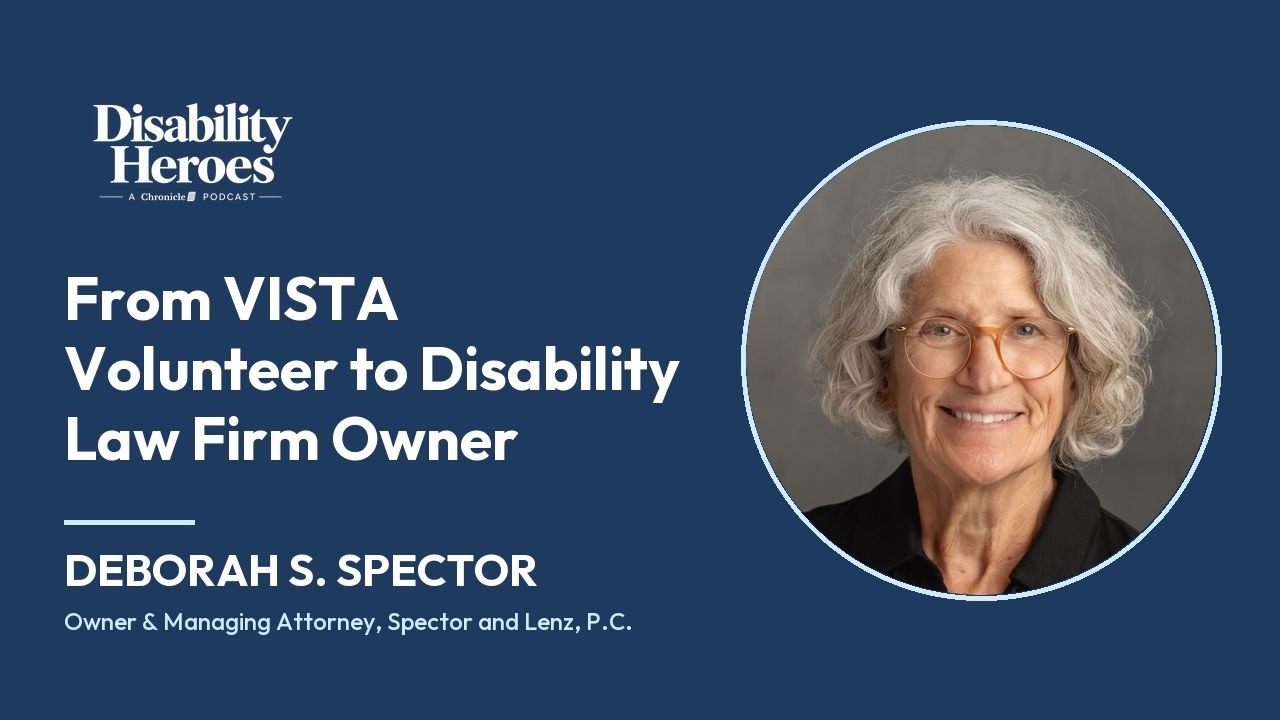
Deborah Spector was licensed in 1977 and started out as a VISTA volunteer at legal aid, making sixty dollars a week. In 1981 she opened her own practice, just as hundreds of thousands of people got government letters saying they were no longer disabled and owed the money back.
She talks about how that termination crisis filled her waiting room and built her practice, the bet she made to take appeals to federal court and borrow to wait out the years before a fee, why every intake call still comes through her, how her team decides which technology to trust, and why, after always planning to die at her desk, she changed her mind.
Deborah S. Spector is owner and managing attorney of Spector and Lenz, P.C. in Chicago, Illinois.
In this conversation:
- Sixty Dollars a Week: legal services, VISTA, and a client named Dora
- You Owe Us Twenty Thousand Dollars: the 1981 termination crisis and the practice it built
- No Business Plan: a $1,500 loan her father co-signed, and the lean early years
- Let's Just Go to Federal Court: building a federal court practice, and what a remand really means for a client
- I'm at the Hub: intake, specialization, and a fully remote team
- The Shiny New Thing: how the firm evaluates technology, automation and AI
- Nerves of Steel: risk, succession, and what she wants to survive her
- Lightning round
"I just don't have the personality for a job."
"When we can say yes, say yes."
This conversation was lightly edited for clarity and never for message.
Deborah's firm: Spector and Lenz, P.C.
Read the full transcriptDeborah S. Spector and Will Yang, with timestamps
Deborah S. Spector00:00
And I would have thought they resented getting them or didn't look forward to getting these cases. And instead, this clerk told us, and I think she was being quite sincere, she said, it is rare in our work to see a situation like this where we have somebody's life in our hands. Outside of the criminal situation. But their safety, dignity, income, we take this very seriously.
Will Yang00:48
My guest today is Deborah Spector. She's run Spector and Lenz, P.C. in Chicago since nineteen eighty-one. She was licensed in nineteen seventy-seven, and she started out as a Vista volunteer at legal aid, making sixty dollars a week.
In this conversation, we get into how the 1981 termination crisis, when hundreds of thousands of people got letters saying the government had decided that they weren't disabled at all, and by the way, they owed $20,000 back, jammed her waiting room and accidentally built her practice.
We get into the bet that she made to take every appeal to federal court and borrow money to wait out the years that it would take to get paid for one. And we get into what she says it actually takes to run a firm through four decades of change, which in her words is nerves of steel. She also told me that she always planned to die at her desk, but last year She changed her mind, and you're gonna wanna stick until the end of the episode to learn why.
Without further ado, let's go ahead and dig into today's episode with Deborah.
Will Yang01:42
Deborah, we're so excited to have you on the podcast today. To kick us off, you were licensed in nineteen seventy seven and you started in legal services. Take me back. What did the world look like when you first walked into the side of things?
Deborah S. Spector01:54
Okay, so first of all, Will, believe it or not, that's going to be fifty years pretty soon. Right? And when I left college, I had planned to go to grad school and took some time off and decided along the way that I didn't want to live in universities, I wanted to live out in the world and do something more practical. And I'll spare you the long story of how I ended up at law school, but I did and I loved it. And when I graduated from law school, I chose, I had an option. To go into private practice with a firm and instead chose to go back to the legal services program where I'd been volunteering. And they were very clever about this and knew they could get me without paying me. So I they made me a VISTA, which is volunteer in service to America. It was the domestic peace corps and it was very popular at the time. So I became a VISTA for sixty dollars a week working for the Cook County Legal Assistance Foundation. Which was an OEO, Office of Economic Opportunity grantee. And this is all under what had been Lyndon Johnson's Great Society Plan. And there was a lot of Economic Development. And we were funded by OEO for a senior citizens project. And they hired me for that as a VISTA and I worked in that project for a couple of years. So that's how I got to legal services. The landscape as far as SSDI and SSI You know, I walked into it knowing nothing. And what I immediately did because I had an older an older client base as my charge, that was my portfolio, older but not necessarily above retirement age, I had to collect referral sources of private attorneys who could handle these matters privately if they had to be litigated. And that's how I became involved in it. I got to know these lawyers and they would consult with me about cases, they would help my clients.
If it was necessary. Now, in those days, SSI fees were not withheld, which meant that SSI, which is of course the welfare program we deal with, companion program to SSDI and SS retirement, but it's it's a welfare program, it's needs-based completely. So we're dealing with a low-income population by definition. No fees were withheld. So if our clients prevailed and received back benefits of any kind, You know, at that point they were in debt and they were in need. And the last people they wanted to pay were their lawyers frequently, and I couldn't blame them. So it was a really interesting landscape in terms of the economics of private practice and who could handle who could afford to handle an SSI case. Because as you may have learned through talking to a bunch of us, until I'm gonna say probably the nineties, the financial profile for firms that do this kind of work was quite different. And it was very small margins. Really small margins. So it was different. Now in terms of the government, you know, look even with everything that's happened over the last year and a half, nothing has changed. It's the same old stuff. And it's relabeled, sometimes it speeds up, sometimes it slows down, but the processes we deal with were the same. The administrative scheme was the same. A few things have changed, but by and large, it's kind of the process I walked into 50 years ago. And that fascinates me. The people have changed, the process hasn't changed. The original legislation dictated what we were going to be doing. And yeah. Now in terms of practice, I I remained at legal services and at some point I decided to move on and decided to go into private practice with some other crazy
Will Yang05:44
Mm-hmm.
Deborah S. Spector05:44
young women.
Will Yang05:46
And before we dig into that side of things, what I'd love to hear about is in this early time period when you are still getting your feet under you, was there a first client who made you either feel like this work was going to be more than just a job? Because it obviously led to a point where you were like, I want to open a private practice too. But before that, like what was that sort of evolution as you then get into the workforce? You're no longer working for sixty dollars a week
Deborah S. Spector06:08
Right, right. I was working for like sixteen thousand a year.
So, okay, I can use her first name and she she has died since. I had a client named Dora, and Dora needed help with a disability appeal and came in to see me frequently, and she was a teeny weeny little older disabled woman, really on her own in the world. And I hooked her up with a Chicago lawyer named Shelley Gomberg, who I just loved. Haven't talked to Shelley in years. I hope Shelley's around.
And he took over Dora's case and for some reason we all stayed in touch. And he would keep me posted on the progress of the case and she was in touch with me frequently. And it worked out successfully and she ended up with income. And that's what this is all about. It's helping people get income so they can survive, so they can live with some measure of dignity, so they can be independent. And Dora got her income and everything was okay. And then some years later, Dora got in touch with me. And was living in a community not too far from where I live. And I don't know why, but she clearly was in need. And we rekindled our relationship, except at this point I wasn't her lawyer. And I I remember going to visit Dora, broader things, brought her things for the holidays. And I realized that and I have to remind myself of this all the time that what we're dealing with here are individuals And you know, in in my religious tradition, each individual is a whole universe. And Dora was a whole world. And entering into her reality was an honor. I don't want to be cheesy about it, but it was an honor and a privilege for me. And that's how I try hard to think about my clients. It's not always easy. This can be very frustrating work. And in terms of the volume of detail that we have to deal with every day and the personalities, It can be difficult to remember that. But yeah, I think that Dora is the one who made me realize, shoot, I'm dealing with a real person here who has a connection to me. Yeah.
Will Yang08:13
So then it takes us to nineteen eighty one when you open your own firm. What made you decide at that point that you know you would rather build something than work inside somebody else's practice?
Deborah S. Spector08:25
Yeah, I just it was it was temperamental. I just don't have the personality for a job. And I haven't had a job since nineteen eighty one, which is pretty cool, you know.
Will Yang08:33
Where do you think that source is from though? Because it's not every day that someone just has that that clear self awareness that like they don't want to work for somebody else and like they want to go out on their own path. Does that go even further back
Deborah S. Spector08:45
yeah. I mean it's temperamental and it's our family tradition. My f yes came from my father. My mother, oddly, worked for the same company for many, many years and it was a trucking company. So my mother was a teamster. I mean, she could plug right into corporate trucking, union business, whatever, and the rest of us ran away screaming. And right now, one of my brothers just retired as a tough criminal defense lawyer in Tucson. He retired this week.
Another brother runs an independent business in California. We're all very independent. And also we are we were raised to take risks
Will Yang09:22
Mm.
Deborah S. Spector09:22
and not be afraid of credit, not be afraid of being in debt. And I hope you want to cover things like that this morning because
Will Yang09:30
Yeah.
Deborah S. Spector09:30
that's part of being in private practice.
Will Yang09:33
Yeah, I think I'm hearing is that you had the entrepreneurial spirit instilled in you from a very early age and and from there as well. You had many models, whether it was your father or even your siblings, just taking those risks. And so naturally you feel, you know, when you're t you're stepping out on your own as well, that maybe it's not that as risky as, you know, others might perceive it to be at that time.
Deborah S. Spector09:52
Exactly. And it it's kind of crazy, but not as crazy as everyone else sees it. And minor correction. My brothers were not role models for me. I was the role model for them. Right?
Yeah, so I did that until nineteen eighty one, stepped out, and I really didn't know what I would what was going to do. I was young and crazy and I officed with a couple of young and crazy women, one of whom then became a very well respected judge in the circuit court. And we were doing all kinds of things.
We were doing a little immigration, a little divorce, a little of this, a little that. Okay, so in 1981, the Carter administration had commissioned a GAO study to study Social Security disability recipients who should be off the rolls. And they came up with, you know, vast numbers of look you've seen this kind of stuff, people who've died and people who don't live in the country, whatever. Well, you can still get your benefit if you don't live in the country, but as an example. And they came up with a study that there were a lot of people who should not be on the rolls.
And then when the next administration, which happened to be Reagan's, came in, they looked at this study as a cost saving possibility. And that's when we had the Great Termination Crisis of 1981. Are you familiar with that? You heard about this before? Okay.
Will Yang11:02
No, tell me more. Yeah.
Deborah S. Spector11:04
So, in 1981, hundreds of thousands of people across the country got government letters. And you won't be able to see my client's name, but you know, government letters that said, "Hi, Will.
This is your government. You've been collecting disability. We have now decided you haven't been disabled for the last four years. So your benefits are going to stop now, and by the way, you owe us twenty thousand dollars. And sometimes it would have a little green envelope attached so you could repay the money when you receive the letter. Well, Well, it was a nightmare. I mean there were suicides around the country, Congress was involved, the press was involved, the courts were involved, and then ultimately, we developed a new system for continuing disability reviews, proper notice, proper termination, the ability to continue getting benefits until you have a constitutionally protected fair hearing before an ALJ. You know, The world changed. But in 1981, there I was young, crazy, and didn't need a lot of money to live on. And all of a sudden the little I can't even call it a waiting room, the waiting area in my office was jammed with people carrying these letters. Because I'd learned how to do this kind of stuff at legal aid. At legal aid, I learned how to do administrative advocacy, which is what this is about. This is applied to ad law. So all of a sudden I had more clients than I could handle. The legal aid people knew I would talk to everybody. And I developed a practice on these termination cases, even though we really couldn't get paid, and used that to develop our practice, my practice. I was solo at that point with some helpers. And that's how it started and I realized I loved it.
You know, I just love this kind of practice. It's I don't know, it just suits me intellectually in terms of personality. For some people it's tedious because you're doing a similar thing for every client. On the other hand, all the clients are different, the judges are different, personnel in the field offices are different, and I just found myself really liking it and developing a mini volume practice for Chicago.
Now, a quick aside, Chicago, unlike some of the other major cities, especially in the Midwest, for some reason has, I think, a pretty small Social Security bar. You know, it's a big city, and there aren't a lot of us who do a lot of this kind of work and we know each other.
And I find that fascinating. It's it's very Midwestern. We have a real Midwestern bar here. So I knew how to do this stuff, and I just started doing more and more and more of it.
And as the law changed and the terminations we still have terminations of course, but they slowed down, it became a regular process, I developed referral sources and it just took off from there.
Will Yang13:54
At that time, you know, you're clearly in some sort of a flow state. What would be the signs that somebody that might be listening and realizes they they also are, you know, falling in love with this work as well that they might keep an eye out for 'cause it was what resonated with you at that time and it's also carried you through the multiple decades in this area.
Deborah S. Spector14:11
You bet. Okay, so again, at the risk of being kind of cheesy about it, number one, you're always dealing with people in need. Even if you're dealing with people who have far more money than I ever will, they're in need of something. They're usually distressed, they're usually stressed out about the process, and you're able to help. You can come in, especially as I got older, as kind of a calm voice to say, "All right, here's w how this works, and here's what we're gonna do about it."
So that's very gratifying. The most gratifying thing, of course, and this probably speaks to a lot of lawyers almost competitive spirit, it's really great to win. And this is a a practice of law in which you win or you lose. You win, you lose, you appeal, you win, you lose, you appeal. It's not like estate planning or an adoption where you can close the file and yeah, it's a win. But it's not controversial.
We don't have a an opponent on the other side. So, that part is really cool.
Yeah. And again, I don't know if that's particular to me, if it's part of a competitive temperament, but I think it's something probably a lot of lawyers share that we really like to win. As an aside, sometimes we'll talk to lawyers who say, I never lose. And the response to that is that's because you only take cases you know you're going to win. What about the rest of the people in Egypt? But yeah, so it was that. The cases turn over pretty quickly.
Mean a case can be in our office for a year or two years before it's resolved. We have cases that are eleven years old, they've gone up and down to the Court of Appeals and back to court and here and there. But by and large, they resolve relatively quickly and you can keep moving and there's always something fresh. There's always a new client coming in with a new problem that you may or may not be able to help with. So that's gratifying. The other thing is that although as I said we have a small bar, we have just a a lovely bar in Chicago. And people who go into this kind of work tend to be really good people, nice people, and less competitive than I find other lawyers, more collegial, smart, but caring and willing to do this kind of of work. And that's gratifying. I like that a lot.
Will Yang16:32
so I'm curious at this time, what was it like being a woman operating a law firm in Chicago in nineteen eighty one? Like what did you have to deal with at that time that your male counterpoint parts simply didn't have to?
Deborah S. Spector16:43
Well, it was all subtle. Anything you know I can remember about that is subtle. And there were women. I c I can recall women who were running small workers' comp firms. There were a couple of remarkable women who had high-end personal injury firms. There were women who were becoming judges. But in terms of overall numbers, we were pretty small. When I graduated from law school, I went to DePaul University in Chicago, and when I graduated our class had the second highest percentage of women in the country second only to Rutgers. And it was a big deal that I graduated in 77 and we had an unusually high number of women. So you can kind of trace back historically how few women were in practice. A lot of women went into public practice. And my school is was an urban school and it was a real feeder for places like the state's attorney's office, the attorney general's office, and that's something that women could easily do. Now Social Security has proved over the years for myself, for my colleagues, I think, to be a great practice for women for a variety of reasons. And I don't want to be grandiose about it, but I think that it's it's a really good practice for women and allowed me the flexibility to take years off to take care of my children. And that was very important to me. So I don't like the phrase, you know, but it allows for it.
And that was great.
Will Yang18:06
When you explore that, what do you think are some of those attributes or characteristics of disability law that specifically make it conducive for women to run successful practices?
Deborah S. Spector18:16
Well, I'm going to flip that and say, you know, like teaching or pediatrics, maybe it's because the opportunities were available to us. I'm not going to say because we're nurturing or because whatever, but because the obstacles weren't there to getting and that's that's the other thing about going into a small private practice on your own. There are no obstacles to getting in.
Will Yang18:39
The obstacles are you and how you run your business.
Deborah S. Spector18:40
Precisely, and how much you're willing to put into it. Right. And the other thing that happened when I started the practice was that my late father took me by the hand to the National Republic Bank of Chicago, which I don't think exists anymore, and co-signed a loan for fifteen hundred dollars, so I could afford to do it. So it was possible too. And I'm sure it's possible today, but I mean I'm talking about no financing, no business plan, no this was a little bit like the Wild West compared to where where we are today.
And will, don't forget, I mean they existed and they were used for a variety of things, but for our purposes, no computers. We did this on paper, everything on paper.
Will Yang19:19
So when you're in those early days of the firm, Were there anything from those lean years that you still think about just because, you know, you're in this maelstrom of just everything's coming at you, you're having to start your private practice, you have this line out the door from, you know, the things that are happening more broadly. What do you still recollect in terms of how you got your bearings to then, you know, get your firm to a successful place?
Deborah S. Spector19:41
Well, such as they were, you know. It was and and this I do look back on with appreciation for the stress we could all tolerate. It was all reactive.
Especially during the termination crisis. There was no ability to sit down around a conference table with a few colleagues and say, let's come up with a business plan for a couple of years given what's going on in Washington or in Baltimore. You know, and it was all reactive. And then it was always catch-up. You know, I would realize the termination crisis before I really read about it or understood what other people were saying about it. I appreciated it in my life, my practice.
And then got my bearings about it and contacted other people. I remember contacting the press. I remember litigating cases. But it was always a step behind what was going on with the government. And my I have the greatest appreciation for people who started firms and have very successful firms now who are able to do, what do you call it, high level? You know, high level planning, because no, mine was really reacting to what I saw. I do have a good sense for trends and I could pick that up, but no, I was reacting. And it probably took, let's see, I left legal aid in eighty one and then I worked full time by which I mean like eighty hours a week until eighty five when I took some time off for my first kid. And I would say the other piece of it was, you know, easily sixty, eighty hour weeks. Non stop, you know, really hard work. And it took off.
Will Yang21:20
Were you focused on the, you know, on the reactive point note, were you focused a lot on that operational getting things done for these respective cases and then stringing everything else kind of together from like the firm operational side at this point? I'm really trying to explore here is it sounds like you had the intuition or taste to know when you did need to take the 10,000 foot view and like get some basic things in place, but otherwise in those early few years it was very much, you know, you're in the grind. It was building up the bones of the practice and like just doing it through the actual work itself versus potentially like from a systemization or or process improvement standpoint.
Deborah S. Spector21:57
absolutely.
It was completely in the moment. You know, I I'm sorry I'm doing this without ever having really thought about this before. You're asking my questions. But no, it was completely in the moment, reactive, taking care of those clients' needs that day. And also, and I'm I hope this is still true for everybody, but you know I don't want to say my generation, you know, lawyers, but we really had it drilled into us and deep in our guts that You know, you didn't go home at night if you hadn't returned a client's phone call. You know, the it was it was that important. The client always came first. And operating with that model, that made the days complex long and very reactive. And I still work that way and I'm trying I'm trying not to. I've tried for forty-eight years, I think,
Will Yang22:45
it's hard to change old habits.
Deborah S. Spector22:47
I'm not taking phone calls, I'm returning phone calls. But yeah, you know, certainly financially.
I had a bigger picture. You know, we'd look at the annual reports, the quarterly reports, figure out what we were earning, what we had to do, whether we could hard afford to hire people, take on more debt, find lines of credit. You know, it's a small business at the end of the day. We're just running small businesses.
Will Yang23:09
Who did you turn to at that time to to get more of that? Was that from, you know, was it from your f late father? Was it from your your, your peers or mentors of yours at that time? Like how are you learning these things on the fly while you're also in the heat of the business, serving these cases on a daily basis and doing these sixty to eighty hour weeks?
Deborah S. Spector23:27
probably my family and also who've been unbelievably helpful to me over the years. They're wonderful. And figuring it out myself. You know, and it could just be enough for someone in the family to say, Well, you better go talk to the Bank of America and get a line of credit. You know, it's just put the suggestion in there. Yeah, I never had a business consultant, I never had a business planner, I never had a coach. I just figured it out. Now, looking back had I been more systematic about it, had I been more intelligent about it, had I had professional help with it, we at this point could have a much bigger practice, a much more successful practice, a much higher annual gross, and it wouldn't be our practice. It would be something different. And when I leave it, whomever takes it will have a different practice. But while I've been leading it, Again, I don't want to be grandiose about this, but it's kind of mission based. You know, our standard for taking cases is about the lowest in the city. And that's by design.
Will Yang24:31
Quick Break from our sponsor. This episode is brought to you by Chronicle. The firms with the strongest operational control aren't necessarily the biggest ones. They're the ones who never miss what the SSA is telling them. Chronicle is what makes that possible. It monitors the ERE and e-file daily, surfacing any changes before they actually become problems, which allow for your team to keep operating on SSA time rather than catching up on it. There's no manual portal checks, no scrambles when a notice comes late, just visibility built into your daily workflow. You can learn more at chroniclelegal.com. All right, now back to the episode.
Will Yang25:08
when you think about, you know, the the work and the practice that you've built today, you have a heavy federal court practice, which, you know, some disability
Deborah S. Spector25:16
yeah.
Will Yang25:17
representatives never take on. Why did you build that and what do you think it takes?
Deborah S. Spector25:22
that was really interesting. Okay, so again, it's very personal. Over the years we had always had some federal court practice. And I'm talking about like two to five cases a year. Just if we were really ticked off because we lost a case, we would have a couple of cases, five cases maybe that we file in federal court. And then during the Bush administration, when things were kind of riding high.
A good practitioner really couldn't lose the case in front of Social Security You know, the allowance rate was really high. There was money flowing through the country. And you know, my opinion, I haven't done studies, but my opinion is the allowance rate, everything about SSA, correlates to the economy. It doesn't correlate to the party in office. It correlates to the economy. And so things were riding high and you really couldn't lose cases. And then in a On a personal note, at that point I took over management of the practice around 08, and of course the economy crashed. And when the Obama administration took over from the Trump administration, and I'm not blaming Barack and Michelle Obama, but they did some really tough hires within the government. And we ended up with a cadre of new administrative law judges, some new policies. A new ethos about these cases and it became very, very difficult to win cases. And that's we're talking like 0809. And I looked at the situation and I had a couple of young lawyers working for me, one of whom was Joseph, and said, you know what? I'll borrow more money. Let's just go to federal court all the time. Now the thing about federal court is that it takes a long time for a case before the agency to mature. So you can be paid on it.
And by being paid, I don't mean so I can live my fabulous lifestyle. I mean it's like I pay my staff, right? And
Will Yang27:17
Mm-hmm, mm-hmm.
Deborah S. Spector27:19
federal courts longer. But it's a real long game. And you have to win in federal court, which means you get a remand, a rehearing, and then you have to win the rehearing. So we're talking two, four, five years before there's completion of one of those cases and the possibility of fees. And there's a little exception along the way called EAJA, but I won't go into it. So I said, let's just do it. We'll just spend our money.
Whatever we have, and if we have to, we'll borrow more to keep the firm going, let's go to federal court all the time. And so we started doing it in two thousand nine, I think. I just made the decision. Let's just take the appeals. And if you're willing to take appeals to federal court, people find out. You know, as I'm sure you've learned, a number of lawyers who will do agency administrative advocacy won't go to federal court. I don't know why, but they won't. I did presentation, I forget for whom, I think the Federal Bar Association with my colleague Ryan on the appeals council. Some practitioners won't even go to the appeals council, which I don't understand. But we go to federal court and I train these young lawyers in brief writing. And one of them is, as I said, probably the best in the country, as far as
Will Yang28:29
Mm-hmm.
Deborah S. Spector28:29
I'm concerned. And we just developed a heavy federal court practice.
We promote it, we let other lawyers know, we let our clients know. And I get queries every week for cases for federal court that are coming in for clients who are not our clients, new people. Yeah, so we now have this busy federal court practice and it's terrific and we've gone through, you know, all kinds of things, including COVID, which changed the nature of everything, but definitely the federal court practice. Things were put in abeyance for forever for a while. And the other thing about the federal court practice is that again, and I think it flows with the economy, but I couldn't prove it to you. There are periods of time when we have what we call a tsunami of cases in federal court. You know, when we just the appeals council is denying so many so quickly and we've decided to take these cases. We do have a standard for what we'll take to federal court, of course, and all of a sudden we have a lot of briefs that are due. And the federal court in Chicago, a particular judge initiated a conversation with the Chicago Bar Association Social Security Committee to address the issue. And so we have all kinds of new avenues open with the government lawyers and it's made everything just move procedurally more smoothly. But again, the work is the same. The issues are a little bit different, the personalities on the court a little bit different, but we're writing the same briefs we were writing 40 years ago.
Will Yang29:56
What would you say going to federal court has taught you about the agency that you maybe never learn from hearings alone?
Deborah S. Spector30:04
what a great question. Well and and especially now, there's a lot of error. There's just a lot. The more stress there is on the administration, the more error we see in their processes and how they handle things. So it's taught us that. I will tell you one thing we learned when we had this this series of meetings with the court. About the briefs and and the and the number of filings and it was actually magistrate judge who's now an Article III judge who came to speak to us and she made it really clear and her clerk made it really clear. They understand when you file a federal case, it's very labor intensive for the court.
So you you know you file the case and then the government has to produce the answer with a record. And then there's a record. Now with electronic medical records, we could be talking about records that are, you know, four, seven, twelve thousand pages, occasionally even more. So it's a dense record, it's a transcript of the hearing, it's all the forms involved, and then the final decisions. So somebody in the judge's office has to read it. Carefully, I mean, close read. And one of the the clerks told us she just spreads it out on the floor in chambers and it's massive piles of paper.
And so it's labor intensive for the court. And I would have thought they resented getting them or didn't look forward to getting these cases. And instead, this clerk told us, and I think she was being quite sincere, she said, it is rare in our work to see a situation like this where we have somebody's life in our hands. Outside of the criminal situation. But you know, their their safety, dignity, income, we take this very seriously.
These are important cases. And when you think about it, what you're taking is, you know, John Smith's SSI case is now being heard by one of the great courts in the country. It's really a cool thing.
And it's because of the the administrative and then judicial review scheme set up in the Social Security Act so many years ago.
Will Yang32:09
Mm-hmm. So when you win a remand, what happens to that client in that case? Is it a victory or is it the start of another few years in the process?
Deborah S. Spector32:16
Yeah, and and same thing at the appeals counsel if you get a remand. The case goes back. Now, by practice, SSA almost invariably sends the case back to the same judge who denied the case before, which clients can find very distressing, but that's the practice. The judge gets an opportunity to rehear and correct any errors that have been pointed out. Yeah, we start the process. I sent out a bunch of notes this morning to my team saying so-and-so's been remanded.
Get the medical records updated since the date of the last hearing. Get ready for another hearing.
Will Yang32:51
When you take a step back, if you were to give the advice to somebody else that might be considering adding this to their practice, what would be one or two top tips of advice that you would give them if you were to think back at your own journey and maybe cut a year or two from the process that it might have taken for you?
Deborah S. Spector33:05
You bet. Well, one is that couple of things. It depends on who it is and what kind of practice that person has. So first I would say do it. Definitely with regard to the appeals council. When I in encounter a colleague who doesn't go to the appeals council, I'm kind of baffled and say, just do it. You know, once you've done six, twelve, you know, I don't write them anymore, another lawyer in the office does, but I've written probably thousands of them. And once you get a handle on How the judge is right, how you're going to structure your argument, blah, blah, blah, blah, blah. You know, you can write it in two days. If you're really adept, you can write it in an afternoon. There's no reason not to do it. A federal court case takes a much bigger investment of time. And you have to be able to analyze the case, you have to know what the law is in your circuit. You you know, it's a different animal. But I would say same thing, do it. It's not like you're committing to a four-week criminal trial or something. You know.
Do it and be prepared not to see any resolution for two years.
Will Yang34:10
Mm-hmm.
Deborah S. Spector34:11
And probably not to see any income from the case for three years, four years. And definitely get a mentor. Get people who know how to write these briefs to agree to read your brief with you, or at least to talk through the theory of the case with you. And we unfortunately have read lots of bad briefs.
But yeah, and there's a rhythm to it. It's not quite a template, but there's a way to approach this that is appealing to the court. And I'll quote the judge who, again, came to the committee. She said, "Look, guys, draw me a roadmap. Tell me how to read through and think through this case so that inexorably I'll get to the result you want." And that's our guiding principle. Draw the judge a roadmap. Connect these dots, Judge
Will Yang34:59
and you'd mention earlier that, you know, y one of the things that you've invested in is training younger attorneys through this process, making one of them, you know, in your words, one of the best brief writers in the country. So that leads me to then the thread of running your firm today, you know, in 2026.
Can you walk me through what your firm looks like now, the people, the caseload, and just how the move the work moves maybe compare to, the earlier days we've covered as you were building up the practice?
Deborah S. Spector35:26
Okay, so go back to that, Will. You know, we were using carbon paper. It was a big deal when we got IBM Selectric II. Do you know what that is?
Will Yang35:34
I'd assume it's a very early IBM computer.
Deborah S. Spector35:37
Well, Selectric Two was an innovation like Chronicles innovation. Selectric two
Will Yang35:40
Okay, okay.
Deborah S. Spector35:42
had a correction key on it so that you could
Will Yang35:44
Hm.
Deborah S. Spector35:45
backspace and a piece of whiteout would hit whatever you had just typed and then you could type over it. It was a it changed our lives. We used carbon paper, we used whiteout. It was a different world. Everything was done on paper. The records were on paper, everything was on paper. And w at the beginning, in the beginning of the firm, I did everything myself. Every single thing.
And I have colleagues now who are solos who do every single thing themselves or with a part-time employee and find that it's actually manageable. If with a small caseload, it's manageable. The caseload gets too big, of course, you can't. So fast forward to unfortunately how we developed, which is kind of like a wheel, our our model. I don't recommend it to people.
But our wheel, our model is the wheel, and I'm at the on the hub. And for a variety of reasons, I have always wanted to do intake myself. So any prospective client who contacts the office, almost any, gets a phone call from me to quickly ascertain if it's something that we think we might be able to offer help with. And I think I'm told by clients. Now, again, I only talk to the clients who've chosen to go to a woman's firm, an older woman's firm, a smaller firm, not one of the national firms, you know, who've chosen sometimes they want to stay local, whatever the reason is. So I'm talking to a self-selecting group. But I think it's important they talk to a lawyer. And in our case, I think it's important that they talk to the senior lawyer on the team, not because I'm smarter than anybody else, but because I've seen almost everything. So if somebody says, you know, I just got a 10 day letter on an SSI termination because of blank blank blank, I know what it is. I don't have to start figuring it out. So our model is that intake comes through me and then I spread the work from there. Now I do have a seasoned lawyer who works for us part-time, retired government lawyer, and she also will take some of the intake But I only refer the intake to her that I know we're not going to be taking, but I want her to speak to the client, perhaps give some general advice without giving legal advice and as a courtesy to the client. Yeah, and then we have a bunch of support people, and I then figure out what needs to be done. If we need to file an application, I have a paralegal who is phenomenal at it.
And I schedule a meeting with him, I send the client questions, and then he handles that. And there are other people in the office who handle the forms. Once cases are on file, be it initial reconsideration at the hearing stage, there are another couple of people who kind of work in the nature of case managers, but work closely with me. And they do the case development. They make sure that We know about all medical developments, that the records are requested and get in, that we get medical support statements when available, that we get personal statements. I'm very big on personal statements. I have clients write, write out their story, but keep it to two pages. Three if you have
Will Yang38:55
Mm.
Deborah S. Spector38:55
to. And I do that because I want that in the federal record.
Will Yang38:59
Mm-hmm.
Deborah S. Spector39:00
Even though I know our judges aren't gonna be moved by them, our administrative
Will Yang39:03
Mm-hmm.
Deborah S. Spector39:03
law judges. That'll be in the record in federal court. So we have case managers kind of people.
Who do that, and then we kind of specialize about different stages of the process. So we have a hearing lawyer who's wonderful, he's in there all the time, dogged, knows every page of the record, and that's the key to it, I think, to his success. He's very successful, and he's quiet, but he is so thorough and no guns in your face, judge. This is administrative law, right? And he knows everything in the record. So if the judge says, I don't know where where are you pointing me to an MRI that showed blank blank blank, he's able to say six page sixty-seven. And that's the granular level that that has to work on to win cases of hearing. We have a lawyer, Ryan, you know Ryan. Ryan does the appeals counsel arguments and is also a tech guy and is re envisioning our marketing and our tech and phenomenal. And then if we lose it, the appeals council.
Then Joseph is in charge of the federal cases. And when you make a decision about federal court, you know the standard of review in federal court is different from the legal standard used by the agency. And so we have to be very careful that we have a viable theory.
Will Yang40:21
Mm-hmm. What I'm hearing is that you've done a really great job of creating specialization within the firm after it starts with you at the hub. What are those points in your mind that it made sense to bring in somebody into this part of the process?
Deborah S. Spector40:34
You bet, and it's the it's the same as it as right now. It's all a matter of time. Does Joseph have enough time to manage the federal practice? He has some outsource lawyers he can rely on, but with his current crop of outsource lawyers and the briefs he can write, is there enough time to do it properly and not really burden any employee? Does our hearing lawyer have too many hearings?
On his calendar, and I ask him frequently, do you want me to start looking for a second hearing lawyer? Because we do it all with one hearing lawyer. And he, no, said it's manageable. I have enough support coming up from below where these other people develop the record and are getting medical source statements, keeping everything up to date. He doesn't have to worry about that. He comes in, not the day of the hearing, and you'll hear complaints about that in in certain practices. But he comes in and he's watching what's developing, and then you know, a week or two before the hearing.
He has an in-depth conversation with the client. I've already had quite a few, so that we know everything in the record, we know what's outstanding, we've developed our theory of the case. We have another employee who abstracts the record for him. I would say at some point, if he says to me it's too many, then that's the trigger or five cents. But I ask frequently, I ask them all. I asked our appeals counsel lawyer last week, can I get you some help?
Will Yang41:56
how do you create the culture within your firm to be, you know, to ha I mean sometimes when they're when people are working for others, right, they don't fully feel comfortable to say, Hey, I need help or I need to I need us to potentially add another person to the team and whatnot. Like it feels potentially outside the realm of what they might feel comfortable asking for, right? And so how do you balance that or is that something where you just set it early on culturally within your firm?
Deborah S. Spector42:19
Yeah, yeah, my the people who work for me are not shy
Will Yang42:23
Mm-hmm.
Deborah S. Spector42:23
about saying I have too many briefs to write in August. Help me, you know. And they know I'm not gonna write them. You know, that part of my career is over. I'm not writing briefs, I'm not going to hearings. I had to stop going to hearings myself when I rolled my eyes during the hearing and went and the judge said, Counsel, counsel and I said to myself, I think that was my last hearing. I think I've done, you know Like forty two years too many or whatever. So no, they tell me. They tell me. I no no, we have a very easygoing collegial group. We work remotely, we're entirely remote. We went remote in March of twenty twenty and nobody wanted to go back. So we work remotely, we meet every morning on Zoom. Anyone who can joins us. We keep our cameras off, so it's like a big conference call. And I have what I call a working Zoom meeting that has problem cases I want to talk about. We go through the docket for the day, the week, and early next week, and then we go through what we call a briefs and case filing list, and that's divided into briefs that are due that we're aware of into the future, cases that we're considering for federal court with their deadlines, the appeals counsel arguments that have to be written and their deadlines, and then I have some catch all categories.
So we go through each of those documents every single day.
Will Yang43:49
Mm-hmm.
Deborah S. Spector43:49
And we're about to, we're in the thick of changing case management systems, which is why my hair got gray. And it's going okay, but we're hoping that we can automate some of that a little bit too.
Will Yang44:02
I think the fact that you've been remote for so long is also a testament to the firm culture because, you know, that requires a high level of trust and accountability across all levels of the firm. And then also what I'm hearing through the your process is you've found a way in which to essentially just to to consistently get the accountability from all levels, which makes it so that it kind of feeds back to the earlier point of then your staff feeling more than comfortable to share with you. Hey.
I need help. I have way too much on my plate and and go from there.
Deborah S. Spector44:30
And I I absolutely take the position, and I want to quote someone in one of our peer meetings, that, you know, everyone who works in our firm is a professional, whether they're a lawyer, and of course they have special considerations because they're licensed and have a different set of ethical rules that apply to them, a heightened set of ethical rules. But I take the position that everybody in the firm is a professional and I can assume that they will get their work done during the day.
We don't have time off, we don't have sick time. It's like, no, we're grown-ups. We're professionals. We're running a small, amazing project remotely, and we've been doing it now for well, I left legal aid in 81. What is that, 46 years? And, you know, it works. I remember in one of our peer meetings, somebody was asked, was talking about someone working remotely, I think, and was asked, Well, how do you know they're working?
I assume they're professionals and they're working. You know. I don't care what time of day they get it done.
Will Yang45:31
Totally.
Deborah S. Spector45:32
You know, and and that's worked for me. Now I have colleagues who, you know, have more conventional structured employment arrangements with their people. But we're we've always been very loosey-goosey.
Will Yang45:44
some of the thing that you mentioned was you're thinking about switching or you are in mid process in changing your case management system, which leads me to ask the question of You've probably seen a lot of technology through the years, as you mentioned, the IBM. But you're not building a
Deborah S. Spector45:56
Yeah.
Will Yang45:57
lot of this necessarily in-house. So, you know, what does it look like for you when you are evaluating these different solutions and whatnot as to what your practice actually runs on? What nuggets of advice would you have for folks that maybe are still doing things more the analog way and they're thinking about digitizing their firms? Maybe they're thinking about succession planning, which I know we'll thread into, but yeah, I'm curious, what have you learned through just trial and error in terms of legal technology as a whole?
Deborah S. Spector46:23
Whoa, okay. And so I'm gonna just jump ahead into touching on AI, We can't have our heads in the sand about what's happening in the tech world. And we have to be smart and responsible about it. But given that, I think one of the concerns I have always had and I watch my colleagues grappling with is the shiny new thing phenomenon. And we are very conservative when it comes to the shiny new thing and are quite we're believers that the shiny new thing can often either not work at all or create more problems than it claims to solve. So we're very, very cautious in We look at everything. We go to everybody at the conferences. You know I've I've met you and in Baltimore, right? Yeah, we go to everybody, we talk to everybody, like, who's this little old lady who's walking around asking Benny questions? I talked to everybody. I took my socks home from you. And and I think Clio gave us socks too. And and I can do kind of an on-the-spot evaluation. This might be of value for us and also things that we learn about on the internet or from colleagues.
This might be okay for us, this might be overkill for us. This might be a bell some bells and whistles that we really don't need. This might be promising to merge things with AI that we really should be doing ourselves with our brains and not with a machine. For example, some of I don't want to say anything about particular products, but some things about vocational numbers. It's like we don't we don't really want to go there.
So we evaluate them kind of roughly that way. And then I would say, be careful about the shiny new thing, but also don't be stupid. And in our new case management system, I know one of our employees who is just outstanding and has a wonderful a non-attorney who has a wonderful view of how the firm operates. And she maintains all kinds of spreadsheets that I don't even know about, about case status and things. She's incredible. And she was, she said, I think it's a shiny new thing.
And we had to persuade her it's not. So there's also that kind of team of rivals approach, you know. And we do the same thing. I should mention, we do that when we determine whether or not to take a federal case. There's one lawyer who does the first pass at it and may come back, and this is not an uncommon model, may come back and say, Great case, take this case, terrible case, don't take this case. If it's terrible case, don't take this case. I look at his synopsis, and if I agree.
Right on the surface, you know, if the client's gone back to work, if if there was, you know, perjury the hearing, whatever, I'll say, forget it, right. But otherwise I may push back and then spread it to the rest of the team. What do you think about this? What do you think about this? Look at this exhibit. And then we debate it among ourselves to decide whether or not to take the case. I think the same thing about tech.
Will Yang49:19
Mm-hmm.
Deborah S. Spector49:20
You know, I'm not gonna take none of us in the firm should be saying, Let's take it, let's not take it. We We study it and we are kind of conservative that way. But we're redoing our website and we decided to go with a sole practitioner, website designer, who does other kinds of marketing things, and he's working with us. We change case management. We're very interested in we had a meeting with Nikhil about using
Will Yang49:47
Mm-hmm.
Deborah S. Spector49:48
Chronicle to send notices to the client because I have people we talked about this at a peer meeting. I have people do that, you know.
Send a note saying, Tell Joe Smith that his case was just assigned to an adjudicator and you're talking to her today. And it would be lovely if that were automated.
Will Yang50:04
I I think the most salient point for me from what you shared is you take that approach that you're doing from the federal appeals process and almost apply it to evaluating software where there's a a few couple pass-through system of like maybe a couple people hop on the demo and then from there you're discussing as to whether or not it falls into shiny new object or if it's something that actually has grounds be like good bones behind it. And then from there you're probably evaluating how continuing to have those conversations. I think sometimes like when we meet with different firms, they don't necessarily have those existing evaluation processes. So sometimes it's a singular decision maker, for example, that isn't talking to the case manager or the paralegals that are going to be deep into the actual work itself when the case managers or the paralegals are screaming from the rooftop saying, hey, like this would be absolutely mind blowingly, you know, different than our current workflow. And so I think it's like bridging that.
And and it goes back to the earlier points that you were saying of just how you operate your firm from a daily cadence standpoint to elicit that feedback from, you know, your teammates as well. That's what I'm taking away from that in terms of the evaluation process.
Deborah S. Spector51:11
You bet. And you know, Will, I as we talk, I realize we do have a couple of perspectives that we try to keep front of mind all the time. Just like with every case, from the time a client first calls me, I'm applying the sequential evaluation of disability. What can I do for this person? How does she fit into the government's rules? But I'm always looking at cases, and I think everyone in the offices, in terms of, what's this going to look like in federal court? What's this record going to look like? What are these little statements going to look like?
What is this doctor's opinion going to look like? And we build our cases backward. We need to build the record. We need to make sure we have a record for federal court. So we're looking back. Now that's not to say that our hearing lawyer won't say, I will try it. I'll give it a try," because the investment at the hearing level is different than it is in federal court. And also, federal court is very restricted. There's not public access to everything that's filed, but nonetheless, it's somewhat public.
And when we're still before the agency, we're willing to play a little harder with riskier cases. So, two perspectives. One is looking back, are we making a good record for federal court? Second, with regard to new software, new processes, anything, one of my first questions is who's gonna do it? And I think that's critical. We have a small team. We don't have hundreds of employees, we have ten, eleven people.
On any given payroll. Most of them are salaried, a few are hourly. And I always have to look at this and say, Well, I'll use one of our colleagues as an example, like with Benny, when we started looking into Benny. Who's gonna do it? Who in our firm is gonna be responsible for Benny? And I had to make sure it was okay with that person, you know.
Will Yang52:58
Yeah, what I what I hear is have you ever heard of the RACI model?
Deborah S. Spector53:02
No, how do you spell it?
Will Yang53:03
R A C I essentially it's a framework where when having these sorts of conversations or decisions, you break out who's responsible, who's accountable, who's consulted, and then who needs to stay informed. And it sounds like what you have is you have a point person that's like, hey, this is who's responsible for this. You have s some different folks that might be accountable to it, you have everybody being consulted about it, and you might have you know, some people on the hourly side that are informed about it. It's just that like things are happening. But that's what I'm hearing in terms of your process there.
Deborah S. Spector53:32
That absolutely describes it. Right, right. On the other hand, we subscribe to no business consultants journals. We don't have a consultant, but that's exactly what we do. Yeah.
Will Yang53:42
Yeah, that makes sense.
Deborah S. Spector53:43
Right.
Will Yang53:44
so I I'm curious in terms of one final thread on the technology side before I kind of pivot into succession planning is you had mentioned that you're often thinking about, you know, what is it that can be automated in different parts of the job to maybe potentially allow for greater time to be spent with clients or just on the more, you know, meaningful sides of the work that move cases forward. I'm curious how does your team separate out those or make those distinctions in terms of, hey, when you're looking at this case management system, this is a thing where this workflow could, you know, lead to us being able to spend more time with clients, et cetera. Like what does that conversation typically look like on that end to differentiate between the two? Because I think it's really easy to fall down the rabbit hole of, hey, let's just automate as much as we can, but there's a balancing act there.
Deborah S. Spector54:30
no.
So and I understand your motivation asking the question. And my response is, how do we make those decisions? Totally out of fear. It is a fear-based decision-making process. Because one of my biggest concerns, and and we talked about it in terms of of automating notices to clients, one of my biggest concerns is that there aren't human eyes on that thinking, well, "Wait a minute.
That's John Smith, and he doesn't answer the phone. What about that's so and so, and we are getting conflicting responses from the two treating physicians?" So I'm very, very concerned about automating without a human touch on the client, and very concerned about automating with information going into case management without being published to the right people in a way that will get their attention. So I operate out of fear.
Will Yang55:26
And how do you take that then in the context of all the different ways that AI has kind of been changing the disability law space? Because you know, you're going to probably hear a lot of shiny new objects on that side or shiny new syndrome on that side. But then on the actual delivery, at least from these conversations I've had with different practitioners, it runs the gambit. But the high level that I would say that I hear is people are certainly interested and intrigued by the propositions that like of different areas of AI.
They definitely have to do that filtering process of what's actually a signal from noise in terms of what can actually help their firms on a daily basis.
Deborah S. Spector56:00
no kidding. And that changes every day. You know there's a website of cases naming cases in which lawyers have been busted. I'll send it to you. It's really interesting. And he has published cases in which lawyers have been busted in court for AI. I'm and it's mind-boggling to us that people would do that, would would publish AI research, AI text, whatever, as their own work product. On the other hand, it is so Damn seductive sorry, so darn seductive. You know, I mean I use Claude all the time and we use ChatGPT business, I think, if we have to have something that's private. And it is seductive, and I think we all really have to be on guard about it. I have my own personal concerns about the kind of mega business model. Behind AI and what it's going to do to our economy. And you know, I'm old enough so that I'm talking through the dot-com bubble and the real estate bubble. And now I think we're seeing the same signs. I I feel the same rumblings from the stock market that something's something not good is going to happen, no matter how much I read that Nvidia stock is going up. So that's one issue. Is this real? How's it and and how is it what's the business model behind it? I mean we're charged a very little amount of money for a business AI program. That can't be enough to sustain it. There's big, big money, there's big billions being leveraged for this. So that's one concern I have. Second is the seductive nature of it. If my employees really start getting into it, I'm not worried about them professionally. And as I said, we all read each other's briefs. We don't read all of each other's documents by any means before they are submitted to the government, but we read the federal briefs.
We see Social Security using it, although they deny it. We're seeing decisions come out that, if not AI, tell me what they are, in which we'll see several paragraphs in a decision, each ending with string cites of maybe 40 cites to a proposition, and then the next paragraph, and then she complained of back pain, 40 cites, and then she complained of headache, 40 cites. I can't believe that.
An attorney advisor is sitting there with a pen and paper, you know, some this is mechanized already. And as I said earlier, what we're seeing because of it is more and more error. You know, they're missing subtlety, they're missing and especially in the initial and recon
Will Yang58:29
Mm-hmm.
Deborah S. Spector58:29
phase, they're missing things. So I I don't have a simple answer for it. I think it's very complicated. We can't pretend it's not happening, but we're real conservative about it.
Will Yang58:38
What are the keys to successfully running a practice through the inevitability of change? And the reason why I have this question is just because oftentimes when I feel like if you study different times of economic booms and busts and businesses and whatnot, it's actually more important to focus on what doesn't change through different decades than it is to focus on what is changing. And so I'm curious like for your take on that, of what do you think is the key? To to deal with all this constant states of change.
Deborah S. Spector59:07
Alright, I'm gonna tell you, don't laugh. It's nerves of steel.
You know, you have to have like a little lady with white hair with nerves of steel. And I used to be a young woman with brown hair with nerves of steel. But truly
Will Yang59:18
Hmm. Fair enough.
Deborah S. Spector59:20
it's like investments, you know, being willing to ride out the waves. Not to take anything too seriously in terms of what appear to be downturns, like as I was describing, the changes in in the administration in the Obama.
I think it it is. It's nerves of steel. It's being able to look at the long game, being willing to ride it out, being willing to take personal financial risk. And that That's huge because there these are big financial responsibilities. And I don't want to scare anyone, but developing it over the years involves being willing to assume a measure of financial risk. And every practitioner I know who's been in it for decades, I think would tell you there are ups and downs in terms of f firm income and personal income. And the other is that In addition to running the small business, which is has its own stress points, at the same time you're running a law firm. And so, you know, we have to manage a lot of people, by that I mean our clients, a lot of people who are in distress using what I hope are the highest ethical standards, and you have to be willing to always put that paramount.
Ethically, what do I do for this guy? And what do I do if I turn this guy away? You know? So I'm gonna say it's it's entrepreneurial spirit, willingness maybe, rather than spirit. I don't think you have to have the entrepreneurial spirit to take over a firm.
Will Yang1:00:55
Yeah, I I I think the point that I'm really taking away or resonating what's resonating with me here is on the risk point, it's taking the first leap because the second you take the first leap, the second one becomes easier. And then it's and then the third one becomes easier from there. And you're learning from this experience side. And I think that's where, you know, people regaining your learning like what does personal agency look like in terms of taking those risks? It's something where it's almost like deconditioning what traditional schooling kind of c does for you. Because traditional schooling is, you know, admittedly just teaching you how to be a great employee within a within a firm. But if you actually are looking to run your own practice or something like that, you need to just expose yourself to the repeated cycles of like, hey, sometimes this works, sometimes this doesn't. But all you need to focus on is making sure that more often than not that you are succeeding from from like the outcome there.
Deborah S. Spector1:01:45
Correct. And you know, it's a cliche, but you have to get over the fear of failure. Now I do have colleagues who about my age, maybe a little bit younger, who around the same time, and some had been at legal aid, I think two or three had been at legal aid, and they had they formed a firm for partners, and I remember when they did it, they had a very careful business plan. They put a lot of research and study into it, and I think they might have a different perspective on the value of starting with a solid, careful business plan. And certainly if one of my kids were going to do that today, I would recommend some business plan, you know, which I didn't start with. I started with
Will Yang1:02:28
Mm-hmm. Sure.
Deborah S. Spector1:02:30
my dad taking me to the bank. Yeah, but I I think it's the risk taking, and the willingness to ride the waves with it.
And and just like the stock market, it evens out over time. You know, we have allow high allowance rates, low allowance rates, problems in federal court, difficulties with the Seventh Circuit, whatever it's going to be, it rides out over time. Because nothing's changed.
Will Yang1:02:54
as you think about, the next chapter and like you finishing your career thinking about the succession planning side of things, I know this is a hot topic for a lot of disability firms that have been operating for several decades. How do you approach that or how have you approached that? Have you had different perspectives maybe a few years ago versus today? And what advice would you give folks that are thinking about, the next chapter for their practice and legacy and everything that they've built up to this point?
Deborah S. Spector1:03:20
You bet.
So in terms of succession planning, I always planned to die at my desk. That was my plan. And I was looking forward to it and I told my family and my colleagues about it. And some people were appalled and others got it completely. And then I changed my mind in the last few years. Last year actually and I think it's the tech that's driving me.
Not because I can't keep up with the tech. I can figure it out. I can keep it up. I can do it. I can't write it. I can't code. But I I know what we're doing, you know. But it's moving quickly. And I think the government is moving quickly to automate as much as it can. I don't know if you're keeping up, but they sent out a lot of notices recently about people uploading their own forms to government portals and whatnot.
And I looked at it and said, I'm of a certain age and have a life, and I think I would like to not be running the firm while this stuff is happening. Let somebody fresh and who's more into tech take that part on and adapt it to our firm. I think it's time to step aside. My ideal, and as I said, I can't talk about it much because we're in the thick of it, but my ideal and what I've seen other practitioners do I respect tremendously. Is pass the firm along to their employees.
Will Yang1:04:36
And do you think that's easier than, you know, potentially some some firms that I've met are family run, multi generational family run? What do you think is the differences when you think about some of your colleagues that maybe went that route versus the going to an employee standpoint?
Deborah S. Spector1:04:49
I know who you're thinking about. My son will not do it. So I have I have four kids, and one of them is a great lawyer. My God. This guy is phenomenal. And he he's done a few of these when he was in private practice in Wisconsin. And he doesn't he wants no part of it. So it's not going to happen in my case. So that drives that question. I'd always kind of thought it would, but it's not happening. I know colleagues who've done it.
And you know, I I I don't envy it, but I admire it and they have wonderful relationships and their firms are great, and you know them too, and it's the younger guys who are driving the tech, not their dad, whose initials I won't mention. It's the young guys who are driving it. And that's what I'd like to see happen with me is if they were my sons.
Will Yang1:05:38
As we wrap up, I'm curious, you know, what does forty years of forty plus years of being in this practice teach you that you think five years cannot?
Deborah S. Spector1:05:47
Well, I did my first Social Security hearing in nineteen seventy seven with Judge Robert F. Doyle of the Chicago office. And I I always remember Judge Doyle telling me things like, Miss Spector, stop talking, do not snatch defeat from the jaws of victory. I mean, there there are great moments, glorious moments in social security practice. Yeah, it's because you just get to see more, you see everything, you see that Nothing is the end of the world. This is a civil practice, and almost everything can be rehabilitated and remedied, excuse me, except the cardinal things like statutes of limitation and not getting your evidence in. But I think it's the variety of fact patterns that people can bring. And then I think some people temperamentally can do beautifully after five years, could do what I do.
But they would be stymied by some of the questions my staff brings to me. And so my plan is, if I can figure out how to effectuate this succession, to remain a consultant with them as long as they want me. You know, just because, you know, and there are things anybody can figure out, like Arcana with the work comp offset. What do you do with the work comp offset if clients are already 63 years old? And how do you factor in the taxes and that kind of stuff.
They don't have to deal with that in the way we've organized the firm. And they will at some point, but I will always be around as a consultant as long as I can to help them get that. WorkComp, LTD offsets, that kind of stuff, no one's really handling but me.
Will Yang1:07:31
You've built something that has outlasted most firms in this space. What do you want most to survive you?
Deborah S. Spector1:07:38
Is that true?
Will Yang1:07:38
I think so. Yeah, in terms
Deborah S. Spector1:07:39
Yeah.
Will Yang1:07:40
of just the track record. You think about like the origin story as well as up to this point like still being I mean, how many I don't know, I haven't looked at the statistics lately, but I'm pretty sure most businesses don't stay open for forty plus years.
Deborah S. Spector1:07:52
Right, right. So here's what Let me think about that one a second.
Well, know the memory of a good name. I think without being grandiose, I think we have a lot of goodwill. And one of the measures of that is that over the past, I don't know, six years or so, we have acquired the practices of several retiring lawyers. And that's something I am cultivating too because I want this for the firm.
And I want this for whomever succeeds me in the firm. I want it to be as robust as possible. And I want to cultivate that reputation as a firm that can absorb other lawyers' cases on retirement. And then in one case, tragically, it was on a sudden death. And it was the guy who didn't use a computer. So his assistant showed up at my house and put boxes of manila folders on my dining room table. And we want to always be able to do that. We always want to be able to say yes unless we have to say no. And I want that philosophy, I would like that philosophy to succeed me. That when we can say yes to a client, certainly to opposing counsel, to anybody, when we can and how I raise my kids, when we can say yes, say yes. And I hope that we can maintain our reputation, not for being softies or stupid or anything else, but for being a firm you can consult That will take a request seriously. I mean, for example, I told you we have a very low bar for what we take in terms of a case. And frankly, it's just this sequential evaluation of disability. And I explain it to clients and I say, if we have something we can say in good faith at each step of the way for you, we'll try it. Won't promise we'll go to federal court over it. But let's try it. Because that's the government standard. And if you if you have facts, that meet those standards, let's do it. We would never, I would hope, I would hope my firm would never say, don't call us if you're under fifty. Or don't call us if your only problem is mental health. Or don't call us if you have a drug history. Or, you know, God forbid if you have a criminal history. I would hope that would survive me, that we're we remain open to people who really need this.
Will Yang1:10:16
Yeah, I love that. Moving into the lightning round. If you could change just one thing with how the system treats claimants, what would it be?
Deborah S. Spector1:10:24
don't get me started, Will. One thing besides besides the phone system.
Will Yang1:10:31
One thing. Fine, I'll give you two two if if you need the second one.
Deborah S. Spector1:10:35
Yeah, okay. We'll we'll put the phone system aside, okay, because we all know that. I would say if there were a way, and I brought this up like when there was an Acus thing about Social Security, and it was headed up by a a law professor from Chicago who people knew and whatever, and he came to talk to us. I would say If there could be a pre-hearing conference at the Office of Hearings operations, that would be a good thing. So, and I know the stress on them, I know they could never implement they could, but they would feel stressed to implement this. But if prior to a hearing before an administrative law judge, the attorney could have some regular opportunities scheduled in for 10 minutes with the judge to narrow the issues, to deal with any apparent problems the judge has in the file, to make a pitch, if it can be an on-the-record decision for why the claimant meets a listing or fits a grid rule. If we could somehow short circuit the need to go to hearing in all these cases without narrowing the issues, I think that would be good. And I told the ACUS committee this, that I think that would be a big improvement. And I'll leave the phones aside.
Will Yang1:11:56
What is your best or most memorable win that you've ever had in one sentence?
Deborah S. Spector1:12:01
yeah, so it was a case in which we had to file a petition for a writ of mandamus in federal court to get a very old claim adjudicated that had never properly been closed out on a disabled adult child. It was a complicated case and it was Joseph's. He he handled the federal courtwork. And that was a memorable win. That was a big deal. When we we were able to sort it out and overcome lots of factual and legal obstacles to get the federal court to say yeah. And there are a couple of others like that, when we've had to go to the federal court and get outside of SSA to say yeah, yeah. And other than that, we have scores of clients who we we had one this week, someone who we really didn't think was gonna make it. And our hearing lawyer just Talk the judge into it. You know? And those are are wonderful. They're wonderful. And then the bad ones are bad ones.
Will Yang1:13:04
Your biggest pet peeve of A L J's.
Deborah S. Spector1:13:08
my goodness. I don't go to ALJs anymore, but I read transcripts, I hear about it, I debrief our hearing lawyer, and there is no excuse for ALJs to be rude to claimants or to attorneys. And they are or anybody, they are the face of the federal government to the public in the in many of these situations. They have no other contact with the federal government, the claimants don't in their normal lives. And I think there's no excuse For not being courteous and professional. That's pet peeve.
Will Yang1:13:38
Makes sense. And then lastly, the best advice that you've ever gotten about this work in just a few words or less.
Deborah S. Spector1:13:45
What was my father saying? Let's go to the National Republic Bank. Come on, we can borrow some money. And my Father telling us, Don't be afraid of that, you know. Don't be afraid to
Will Yang1:13:57
Makes sense.
Deborah S. Spector1:13:58
go out on a limb if you want to do this in private practice. And he didn't even know what kind of practice I was going to have. Just don't be afraid.
Will Yang1:14:05
Deborah, what is the best way for folks to get in touch with you or learn more about your work if they are ever so curious?
Deborah S. Spector1:14:12
well, Will. Anyone's welcome to call me anytime. You can call our office, you can contact us through our website. You are welcome to call my work cell phone [number] or my office [number] just call us or you can text me because our new case management system promises that we can use texting. And yeah, just call me. And one of the keys to this, I think too, is for whomever the public facing person is in the practice.
And in our practice it's me, but has to be willing to talk to everybody all the time.
Will Yang1:14:54
Deborah, thank you so much. Really appreciate this conversation. You've clearly built quite the firm and quite the practice seeing your ups and downs. To your point, you survived all the different ups and downs as well. And I think folks are going to find this really valuable and just learning from your experiences.
Deborah S. Spector1:15:11
Well, I'm really so delighted that you asked me to do this. Thank you, Will. Thank you.
Will Yang1:15:15
Yeah, of course.
Deborah S. Spector1:15:16
and absolutely, let me put in a plug. Chronicle was life changing for us. That's a piece of tech that we we've been using a different platform to interface with ERE. And Ryan of my office met Nikhil, told me we better take a hard look at this and boy, that's been a great boon to our practice. Thank you very much.
It's made my life much less stressful. Thank you. All right. Great. See you soon.
Will Yang1:15:41
That's our job. So appreciate that. Thank you so much, Deborah. .
Will Yang1:15:45
Disability Heroes is brought to you by Chronicle. Daily ERE monitoring built for disability practices.
If you want to learn more about how Deborah's practice and many others are seeing success with Chronicle, You can learn more at chroniclelegal.com.
That's it for this episode though, I'll catch you guys in the next one.