
About this episode
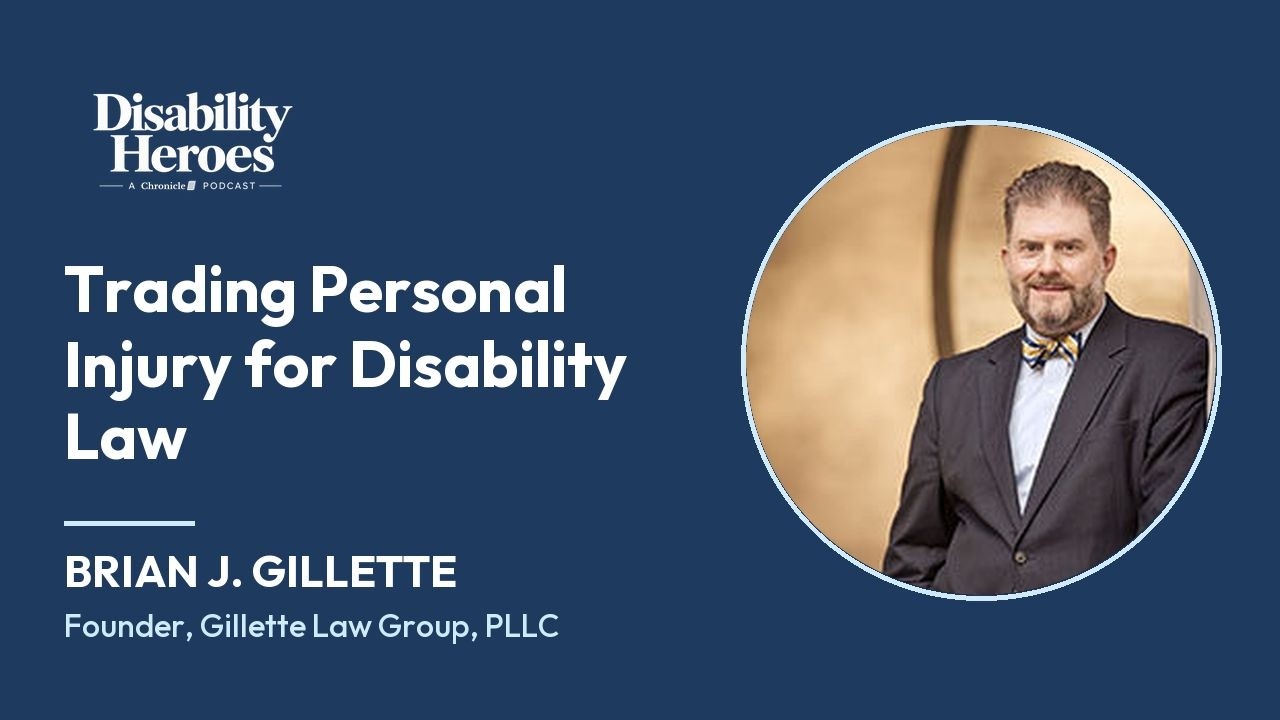
Brian J. Gillette spent his early career in personal injury, where the economics are easier and the cases settle. He traded it for disability work, where clients come back to hug you.
He has spent nineteen years building Gillette Law Group in Williamsburg, Virginia, and he is candid about the trap of being the only technician in your own firm. Recent health challenges have changed how he thinks about succession, and he talks about that openly here.
Brian J. Gillette is founder of Gillette Law Group, PLLC in Williamsburg, Virginia.
In this conversation:
- The Leap: why he traded the easier economics of PI for clients who come back to hug you
- The Only Technician: the trap of being the one person who can do the work
- Hiring for the Mission: who he looks for, and what he stopped screening for
- The Client Experience: what a claimant actually experiences at his firm, start to finish
- The AI Sandbox: what he is testing, and where he thinks the field is going
- Succession: how recent health challenges changed the way he thinks about what comes next
- Lightning round, including the song he plays every time a case does not go his way
"I wanna leave them better off after they've talked to us than before."
"Add the capacity before you have the money."
This conversation was lightly edited for clarity and never for message.
Brian's firm: Gillette Law Group
Read the full transcriptBrian J. Gillette and Will Yang, with timestamps
Brian J. Gillette00:00
I would not recommend somebody go out on their own like I did in take four cases with them. I starved for two years. I lived off of a credit line. And it wasn't easy.
Will Yang00:32
My guest today is Brian Gillette, who left personal injury law to start his own social security disability practice in two thousand seven with just four cases, and has spent nineteen years building Gillette Law Group in Williamsburg, Virginia.
In this conversation, we get into why he traded the easier economics of PI for clients who come back to hug you, how he grew from newspaper ads and the yellow pages to a practice that runs on Google reviews and referrals, and the hardest part of being the only attorney of the firm, protecting time to work on the business instead of just being in it.
We also talk about the AI tools he's testing for hearing briefs and how health recent health challenges have changed the way that he thinks about succession. And stick around for the lightning round where Brian shares the song he plays every time that a case doesn't go his way. Without further ado, Let's go ahead and get into today's episode.
Will Yang01:18
I'm so excited to have Brian Gillette on today's show. Brian, just to kick us off, can you share with us how did you get into disability law?
Brian J. Gillette01:26
Well, for much of my early career I had been doing personal injury, auto accident cases, but I had handled a few Social Security cases because there was a an associate I worked with at a prior firm who started a whole Social Security section at our old firm. And what I found was that the people that I was helping with Social Security were really appreciative and grateful. You know, some of would come in person to thank me, give me a hug, tell me how I'd made a difference. In their life. And so when I started my own firm in two thousand seven, we had the big demographic wave of the baby boomers who were not yet to retirement age, but were starting to get in that plus fifty range where the rules start changing in your favor and where they started developing more health problems. And so I decided instead of trying to go out and compete with all the big PI advertisers on TV, that I would focus on Social Security disability. And that allowed me to start off smaller. Initially it was just me in four cases. And eventually my mom started helping me out. And then eventually I hired my old paralegal part time. And then it's just grown from there. When somebody's applying for disability, they're going thro through a really difficult time and most of the time this is not something somebody anticipated would happen. You know, they've worked hard, they played by the rules, they're raising a family. Their plan is to keep on working, but sometimes life doesn't work out that way. And people are confused, they've never gone through this process before, and I got a lot of satisfaction about helping guide people through this process.
Will Yang03:00
When you were thinking about making that switch over from personal injury, which arguably has easier economics in terms of running a firm, What were some of the other considerations in terms of how you wanted to, you know, continue practicing as an attorney? Because my understanding is your practice not only covers social security, but it also covers the Virginia retirement system.
Which is a little unique than some of the other disability practitioners in your area. So how'd you think about just like the overall area focus for you or did that get extended or added into the practice over the years when you went from like the four cases and scaled it up?
Brian J. Gillette03:31
With PI, I'm sure I would have made a lot more money over my career if I'd stayed in PI. But when you do that, you need a paralegal who knows what they're doing. And you need to have the money available to advance the costs for litigation and auto claims. And I just didn't have that at the time. And so I thought as I looked around at the market I saw There aren't that many people doing Social Security cases. I've got this colleague of mine from a prior firm who can serve as a mentor for me. We've got this agent of the baby boomers, big demographic wave. I'm gonna focus on that and then I'm gonna let all the other people, you know, all the other PI attorneys know, hey, I'm not doing PI anymore, but I'm doing these Social Security cases, and if you don't know what you're doing, you know, send them my way because I know what I'm doing and I can help these folks out.
You that's what I was really thinking about at the time was, you know, how do I get started on my own with limited budget for handling cases and and moving forward. And so I focused on the Social Security. It allowed me to narrow down my marketing to a specific, you know, niche. And that worked out for me. The Virginia retirement system claims are for state municipal workers. It's firefighters, police officers, correctional officers, and it's a plan that they stopped putting people into in the mid-teens. And so over time these cases are going away. But I had a school teacher that I was helping with the Social Security claim and she came in and I said, Well I can help you with Social Security, but I don't know anything about this Virginia retirement system disability. And so I'll help you with Social Security, but I can't help you with that. A couple of weeks later I'm volunteering at a pro bono clinic and she comes in looking for help with a Virginia retirement system disability
Will Yang05:11
Mm-hmm.
Brian J. Gillette05:12
claim. And I'm like, I can't have you wandering around town looking for help with this. I said, look, I don't know anything about this, but I'll take on your case. I'll do the best I can. You pay me what you think is fair at the end. And I took it on. I learned it wasn't that much different than Social Security. Many of the things we do are the same or overlap. There's slightly different standards that I had to learn. But we like them because when someone applies for Virginia Retirement System disability, they're required to apply for Social Security disability as well. So oftentimes it's two claims in one. And so that's sorta how we got into that. But it is an area that over time is going away because they've stopped putting people into that plan.
Will Yang05:51
I think that's interesting there though is it demonstrates how scrappy you were in those earlier years and
Brian J. Gillette05:55
Yeah.
Will Yang05:56
you're also playing to the intuition, right? It it was intuitively coming to you because you didn't want to learn the system, but then you were like, Well, I gotta help this person this moment. So I'm gonna I'm gonna learn the system and and see how it can help. So if you take us back to that early time period, you got four clients. Where did the four clients come from? And then from there, you know, your mom's starting to help you out, you know, how are you getting the word out?
You're in this niche, you're getting some referrals, presumably from your past PI side of things. What were those earliest days like? What were you scared of? What were you excited about?
Brian J. Gillette06:27
So you know, this is two thousand seven and I had f four or five clients that I had at my old firm and when I left they didn't know what to do with them and they just said take them with you So I took those with me, and I wasn't quite sure, where my clients gonna come from. But I started running, this is back in the day when people actually got newspapers delivered to their houses and they got their fingers
Will Yang06:50
you put newspaper ads in?
Brian J. Gillette06:51
they got their fingers dirty from, like, turning the pages of a newspaper. We have a a local newspaper that I put advertisements in. Eventually, I did the larger regional newspaper Yellow Pages ad. So you can see how old I am, because none of this stuff really matters anymore. But I actually started doing T V ads. I think it was January of two thousand nine is when my ads started running.
And TV worked for quite a while. I can't remember exactly when I stopped, but I think it was somewhere around twenty fifteen, twenty sixteen. One of the challenges with television is you get a lot of calls, which means you have a lot of people that are reaching out, raising their hand, looking for help, and you've got to screen those calls and see how many of these people are people you can actually help.
And one of my goals has always been if somebody has the courage to raise their hand and reach out for help, I wanna leave them better off after they've talked to us than than before. And that may not mean we're taking on their case, but help them to understand maybe why we're not taking their case, what what might change that might change our position on that, what they might do to make their case stronger, what might need to happen before they're You know, like if somebody calls up they're still working, well they're if they're making more than substantial gainful activity, that's the end of it. You know, we can't do anything for you. Maybe give us a call if you you know, are thinking you're gonna stop work.
And then also, you know, I became the eventually I became the chair of the Virginia Trial Lawyers, Social Security Law Section. So I'm going to the Virginia Trial Lawyers meetings where I'm meeting other attorneys and letting them know I do Social Security disabilities, so I'm getting referrals from other attorneys. At one point I was sending a mailed monthly newsletter to every client that I had, every referral source that I had. Eventually that got pretty expensive. I mean the the list was in the thousands. And so eventually I scaled that back and then eventually switched the focus of my newsletter to referral sources. So other attorneys, other professionals, other people who come into contact with potential clients earlier on in the situation where they can refer them to us. So right now, besides Google business profiles, you know, one of the things we've always tried to do is take really good care of people and as a result of that we've got a whole lot of nice Google reviews, which I think, you know, people multiple people have said, we read your reviews, they're great. We said you're the one for us and they call us. Right. So I think the Google reviews and the newsletter I send out to referral sources and then past and current clients who refer are our main sources these days.
Will Yang09:26
So you mentioned earlier that you know you quickly got involved with the trial attorney network and you were part of that from the early days. And so what I'm curious about is How did you think to yourself in that moment that you should get involved on that side on the community side in general? Where have you sought and found community when running disability law? And yeah, curious how that community has helped you through the years and in building your practice?
Brian J. Gillette09:50
So my mentor in starting my practice actually started the Social Security law section of the Virginia Trial Lawyers Association. When I was doing personal injury law, I found that it's a really great organization, both in terms of educational programs that they put out and also I think one unique thing that they have done is many times trial lawyers associations just support one political party and ignore the other one, which leads to when there is a shift in who's in control. If you don't have any friends in the new group that's in control, you don't have much voice. But I think the Virginia trial lawyers have done a good job of making friends on both sides of the aisle so that no matter which way the pendulum swings, they have people that they can reach out to when there's issues of concern that legislators can have some impact on.
And so I think that it's a a great organization, really smart people involved in it. And so I've just been happy to be a part of it. We have an email discussion list for the group where we share information with each other. I would say one of the other big ones is the NOSSCR email discussion list. I mean, that's been invaluable over the years. If you knew nothing about Social Security Disability and you just read that list every day, over time you'd have significant increase in your knowledge of what's going on. And what's great is it's like the practical issues that you deal with every day. It's not theoretical. It's like down in the trenches, here's the problem I've got, what can I do about it? Has anybody dealt with this before? You know, Who's dealt with this judge before? Who's dealt with this vocational expert? Who's dealt with this medical expert before? Sharing information and resources about them.
I found it invaluable.
Will Yang11:35
Was that all just intuitively picked up or was it from that mentor of yours that was telling you what worked for their practice? 'Cause you're saying
Brian J. Gillette11:42
Rough.
Will Yang11:42
these things all like, you know, well I just do these things, but actually
Brian J. Gillette11:45
Yeah.
Will Yang11:46
for somebody that's listening that might be starting their own practice, it's not always that intuitive.
Brian J. Gillette11:51
So early on I would say the the influence of my mentor was there with the newspaper ads and the yellow pages and that sort of thing. In the middle there, I had you know, the folks who shot the TV ads, it's a marketing agency that's focused on social security disability practices. And so I worked with them for a number of years. They did my first real website. And then I'm a member of something called Great Legal Marketing.
Ben Glass is a an attorney in Fairfax, Virginia, and he's with his son has this marketing marketing group they run conferences. I'm in his mastermind group. I'm an information gatherer. I do a lot of reading.
Dan Kennedy, Seth Godin, Tim Ferriss. I listen to a lot of podcasts. One thing I've learned over time is to every strength there's a flip side weakness. And every challenge is a flip side opportunity too. But one of the one of the challenges I've had is that I'm an information gatherer, but that doesn't necessarily mean I implement the information that I learn. And you know, I'm the only attorney in my firm. And so started in two thousand seven, it's twenty twenty six, I'm in my nineteenth year, and I've not gotten as far as I would like to. And part of that is if you ever read Michael Gerber's The E Myth Revisited, where he talks about the visionary, the manager. Technician. I'm the only technician in the firm. And that technical work tends to take priority over other things. So he talks about working on your business, not just working in your business. And when you're the only technician, you get sucked into working on the business. And I'm also a recovering perfectionist, right? So I like to have like long uninterrupted time That I can work on something so that I can go over it thoroughly and make sure it's just right so that I know, all right, I thought about this carefully, I went through it thoroughly, we can launch this, right? But maybe one week you have no hearings and you start on a project like that. But then the next week you've got seven hearings. Well, nothing's happening in that week except those seven hearings. And then the next week maybe it's only three, you know, but then a month goes by, like right now.
So I wrote a book, 102-page book. I wrote it in about four days with the help of Claude, which is awesome. But I know I significantly revised three chapters of it and then I got several people to read it and give me some feedback. And now it's July and I haven't gotten back to doing it. You know, and I'm like, I don't even remember did I incorporate those changes? Did I not incorporate those changes? And it's like now, you know, when am I gonna get you know, enough time to sit down and go through this and sort through it. I'm gonna have to it was supposed to be the twenty twenty six edition. I'm gonna have to change it to the twenty twenty seven edition by the time I get around to it. But that's one of my biggest I would say one of my biggest challenges as a firm owner is when I'm the only a technician, the technician role takes priority over the working on the business, which leads to you not making the progress you would have liked to have made.
Will Yang14:52
Yeah, I think that's a really s salient point on that part of working on your business versus in your business. And then also this constant push and pull action that's happening for you as the operator. How do you balance that when you do feel like you're in flow? And then, you know, how did you get to that place over time? Cause I'd imagine there's somebody listening as well who's Thinking about branching down on their own, and that's really exciting because it's this opportunity to do things their own way. And you know, on this side, you've been doing this 19 years now. You've obviously had the l the luxury and freedom to be able to say you've done things your way, but also on the flip side of that, the great point you're bringing up is this balancing act that you're also having to juggle on the back end of that because you have all this freedom and you are ultimately the one that's making some of these decisions. So how have you developed that over time in terms of the taste to determine, hey, like this is the thing I need to work on right now for the business?
Brian J. Gillette15:40
Well, one thing I'd started doing is blocking time. Like every morning from like seven to eleven, I think, I've got Brian's thinking time. And so many times I'll I won't go into the office, I'll go to a coffee shop with my laptop and then, you know, spend that time not thinking about what's the next hearing, what's the next call I got, but hey, what are the projects that I wanna work on? What are the priorities, you know?
Who can I delegate these things to to get it done so that's not waiting on me being the bottleneck in my practice? So, you know, blocking time to work on your business that you honor the same way you'd honor I've got a hearing at that time. Because, you know, that's challenge. Sometimes people block time, but then they're like, you know, all right, now I can have a breather and they don't use that time, they don't respect that time like they would if it was a hearing. I mean if it's a hearing, you're showing up, you're doing the hearing, right? Block the time to work on your practice and honor it the same way you honor if it was a hearing. So that's one of the things I've done, but it's hard, particularly when you only you're the only technician. But you know, I don't know if you ever heard of mind mapping, but I have like mind maps with all sorts of things, right? And sometimes I'll come back to because I wrote another book last year and I actually started it 12 years before, right? But sometimes I'll look at my mind map and I'm like, I actually got that done and I got that done and I got that done. So I think just writing stuff down on paper helps to move things forward.
Will Yang17:12
It helps actualize it, right? You're you're you're setting the intention that you're gonna do it and then
Brian J. Gillette17:13
Right. Right.
Will Yang17:16
you go ahead and do that. That's awesome. On that side of it though, so you're working on the bus business, it's growing as well. How do you tell when it's time to bring on a team member? Because you are still like the main technician as in your own phrase phrasing there, but I'm sure you have some help around as well. Like when did you make the determination that, you know, it was time to to to add help at different points in time over the last nineteen years of running your practice?
Brian J. Gillette17:39
You know, it's been so long now I can't actually remember when I added my my paralegal. She had worked with me at my prior firm and her husband was a state trooper and she wanted to she didn't want to work full time 'cause she wanted to spend some time with her husband that she just didn't want to spend seven days a week with her husband. So we worked out. She worked Monday, Wednesday, Friday for me and had four day weekends every weekend. And that worked for a while but I don't know if I have a hard and fast rule or great wisdom. It's just, you know, when there's more work than you can handle. And that's one of the challenges, particularly with Social Security, where there's such a big lead time between when you take a case on and when it turns into a fee, because I mean it could be 18 months easily between when you take in a case. And so that's one of the challenges of growing a Social Security practice is that oftentimes you you really need to try to add the capacity before you may have the money. For it because you're waiting the time for the case to to you know to go through the process to get paid. So that's been a challenge. But I think one of the best things that I have done is building my team. In the the process I have for you know identifying people who connect with the mission. You know for the folks who work for me it's not just a job, it's not just a paycheck.
You know, they connect with the mission of making a positive impact in in people's lives. Many of them have family members who've had health issues. They've grown up in families where there have been people with disabilities and they get that same kind of satisfaction that I get out of helping people. And so I was very intentional about that. Like, there have been times, you know, the economic cycles come and go and sometimes it's easier and harder to hire people. But I've had recruiting seminars where I bring, you know, like six people in at the same time and I talk to them about who we are, what we do and why we do it. And then, you know, we have quick like three question interviews afterwards where, hey, was there anything you heard today that particularly, you know, stood out to you? And if they say, Well, you know, I live down the street and I need a job and you've got a job, well, that doesn't sound too hot. But if they say You know, when I was growing up, my grandmother had a stroke and she had to move in with us and I saw how she struggled and how the family had to work together to take care of her. And so I know what it's like to, you know, deal with that kind of stress. That's somebody who is gonna understand our clients and have some empathy for them and treat them like a human being and not just a case number or or a hassle, you know? And so I think that's Part of why we've got such good Google reviews. It's mostly it's not talking about me, it's talking about my team. And I think that's one of the things I'm most proud of is the group of people that I've attracted to come work for me to accomplish the mission.
Will Yang20:21
Before we continue, a quick word from our sponsor. This episode is brought to you by Chronicle. If you're running a disability practice, you know the drill. Your team logs into the ERE, checks case after case for updates in hopes that nothing slips through. At a handful of cases, it's manageable, but at hundreds it becomes impossible. Chronicle automates that monitoring. It checks the ERE and eFile daily across your entire caseload.
This surfaces what changes and keeps your team ahead of SSA activity instead of chasing it. More than twenty eight hundred disability professionals are already using it, and you can learn more by checking out chroniclelegal.com. All right, now back to Brian.
Will Yang20:57
Yeah, I love that. I love that X factor too, where it's spiking
Brian J. Gillette20:59
Okay.
Will Yang21:00
on your own personal empathy and then it's extending to how your team shows up too in terms of their connection to the mission. I love that example too that you shared of, you know, how you screen those questions in that hiring process. That was going to be my follow up question was like, what is the tactical thing that you would tell somebody who's trying to index for, you know, high empathy, high EQ in terms of those candidates? Past that.
What are some of the other traits that you would say as you've been growing or you've added people to your team through the years that you think make them, you know, really good at disability? Is it something where, you know, there's high communication or s other respective traits that they are able to carry over into how they are working with your clients or any other traits that come to mind when it comes to building out your team?
Brian J. Gillette21:45
So I think it's a balance of empathy, educator, and someone who can get things done. You know, a lot of folks who reach out to us for help are going through very stressful times, you know, and sometimes they just need somebody to listen to them so that they know they've been heard.
So that's important, but also there's a balance there. If somebody's calling every day and wanting to talk for forty five minutes, we we can't do that 'cause we've got people who need our help and we gotta help them.
Helping to educate people so that they know what it is they can be doing to make their case stronger, what it is they really need to focus on. You know, because I find many times when people raise their hand and reach out to us, they want to list off their diagnosis. But, you know, with very limited exceptions, like Lou Gehrig's disease or something, it's not the diagnosis that gets you approved. And then they want to shift to talking about, well, I've had this surgery and that surgery and this treatment and that treatment, this therapy, that therapy, this medication, that medication. But If all those things are really successful at relieving your symptoms, then you go back to work. Getting them to understand they need to focus on what are the symptoms that you still have despite the treatment that you're getting and how do those symptoms affect your ability to work eight hours a day, five days a week consistently, is really important. And then get things done. I mean, you've you've got to say, listen, Mrs. Jones, I hope that our conversation's been helpful today, but I've got other people that need my help and I really gotta get back to it. But you know, and and so one of the things we've tried to do is anticipate these questions and needs of our clients and to proactively communicate with people at each stage. Of the process and both in writing and videos and text reminders and things like that so that like common questions we started developing little videos that we can send to people so that they can learn a little bit more. This particularly for like prospects calling in with a date last insured you know 10 years ago explaining hey theoretically you've got a claim, but you're gonna have to prove you were disabled before this date last insured. Oftentimes that's difficult because maybe the medical records have disappeared, maybe you're not treating with the doctor you were treating with back then, and you know, this is part of why we're not taking your case. If something changes, or if you just decide to f find somebody else or go on your own, you need to know.
It's not good enough to show them you're disabled today. You gotta show them you were disabled before your date last insured. So we just try to be proactive, anticipate the questions and concerns and needs of our clients and try to educate them in advance so that we maybe cut down on some of the the phone calls and also the what's the status of my case? We try to tell them in advance before they pick up the phone to say what's the status of my case by letting them know.
All along the way, what's going on and what to expect. You know, reconsiderations don't take two weeks. You know, you can expect it's probably gonna be seven months or more before we get a decision. In the meantime, here's what you could be doing to make your case stronger. Things like that. But, getting things done, I mean it's a you know, it's a high volume practice. There's lots of people that need help and lots of people with lots of different problems and being a problem solver, that helps. Knowing what resources exist in the community that you can refer people to, that helps. But I think the main thing is that connection to the mission. It's not just a job, it's not just a paycheck. This person on the other end is a person who's struggling and needs help and needs some understanding and maybe they have some mental health issues that makes them not the most pleasant person to deal with, but don't take it personal.
You know, if they were functioning well they'd go back to work.
I don't want anybody abusing my my staff and we've fired people or fired clients because of that. But also understand, these people are going through some of the roughest times in their lives and some of them have mental health issues and many of them are frustrated and you know, so that's one of the things I screen for too, is how You know, have you dealt with anybody who was upset? How do you deal with that? How do you manage it? I think also, you know, trying to keep your pulse on how's the staff doing? Is anybody getting overwhelmed? Are they about
Will Yang25:59
Mm.
Brian J. Gillette25:59
to, you know, lose their cool? Are they burned out? Do we need to make a
Will Yang26:03
How do you spot that? Like what is the thing that you're looking at from your staff?
Brian J. Gillette26:06
Well since the pandemic that's gotten more challenging for me 'cause I have more clients who work remotely at times. But you know, sometimes I'll ask certain team members, Hey, how are they doing? You know, and she's about to explode. I had no idea. Let me talk to her,
Will Yang26:21
Mm-hmm.
There was two really salient points there that I heard. The first one was that you set boundaries and expectations with your clients, which is not something that everyone always does well, right? And so I think that sounds like it's something that helps your practice stay sane internally. And then on the other side of that was the proactive nature of how you've built up the operation side of your firm. And that's something that we see a lot. It's folks that are on the other side of the spectrum, they're super reactive.
You know, that you're getting in in inundated with calls to their practices. So I'm curious if we can explore that second thread a little bit more. What are what was the process of getting to this proactive state? And what have you found most valuable for, your staff's sanity, your own sanity, and also your clients, well-being. How did you recognize that? Like the proactiveness was actually the key to kind of stopping the cycle where, you're just kind of touching and going on the reactive side of things.
Brian J. Gillette27:13
Well, I think I was lucky that I was thinking about this from the very start. So as
Will Yang27:18
Mm.
Brian J. Gillette27:18
I was creating, you know, like, my merge letters that go out at various stages of the process. I'm thinking, all right, what is my client thinking about now? What is it that they're concerned about? You know, what can I tell them before they have to ask us about it? So it started off with those sort of merge letters that you send to clients along the way over time. You know.
We use software that manage our leads. Part of what we can do with that is send out emails and text messages at certain times in the process. And we've been using that, putting links into other resources, videos, things like that. But you know, I think I was really lucky to be thinking about that from the start because you know, in the past I've worked in firms where people get stressed out, the staff get stressed out, and they see the client as a problem or an annoyance. And I didn't want my firm to be like that. You know, the whole reason we have a a practice and a business is because there's people that need our help. And looking that at them as an annoyance just to me is antithetical to what I want it to be about. You know, these people are struggling, they're scared, they're frustrated, they need help. That's part of what we use, you know, if we have a client who's troublesome We'll say, listen, we're on your team. We're on your side. And, you know, we don't get paid unless we're successful in getting you approved. So we want to do everything we can to work together with you to get you approved. And hey, this isn't a hot potato that you drop in our lap. We work together as a team. You know, we don't know everything that's going on in your life. We don't follow you around with a camera. So there's times where we're going to need your participation. We're going to need your input.
We need information from you. We're gonna need you to fill out some forms and get them back to us. We need to work together as a team. So I think being proactive. We at the start of a claim, we have I can't even remember what we call it, but it's something like client agreement, where we lay out, hey, if you move, give us a call and let us know your new address. If your phone changes, give us a call and let us know your new phone. If you're hospitalized, give us a call and let us know where.
You know, so at the very start we try to set out, hey, this is how you can help us to help you, you know,
Will Yang29:27
Mm-hmm.
Brian J. Gillette29:28
proactively. So I think I was just lucky to be thinking about it from the start because I think once you dive into it and you've got a hundred clients, it's hard to take the time to sit down and think through these things and get it set up.
Will Yang29:40
One of the things that's coming up from this conversation is the The battle that happens when firms are growing their caseload and then people feeling more like a number if they go to one of those larger firms or if it's one of those smaller ones. When you think about, you know, claimants that are coming to you all, what do you tell them in terms of what they're going to experience that's so different than maybe another experience that they've had with a larger firm or, you know, a firm that might not be as in the weeds with them from day one with their case?
Brian J. Gillette30:11
Well, I think we're lucky in that many people who come to us have read our reviews beforehand and so they have an idea of what to expect. But again, you know, hiring those right teammates who have the empathy, who are good at educating people about what to expect, to follow through on the systems we have, to get people the information they need so that they know what to expect, know what they can do to help improve their case. Has been what's worked for us.
Will Yang30:38
Yeah, for sure. I mean, that's one of the things that's coming to mind as I hear you share that is not everyone's thinking about it like like you are, as is what I'd share on being on the other end of that. And the other thing that I'm curious about is I'm sure everything has changed quite a bit the last few years. You mentioned earlier that you were writing a book with the help of Claude, you know, AI is a hot topic and disability and the rest of the world. What are you doing on that end? And also, what have you been doing on like the medical chronology side? I'm curious what other operational improvements you've you've added to your practice through the years.
Brian J. Gillette31:07
So my dream is I find an AI tool that I can take the claim file and give it to it and it spits out a brief that's ready to be sent to the judge. We are not there yet. I think one day we'll get really close to it. I've tried all sorts of things.
The one I'm using the most these days is Thomson Reuters CoCounsel because I feel confident in the security of uploading the claim file in there. And you can run as much through it per month as you'd like for I think I pay 250 bucks a month. The downside is you have to be a bit of a prompt engineer.
There's lot of trial and error, and it's not ideal yet. But it for example, I had a case where I thought a listing might be met for hearing loss. And so I gave it the file and I said, here's the listing for hearing loss. Is there evidence that the requirements of this listing are met? And sure enough, it found me the word recognition scores that I needed. And then the nice thing about this is then I said, All right.
Now, based upon that, write me a brief to the judge, arguing that the requirements of this listing are met with citations to the record. And, it wasn't perfect, but pretty close. So I find that it's flexible. I know what I'm paying
Will Yang32:18
Mm-hmm.
Brian J. Gillette32:19
every month. A couple of months back I had a call with somebody higher up there who seemed interested in maybe helping to develop some prompts because over the time I've been using it they do have a library of prompts that you can select from. But you know, social security disability isn't the area that people develop for first, right?
Will Yang32:35
Mm-hmm.
Brian J. Gillette32:36
but they seemed I said, look, I'm the chair of the Virginia Trial Lawyers Association section. I'm on email discussion lists with Social Security attorneys all over the country. If you do something great, you know, I can tell tell the world about this. And so I think that got their attention and they're they're working on something. But think Nick Coleman at LexMed AI, he's probably got the tool that I would say is in the lead for giving you good quality output, but you do pay each time you use it, although I think he might be willing to work at some sort of flat rate deal for you if you commit to paying every month. But I mean I think he's likely to get the get the closest to something good sooner because he's a social security attorney and he's building this tool and he s knows what we're looking for and he's focusing on that. So I think, in the short run at least, I think he will be in the lead.
But I've used all sorts of AI tools from ChatGPT to Claude to Grok to Notebook LM, Perplexity. I use Perplexity for searching now more than Google because you know you you ask Google something, it gives you pages that might have the answer, although they're doing better now with their little AI overview. But Perplexity'll give you an answer and then it'll give you footnotes where it's getting the information. So I've been using that a lot.
Thinking about canceling the Claude subscription I mean the ChatGPT subscription because I just find Claude superior.
Will Yang33:58
I was gonna say, I was gonna be surprised if you said it the other way right now.
Brian J. Gillette34:01
no, yeah. I mean the chat was the first one I paid for and then Claude I just think is superior. So I've been testing out all sorts of things. The time will come. The time will come, but I don't think we're quite there yet, but I mean that is one of the challenges, particularly, you know, when they changed the rules, twenty seventeen or sometime where they said, you gotta submit everything.
No matter whether you think it's relevant or not. And so the case files ballooned to thousands of pages. That's one of the the biggest challenges is, you know, going through all of that and picking out the good stuff so you can point the judge to it.
Will Yang34:36
Yeah, it sounds like what you're asking yourself as you're exploring these different workflows is is it going to be strong enough to be catered to the specific social security workflow? And then on the other side of that, is the flexibility going to be possible to refine further as well into my desired workflow, like my personal workflow? So like when you're exploring that, something that I'm curious about is, you know, what are the signs that you're looking for? How do you go about testing that? I mean, how have you learned that? You mentioned earlier, you know, it requires some prompt engineering for co-counsel. I know at a past, you know, round table that you joined us in and you mentioned we're attorneys. We're not trying to become prompt attorneys or prompt engineers. And so what I'm curious about is for someone who's listening who doesn't have, as much of maybe the innate curiosity to want to explore some of these AI tools and dabble with them, how can they make the most of their time that they might be hearing about AI from other disability attorneys, but they're not really sure where to start. You know, what what advice would you tell somebody who's still on the the earliest part of adoption when it comes to AI in their practice?
Brian J. Gillette35:39
say try out different things and see how it works for you. I mean this area changes so quickly. I mean in three months there could be tremendous changes in the abilities. You know these tools like Thompson Reuters they want you to sign up for a year. And I did and who knows when my renewal is but it's doing good enough right now that I'm not looking into it. But be careful and consider do I want to sign up for a year?
With this tool when, you know, three months from now I might learn that LexMed's got it nailed and I wanna move to them. But I would encourage folks to just go play in the sandbox and see what things are able to do and talk with others who are using these tools, maybe set up a little group where you share ideas among each other, of prompts at work, things like that. I mean it's the future.
I've been around so long. I got a law school, I had a yellow monitor, I didn't have an email address. Right? But I mean, this is gonna whether you like it or not, it's coming, it's gonna be here, and it would be a good idea to have some at least basic knowledge of what's out there and what's available. And it can make your life a lot easier in some ways.
But I would say one of the biggest challenges I've found with the AI tools is, you know, like If you give it a twelve thousand, you know, a r file with twelve thousand pages of medical records and it gives you back a two hundred page summary with, four hundred footnotes, that doesn't really help. But for example, I had a I had a young lady with really bad scoliosis who had had multiple surgeries when she was a child, and she was in her twenties, I think. And I got the medical records from the children's hospital where she had all these surgeries. And the judge gets them and she's like, Why are you submitting all this stuff? And then I used AI to go through it and say, Find me every surgery, find me every imaging report, blah blah blah, and then summarize it all. And then I laid it out for the judge. This is why I submitted it. She's had four surgeries, she's got Harrington rods, she's got still abnormal curvature. You know, this is why it's relevant, because the judges only have so much time they can spend reviewing a file. And so if you can find the good stuff and show a path to approval and make it easy for that serves your client.
Will Yang37:53
Mm-hmm. We're starting to talk about the future of, you know, disability law as well. So I think there's two threads that I want to pull on here. The first one is you'd mentioned a little bit your dream state of, being able to get a hearing prepped from AI that's pretty much ready to go. Where else do you think the future of disability law is shaping up to look like? What would you describe or what gives you hope or excitement in terms of what you've seen in recent years?
And then the next question I'll explore is gonna be curious to take it back to your practice on the future and like succession planning from your side as well. But let's first focus on the first part, which is just more broadly in the space. Where do you think the space is headed?
Brian J. Gillette38:29
Don't see a lot of younger attorneys getting into this practice area. I know NOSSCR has its next gen group. But I was at the NOSSCR conference in May and looking around and I'm like, where are the young'uns? And I think one of the big challenges these days is that folks getting out of law school oftentimes have hundreds of thousands of dollars in debt. And, Social Security disability isn't the most lucrative practice area, I mean you can make a good living. Top firm in the country, I think, brought in forty four million dollars in fees. So you can make money in this practice area. But folks with two hundred thousand dollars in student loans need to service those loans. I mean if you were I would not recommend somebody go out on their own like I did in take four cases with them. I starved for two years. I lived off of a credit line. And it wasn't easy. I think my guess is that over time this practice area is going to be consumed more by national and regional firms who do a large volume and have systems and handle these practices 'cause, you know, like I said, I'm the chair of the Virginia Trial Lawyer Social Security Law Section. And as I look at our membership and I look around the state, there's really, you know, very few people that are more than about ten years younger than me. And most of them aren't more than five years younger than me and or older. I just don't see younger attorneys coming along behind us. And I think that's gonna lead to more national and regional firms doing this Practice area.
Will Yang39:59
What do you think would change that?
Brian J. Gillette40:06
Raising the fee cap. You know, they'll the last two times they've raised the fee cap, it hasn't kept up with inflation.
That could help.
Will Yang40:13
On the second side of that, curious to explore how are you thinking about the future of your firm and succession planning or or just in general on that side of things.
Brian J. Gillette40:22
So that's an area that has changed for me recently over the last couple of years. I've had some health challenges and I always thought I'm gonna work as long as I possibly can. I don't really want to retire. I could see maybe cutting back to three days a week, but you know, I've got my own firm. I like what I'm doing, I like helping people, I've worked hard to build this firm. Why in the world would I want to retire? What would I do if I retired?
But because of my health challenges, I understand that there might come a time where I don't have a choice. And so I've had to be thinking about that. I'm putting a place you know, worst case scenario, external buy sell, if I became disabled or deceased, here's another attorney who could come in and take over the practice and pay some share of the fees to my estate. But that's kind of a worst case scenario.
I'm trying, I'm still pondering, you know, what is the future? You know, one option is you could cut costs, maximize profits and fade away. Well, I didn't work for nineteen years to build this firm to do that. Another is to find a younger attorney who could grow into taking over from me at some point. And I tried that and it didn't work out.
But I think it's partially mostly my fault. And I think finding that person is challenging. I've found a lot of younger attorneys these days are really risk averse.
You the starting their own practice they want the security of a paycheck every two weeks and I think, you know, I taught at the law school here in Williamsburg a couple of semesters and the law school definitely focuses on big law, big law, big law, big law. And if you can't get a
Will Yang42:01
Mm.
Brian J. Gillette42:01
big law job then government. And they don't really you know, I taught a a class on solo small firm practice because I was trying to teach the class I wish I had when I was in law school.
But I found many of the students, you know, weren't really ready for it, you know.
And I probably wouldn't have been ready for it when I was in law school 'cause I went straight from undergrad to to law school.
But I think there's a lot of a lot of fear and of uncertainty and so I've I think it's gonna be difficult for that route. Another might be to find someone similar to me and merge together.
But I think even with that, I need to find an associate. And ideally, I would like to find an associate who has some experience doing Social Security Disability practice. So I'm not starting from scratch to train somebody up. And then another option is to be taken over by a larger firm or to sell out to some regional, national firm who's interested in gobbling me up. So those are the things I'm thinking about these days.
Will Yang43:02
How did you figure out what each of those potential paths were? And then also which of these paths would you say would be your ideal or top few outcomes for you?
Brian J. Gillette43:11
That's what I'm still thinking about. I mean, it's hard when you've worked for yourself for nineteen years, and you're the one that gets to make the decisions and say who we're working with and who's working with us on the team and where's our office gonna be and what kind of cases are we gonna handle, you know, what's our case selection criteria and how do we want people treated, both teammates and clients.
It's sort of not necessarily scary or but maybe a little unnerving to give up some of that control.
And you know, it's it's kinda like dating, right? And you're trying to find somebody who's gonna be your your life partner, right? And making the right choice and sometimes, you know, you don't you just don't know until you get into the relationship how's this gonna work.
Will Yang44:02
It's also deeply personal, right? It's something that you've worked on this for nineteen years. It's part of your identity. Like it's something we're letting go of that is is gonna be difficult regardless of what the the pathway would be there. So I'm sure it's some level of reconciling with that as well.
Brian J. Gillette44:17
'Cause you know, like I said, I probably would have made more money over my career if I stayed in personal injury but I really see what I do as my vocation, right? And I want to do some good in the world while I'm making a living. And so it's important to me that we respect the human dignity of everybody on the team and everybody that we're working with. And sometimes, you know, in these high volume practices, people become cases in numbers and not people.
And so that's something that's really important to me is that people get treated right. I mean, for one thing, my name's on the firm.
Will Yang44:52
Mm-hmm. And on that thread, I'm curious if somebody is thinking about working with your firm, what do you typically tell them in that moment of like what they're gonna get with you all versus, another larger potential firm or a different firm in the area?
Brian J. Gillette45:05
So that's something I've been doing thinking about too, because you know, When somebody's looking to to join your firm, they've got questions and concerns too. And I think I need to get clearer on, hey, like for example, if I'm looking for an associate who potentially can grow into taking over from me, I think I need to have a clearer plan on what does that look like? You know, what is the timeline here? What is it that you can expect? What's the kind of support you can expect from me? What is it I'm gonna expect from you? And so that's something I'm working on. Get clearer on 'cause I think you're getting clear on what it is you want makes it a lot easier to achieve what it is that you want.
So I'm working on that. But you know.
Will Yang45:47
Kinda takes takes back to the mind mapping, right? It's mind mapping for the succession plan.
Brian J. Gillette45:51
Well, and also, you know, it's an area that I'm I don't you know really have a whole lot of experience with because I've never
Will Yang45:57
Mm-hmm.
Brian J. Gillette45:57
I mean, I've had an associate for about a year, and I think that that failure was due in large part to me not having a clear plan for this is what you can expect, this is my vision for the future, this is how I see you growing here. And so I want to do better with that.
Will Yang46:16
That could be the last chapter in th in terms of the f the firm and the succession plan. It would be a beautiful one.
Brian J. Gillette46:21
Well, you know, I I've got four kids, but none of them are lawyers. So that's not gonna be an option for me. And what I think would be a tragedy is if I had some health problem and I couldn't do it anymore, and then it just everything I've built over nineteen years just sort of crumbles away to nothing. Not just that the value that I created that potentially could be passed on to my family or something goes away, but You know, all the systems, the team, you know, the way the culture that we've created of helping people, if it just sort of went away, I think that'd be a real tragedy.
Will Yang46:57
Yeah. I think it's so profound that, you know, you're you're spending so much intentionality thinking about the the legacy and future of your firm as well. It really speaks to a lot of the earlier threads that we've explored in this conversation, just in terms of how meticulous you are in in like information gathering.
Brian J. Gillette47:14
Ha ha.
Will Yang47:15
You already have like five different potential pathways, I think that you mentioned earlier. And it's just kind of refining that further down. As we start to to wrap up here, I'd love to take us into The lightning round. This one's more so for quicker, quicker kind of pithy takes on on some questions. So the first one to kick us off is curious if there's one case that stands out through all the years that you always think back to when it comes to that moment of, you know, why you do this work and what keeps you going.
Brian J. Gillette47:45
So I remember a hearing with it was in person with a veteran who had had some drug problems. And as at the end of the hearing the judge did inform him that he was gonna get approved. And afterwards outside in the hallway he was giving me a hug and I was thinking, you know, about how sometimes people make choices in their lives that are you know, not healthy and not good for them. And some people will judge them and discard them and say, you know, you made your bed lie in it. And I really like helping people that I know without my help they wouldn't have likely been successful and there would be other people who would just shun them. And I like helping people like that.
I mean, I like helping all sorts of people. I mean, hard working people who never thought they would retire and have families they're caring for. But in particular, you know, somebody who really is faces big challenges both from within their lives but also the way others treat them, gave me a lot of satisfaction.
Will Yang48:53
The next one is what do you do the day that a case doesn't go your way?
Brian J. Gillette48:58
so have you heard the song "Tubthumping" by Chumbawamba?
Will Yang49:02
Mm mm.
Brian J. Gillette49:03
you go play it. It's I get knocked down, but I get up again. Never gonna keep me down. I get knocked down. Yeah, that's yeah,
Will Yang49:06
yeah yeah yeah yeah. Okay. Yeah yeah. I just wanted you to sing it.
Brian J. Gillette49:10
that's the song I that's the song I play when I when I have a bad day, lose a case.
Will Yang49:14
Nice. Is there one particular pet peeve when it comes to ALJ behaviors that you don't like?
Brian J. Gillette49:21
I get really frustrated by judges who have low approval ratings and always seem unhappy and nasty. I don't understand why they treat people that way. And I wish that if they just don't enjoy their jobs so much, that they go find something that's a better fit for them. I mean, sometimes I think, do you have to pay the rent every month?
Do you have to make payroll every two weeks? Do you have to pay for all your health insurance? Do you have to pay the IT guys to fix the computers? Why so unhappy? And if you're so unhappy, do something about it. Change your life. So one day, when I'm ready to retire, I might just say, Why? Why are you so unhappy? Did I do something to upset you?
Will Yang50:01
Good mic drop moment. What is
Brian J. Gillette50:03
Ha ha ha.
Will Yang50:04
what's what's one thing about disability law that you think would surprise a total outsider?
Brian J. Gillette50:12
I think most people are totally ignorant to what it is needs to be proven in a disability claim. And I think some some people think that there's widespread fraud and I think there's some people that just think it's impossible to get approved.
Think it's more complicated than most people think, because most people never think they're gonna need to deal with it. But the statistics are one in four people are gonna become disabled at some point in their life before they reach retirement age.
Will Yang50:41
Good one to leave on. Brian, if anybody wants to get in touch with you, whether it's a fellow practitioner, a potential claimant, what is the best way that they can do so?
Brian J. Gillette50:51
I'd say our website's GilletteLawgroup dot com. We can set up a time to talk. Happy to talk with folks. I love what I'm doing. I like sharing. I have an abundance mentality. You know, I think there's plenty of work out here for all of us. And if I can help you, let me know.
Will Yang51:08
Awesome. I love that. Love this conversation. So many so many gems in terms of the tactical as well as so clear the empathy that you lead your practice with as well. So Brian, thank you so much for the time today.
Brian J. Gillette51:19
It was my pleasure.