
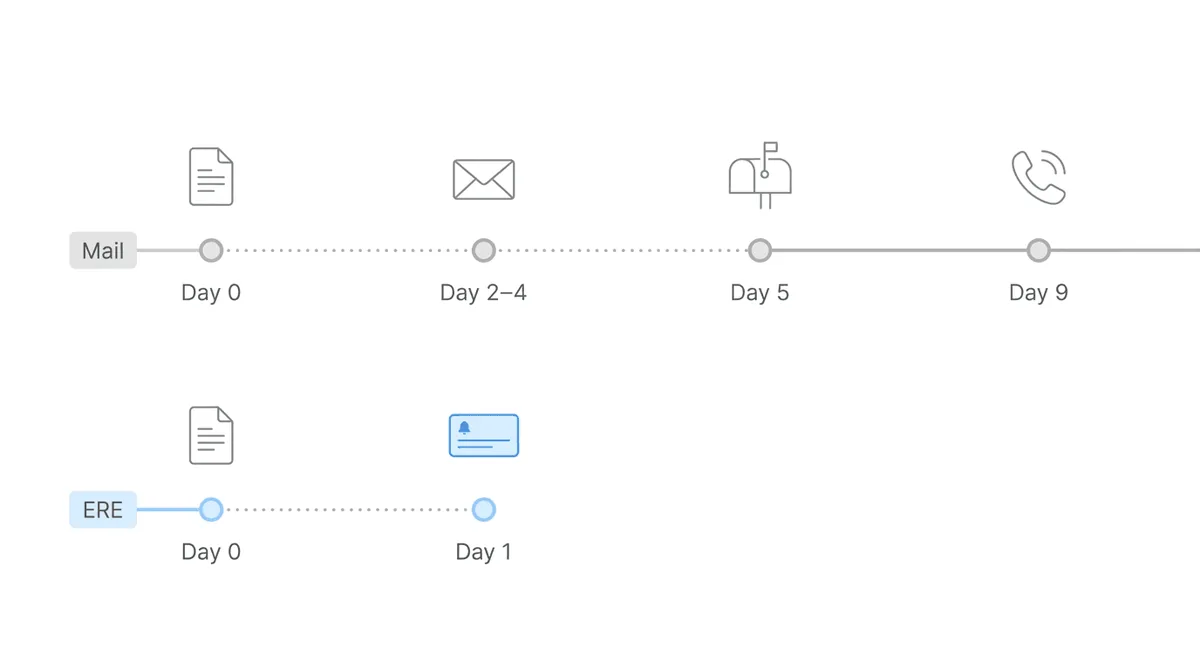
The SSA sends consultative exam appointment notices by physical mail. That is the process, and it has not changed in any meaningful way. What has changed is that the SSA also posts CE notices to the ERE: the Evidence and Case Status portal: the day they are issued. The postal copy follows days later.
Firms that rely on the mail to learn about CE appointments are operating on a delay they cannot see. Mail takes 2-5 days on average. A 20-day response window gets shorter with each day the letter sits in transit, and when the claimant is the one receiving the notice at home rather than the firm, the window narrows further before anyone at the practice even knows an appointment exists.
The better approach is to catch CE notices at the source: the ERE, where they post before the envelope has left the facility. Chronicle’s daily e-file checks surface CE notices the day they appear, giving firms time to confirm the appointment, contact the claimant, and document the action while the window is still open.
What Makes CE Appointment Tracking Different From Other SSA Deadlines
Most SSA deadlines follow a predictable pattern: something happens in the case (a denial, a hearing notice, a questionnaire), the firm receives an alert, and the team acts. CE appointment tracking does not fit that pattern neatly.
CE notices are sent directly to the claimant, not to the representative. The SSA issues the notice through DDS (Disability Determination Services) and mails it to the claimant’s address of record. The representative gets a copy through the ERE, but only if someone is actually checking the e-file for that case. That is the structural gap. A hearing notice arrives through formal representative channels; a CE notice may land in the claimant’s mailbox, get buried with other mail, or arrive at an address that no longer reflects where the claimant lives.
By the time the claimant calls the firm to ask what they should do about the letter they received two weeks ago, the window may already be compromised. The SSA’s CE procedures give DDS staff a follow-up protocol for no-shows, but the trigger is the missed appointment itself. Acting after the fact, at that point, is the wrong position to be in. The goal is to know about the CE notice early enough to be deliberate rather than reactive.
The Mail Delay Problem Nobody Talks About
There is an assumption embedded in how most firms handle SSA correspondence: the mail arrives, someone scans it or logs it, and the workflow begins. That assumption holds reasonably well for most documents. CE notices are a different case.
The appointment is scheduled, the examiner has been engaged, and DDS is expecting to receive a report. If the claimant does not show up without a documented rescheduling request, the case can move toward denial. That is not a recoverable situation if it happens before the firm is even aware there was an appointment, and that scenario is not hypothetical.
Jonathan Heeps of Martin, Jones & Piemonte described a pattern recognizable across firm sizes: “We’d get a 10-day notice on day 9 or a 25-day letter on day 24. That made things a lot more challenging.” CE appointment notices fall into exactly that category. Short-window documents where mail delay directly compresses the time available to act. The automation benchmarks for disability firms puts specific numbers to how much time manual correspondence handling consumes across a typical caseload.
The problem compounds in specific ways. A claimant who moved recently may have a forwarding address that adds several days to delivery. A claimant who does not attend closely to their mail may set the letter aside before thinking to call. And a firm without daily ERE monitoring has no independent visibility into when the CE notice was issued, which means no ability to calculate how much of the window is actually remaining. The firm is not operating on a 20-day window; they are operating on whatever fraction is left after mail and internal processing have consumed their share.
Physical mail dependency leads to late awareness of notices and questionnaires. This is the structural observation, and it applies to CE tracking as directly as anywhere in the SSD workflow. For a broader view of which SSA deadlines carry the most operational risk, the SSA deadlines disability attorneys track reference is a useful companion.
How ERE-Based CE Monitoring Changes the Workflow
Chronicle checks the ERE and e-file daily for each monitored case. When the SSA posts a CE notice to the e-file, Chronicle detects it and surfaces it as a change: the same day it posts.
The workflow that follows is the firm’s to design. What typically happens: Chronicle flags the CE notice as a new document in the e-file; the alert routes to the assigned case manager; the case manager reviews the notice, notes the appointment date and examiner, and contacts the claimant to confirm they received their copy and understand what the appointment is. The appointment date gets logged in the CMS as a hard deadline, not a note. If the claimant needs to reschedule, DDS gets called before the appointment date.
Chronicle is the detection layer in that sequence. It is not a CMS; it monitors the ERE while the firm’s case management system handles task creation and follow-up execution. The contribution Chronicle makes is temporal: the earliest possible awareness that a CE notice exists in the file. For a clear breakdown of how ERE monitoring and case management fit together without overlap, ERE monitoring vs case management software covers the distinction directly.
That timing difference matters more than it sounds. Knowing about a CE appointment 8-10 days before the date is a meaningfully different operational position than learning about it 2-3 days out because the claimant called. One allows for deliberate, documented follow-up. The other is scramble mode, and scramble mode is where documentation tends to fall apart.
Chronicle alerts firms when new SSA correspondence or ERE documents are posted. CE notices fall directly in that category. The daily check frequency is the key variable: it is what converts “we’ll know when the mail arrives” into “we know when the SSA issues the notice,” which is the position you actually want to be in. For firms newer to ERE monitoring, how to automate ERE tracking walks through the broader setup.
What the Virtual Mailroom Adds
ERE monitoring addresses CE notices that post digitally to the e-file. There is a second channel that matters, though, for firms still receiving physical SSA mail.
Al Frevola of The Disability Champions described his firm before Chronicle: “We were a paper-mail driven firm, trying to manage a huge volume of incoming mail. We had to scan everything manually, then distribute it to case managers to process, calendaring deadlines, tasks, and more.” That description is not unusual. Many SSD practices built their entire correspondence workflow around physical mail, and those workflows were never designed with CE deadline risk in mind.
The problem with manual scanning and distribution is that it creates an invisible queue. Documents arrive, get scanned when someone has bandwidth, get routed based on who is at the desk that day, or they don’t get routed at all during a busy stretch. For routine correspondence, the friction is annoying. For CE notices with a narrowing response window, it is something closer to a liability.
Chronicle’s virtual mailroom centralizes SSA mail handling by digitizing and organizing correspondence into a consistent workflow. A CE notice arriving by mail enters the same pipeline as a document detected through the daily ERE check: logged, routed, tracked. In most cases, the ERE posts the notice before the physical copy arrives, so the ERE check catches it first. But when a claimant brings a copy to the office, or when a physical notice arrives before the next ERE check cycle, the virtual mailroom provides the consistent capture point. The outcome is an auditable record: a CE notice was received, when, and what was done about it, which is what matters if any of this is ever reviewed.
Building a CE Tracking System That Holds

A reliable CE tracking system has five components. They do not all need to be implemented simultaneously, but each one closes a different gap.
Detection comes first. Daily ERE monitoring that surfaces CE notices the day they post. Chronicle includes deadline monitoring and alerts to reduce missed tasks in case prep, and CE notices are exactly the document type that requires this level of consistency. Nothing else in the system matters if detection fails.
Routing is what converts detection into action. The CE notice should reach a specific person, not a shared inbox, not a general alerts queue. Alert routing that connects a document type to a responsible case manager is the difference between a notice that gets acted on and a notice that gets lost in review.
Documentation means logging the appointment in the CMS as a hard deadline, with lead-time follow-up tasks attached. Not a sticky note. Not a calendar entry. A tracked deadline that a supervisor can audit.
Confirmation is the claimant contact within 24-48 hours of receiving the notice. Verify they have their copy, understand the appointment details, and know that attendance is required. Document that the conversation happened.
Escalation covers the edge cases: the claimant who cannot be reached, the claimant who needs to reschedule. Manual ERE monitoring fails quietly; it is not the login, it is the lack of an audit trail for what was checked and when. The same logic applies here. The firm needs a record of what was done, when, and by whom, not just a record that the CE notice was received. Firms evaluating which ERE monitoring software provides this kind of automated audit trail can use the comparison to identify what to look for in a solution.
Chronicle is CMS-agnostic; it works with Prevail, any CMS with an API, or no CMS at all. Firms build these workflows around whatever system of record they already use. Chronicle handles detection and routing; the CMS handles execution and documentation. Those are two different jobs, and conflating them tends to create gaps in both. Firms also moving toward a fully digital SSA correspondence process may find going paperless with SSA a useful reference for the broader transition.
FAQ
How does the SSA send CE appointment notices?
The SSA sends CE appointment notices by physical mail to the claimant’s address of record. The notice includes the appointment date, time, location, and name of the examining physician. A copy is also posted to the claimant’s e-file in the ERE, accessible to the appointed representative. Firms with daily ERE monitoring will typically see the notice in the e-file before the postal copy arrives at the claimant’s address.
How long does a disability firm have to respond to a CE notice?
The SSA’s CE notice procedures operate within a 20-day window from issuance. The more actionable question for firms is how many days remain by the time they first become aware of the notice. Mail delays of 2-5 days, plus any time spent in internal scanning and routing, can significantly compress the available period. ERE-based monitoring eliminates that compression by surfacing the notice the day it posts.
What happens if a claimant misses a CE appointment?
If a claimant misses a CE appointment without good cause and without contacting DDS in advance to reschedule, the claim may be denied on grounds of failure to cooperate. DDS has follow-up procedures for no-shows, but those procedures are triggered after the appointment has already been missed. The representative’s role is to ensure the claimant knows about the appointment and, when needed, to facilitate rescheduling before the date arrives.
Can a firm track CE notices through the ERE without monitoring software?
A firm can manually review each case’s e-file for CE notices by logging into the ERE. The practical problem is coverage and consistency: there is no automated alert when a CE notice posts, which means the firm must check proactively at regular intervals or risk missing a notice between cycles. At higher case volumes this is not operationally sustainable. Automated daily monitoring eliminates the dependency on manual check frequency.
What is a virtual mailroom and how does it help with CE tracking?
A virtual mailroom digitizes and routes physical SSA mail through a consistent intake workflow rather than relying on manual scanning and distribution. For CE tracking specifically, this matters when a physical copy of the notice arrives at the firm, or is handed over by a claimant during a call or visit. Chronicle centralizes SSA mail handling by digitizing and organizing correspondence into a consistent workflow, so CE notices captured from physical mail enter the same tracking pipeline as documents detected through daily ERE checks.
How Chronicle Supports CE Appointment Tracking
Chronicle is an SSD ERE monitoring and analysis platform. It automatically checks the SSA’s Evidence and Case Status portal (the ERE) and the e-file for changes across your firm’s cases daily, including CE appointment notices.
For disability firms that currently learn about CE appointments through claimant calls or physical mail, Chronicle provides an earlier detection point. The daily e-file check catches CE notices when they post to the ERE. The virtual mailroom handles the physical mail channel. Together, they address the two primary gaps that manual monitoring leaves open.
Chronicle is not a CMS; it monitors the ERE while your CMS manages tasks and firm execution. Firms using Prevail, Clio, Filevine, MyCase, or any other case management platform can add Chronicle without switching systems. The monitoring layer and the execution layer stay separate, each doing the work it is built to do.
Chronicle supports the full SSD lifecycle: initial, reconsideration, hearing, and post-hearing updates. CE notices appear most often at the initial and reconsideration stages, which is where daily monitoring delivers the most operational value, and where many firms have the least automated visibility into what the SSA is doing. The disability law firm dashboard software guide covers what to look for in a visibility layer that surfaces these early-stage changes without manual effort.
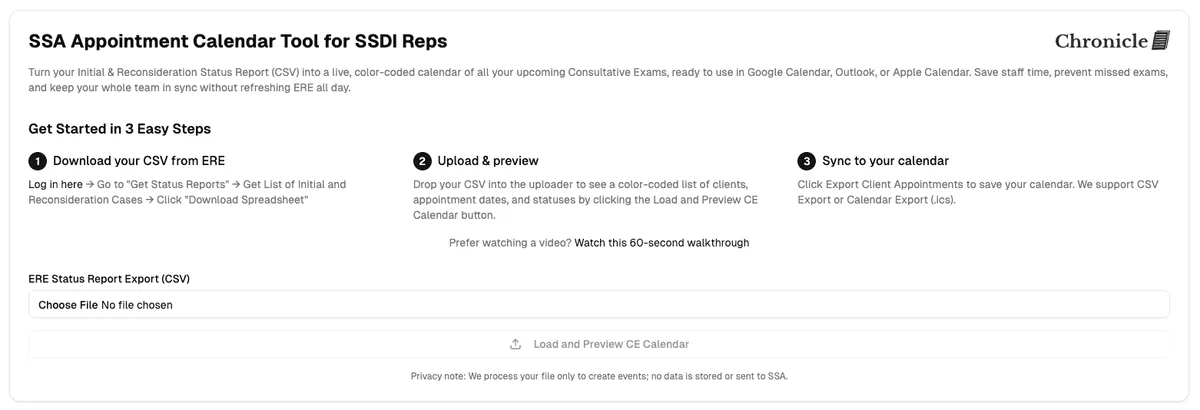
If you’re not yet ready to use Chronicle, you may find value from trying out our free SSA appointment calendar tool.