
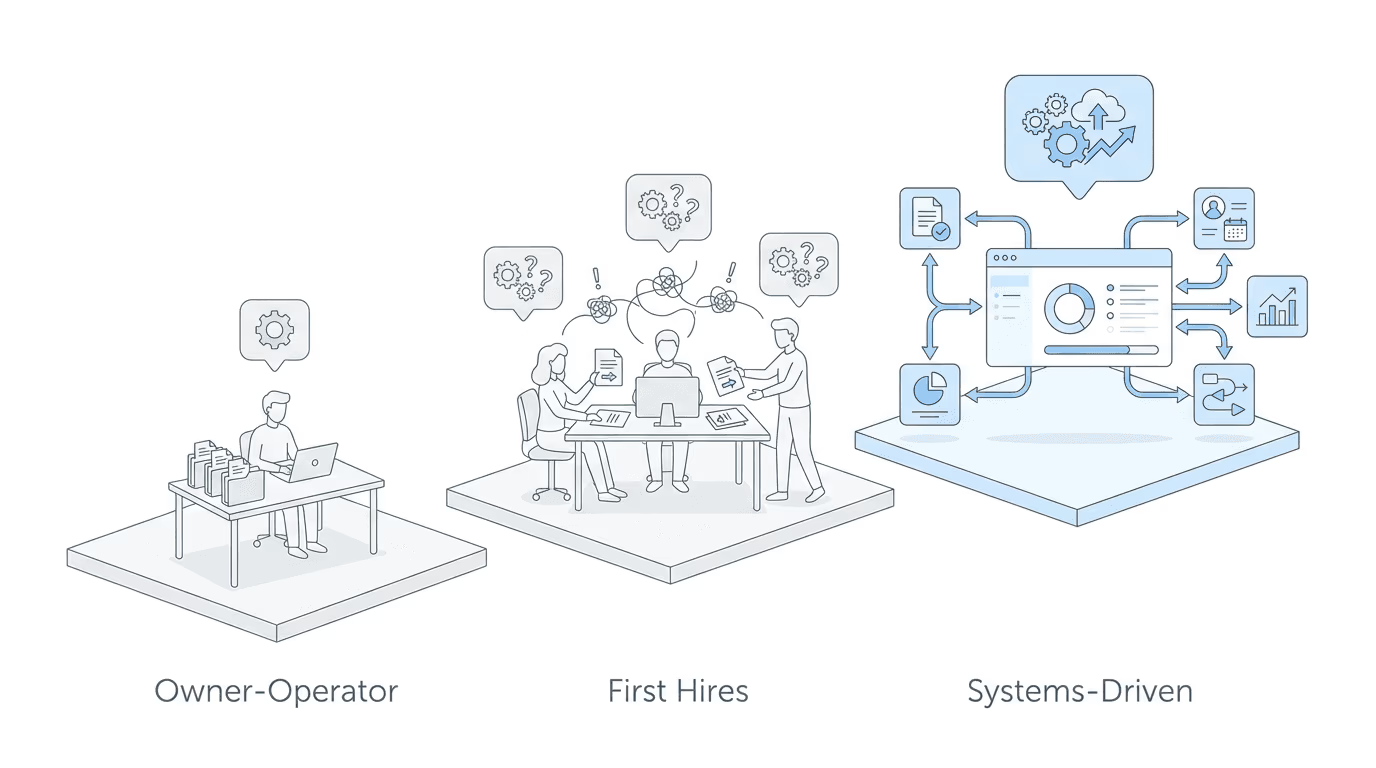
Growing a disability practice means navigating three distinct operational stages: under 150 cases, 150 to 300 cases, and 300 to 600 cases. Each stage has predictable bottlenecks. What worked at the last stage becomes the constraint at the next.
The core insight is straightforward. Below 300 cases, you can grow with people. Above 300, you need systems. The owner-operator model that got you to 150 cases will not get you to 600.
Most law firm growth advice doesn’t apply here. The typical framework uses revenue thresholds ($250K, $500K, $1M) that assume predictable billing cycles, and SSD firms don’t work that way. Contingency fees arrive in irregular waves. Case cycles stretch 18 to 36 months. Revenue tells you what happened months ago, not what’s happening now.
Active caseload tells you what’s actually happening in your operation right now. The firms that grow without breaking understand this and prepare for each transition before it becomes a crisis.
The Growth Stages: What Changes When
Revenue-based growth frameworks assume your income tracks directly with your effort in any given month. SSD economics don’t cooperate. A firm at 200 active cases and a firm at 400 active cases might show similar monthly revenue depending on where cases sit in the pipeline, but their operational realities look nothing alike.
Active caseload is the metric that predicts operational strain. It determines how many ERE logins you need, how many client calls come in, how many deadlines hit each week. How much admin work compounds on itself.
The three stages aren’t arbitrary. They reflect inflection points where the character of the work changes, and firms that ignore them tend to learn the hard way.
Under 150 cases, most firms operate in owner-operator mode. The founding attorney knows every case. Memory-based tracking works. Heroic effort fills the gaps.
Between 150 and 300 cases, firms make their first hires and attempt to delegate. Credential sharing, documentation gaps, communication breakdowns. The firm starts paying the cost of processes that were never written down.
At 300 to 600 cases, adding more people stops solving problems. Coordination overhead cancels out capacity gains. The firm either shifts to full-lifecycle, systems-driven operations or hits a ceiling that hiring alone can’t break through.
Under 150 Cases: The Owner-Operator Model
At this stage, the owner typically knows every client by name. You can remember which cases have hearings coming up. You notice when something feels off because you’re touching every file.
This works. It works because the volume is low enough that nothing critical slips through the cracks for long.
ERE checking is manual but survivable. Three or four logins per day, scanning for changes, taking notes. The Social Security Administration’s ERE portal is where case updates, decisions, and documents appear, and at this volume, a single person can stay on top of it. Client communication happens because you’re the one talking to clients. Deadlines get met because you’re the one watching the calendar.
The danger is that this feels sustainable longer than it actually is.
At Disability Advocates LLC, the managing partner described the inflection point: “It wasn’t as bad at 50 or 75 cases. But once we hit 100-125, it became more and more cumbersome.”
Warning signs you’re hitting the ceiling:
- ERE updates get discovered days late
- Clients call with news you should have told them first
- Weekends disappear into catch-up work
- You start missing items that manual tracking should have caught
The owner-operator model works until it doesn’t, and the transition usually happens faster than expected.
What to protect as you grow: the client relationship quality and case outcome focus that made you successful in the first place. These become harder to maintain at scale, not easier. The goal isn’t to abandon what works but to build systems that preserve it when you’re no longer the one touching every file.
150-300 Cases: Where Delegation Gets Real
The first hire is the most consequential decision a growing firm makes. Most firms get it wrong.
The mistake is hiring to absorb overflow. You’re drowning in admin work, so you hire someone to do admin work. Temporary relief. Not leverage.
Leverage comes from hiring someone who expands what the firm can do, not just how much of the same work gets done. A case manager who can own a segment of the caseload creates leverage. An intake specialist who converts more leads creates leverage. A paralegal who handles all hearing prep frees the attorney to focus on what only an attorney can do.
The ERE delegation problem surfaces immediately. Someone needs access to check cases. That means sharing credentials or setting up separate logins with their own 2FA friction. Staff at Martin, Jones & Piemonte estimated spending “five or six hours per week per paralegal, just checking the ERE.” Multiply that across a growing team and the numbers get uncomfortable fast. This is the stage where ERE monitoring software becomes essential rather than optional.
There’s no audit trail for who checked what and when. If a document was supposed to be caught and wasn’t, finding out what happened requires reconstructing from memory. The more people involved, the harder this reconstruction gets.
Client communication starts breaking at this stage too. Updates rely on whoever happened to check the ERE last. Clients sometimes learn news before the firm does. At Viner Disability Law, the team experienced this directly: “We would receive calls from our clients telling us they’d been approved or denied. That doesn’t look very good professionally.”
Then there’s the documentation gap. “How we do things” exists only in the owner’s head. New hires ask questions that reveal there was never a real process, just a pattern the owner followed intuitively.
Process documentation is unglamorous work, but it unlocks everything else. What happens when a new document appears in the e-file? Who contacts the client after a status change? How do you prioritize which cases to review first? Writing this down takes time. Not writing it down costs more time downstream, every single week.
300-600 Cases: When Hiring Stops Scaling
At some point, hiring more people stops solving problems.
This isn’t intuitive. If one paralegal handles 100 cases and you have 300 cases, three paralegals should handle it. In practice, coordination overhead partially cancels the capacity gain. Three people need to communicate about handoffs, shared cases, and who’s responsible for what. Someone has to manage the team. Meetings multiply. The math looks clean on paper but falls apart in execution.
The Disability Champions experienced this before shifting their approach. The firm was “wasting 80 to 90 man hours a week doing things a machine should handle.” Two full-time positions worth of time, every week, on work that wasn’t advancing cases. Understanding where your firm stands against automation benchmarks for disability firms can help quantify the gap.
Systems-driven means the operation runs on data, dashboards, and workflows rather than individual heroics.
The firm should know case status without asking anyone. When a decision posts to the ERE, everyone who needs to know should find out automatically. When a deadline approaches, the relevant staff should see it without someone remembering to tell them.
Manual processes that scaled to 200 cases become impossible at 400. You can’t check 400 cases by hand and catch everything. You can’t rely on memory for 400 sets of deadlines. You can’t coordinate client communication across 400 matters through email threads and sticky notes. Something will fall through, and at this volume, “something” means real cases with real consequences.
The goal is redirecting staff time to judgment work. Client conversations. Hearing preparation. Case strategy. These require human skill. Data retrieval does not.
The Bottlenecks at Each Stage
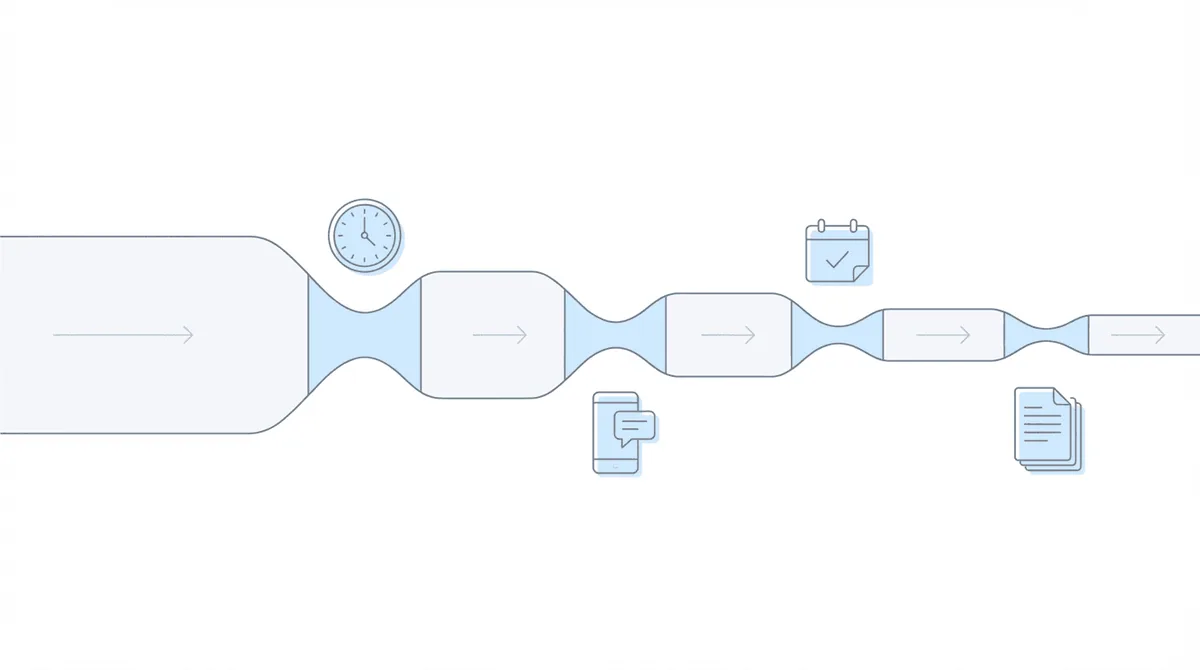
Each growth stage has characteristic failure points. Recognizing them early gives you time to respond before they become crises.
ERE checking time: at 150 cases, manual ERE monitoring takes three to four hours per day across the team. Tedious but possible. At 300 cases, the math stops working. Staff at the Law Office of Nancy L. Cavey estimated each paralegal was spending 15 to 20 hours per week in the ERE. That’s half of a full-time position spent retrieving data that could flow automatically.
Client communication lag: when clients learn about their own cases before the firm does, trust erodes. This happens when ERE checking falls behind or when the person who checked the ERE doesn’t tell the person who talks to the client. The larger the team, the more handoffs, the more places for this to break.
Deadline pressure is a different kind of problem. At Martin, Jones & Piemonte, the team described the mail timing issue: “We’d get a 10-day notice on day 9 or a 25-day letter on day 24. That made things a lot more challenging.” When you’re relying on physical mail for SSA updates, you’re always behind. When you’re relying on manual ERE checks, you’re only as current as the last time someone logged in. For a full breakdown of the deadlines that matter most, see SSA deadlines disability attorneys must track.
Hearing prep capacity compounds all of these. Medical chronologies that took two hours at 100 cases take longer at 300 because files are larger, deadlines are tighter, and there’s less margin. If the same people doing hearing prep are also checking the ERE and fielding client calls, something gives.
The Disability Champions described the mail problem plainly. The firm was “a paper-mail driven firm, trying to manage a huge volume of incoming mail.” Physical mail creates a single point of failure. It can be delayed, lost, or misrouted. By the time it arrives, the deadline clock has already been running in the ERE.
| Stage | ERE Checking | Client Comms | Deadline Risk | Hearing Prep |
|---|---|---|---|---|
| Under 150 | 3-4 hrs/day, survivable | Owner handles directly | Low if attentive | Manageable |
| 150-300 | 5-6 hrs/week per paralegal | Handoff breakdowns | Rising with volume | Stretched |
| 300-600 | Impossible manually | Systems required | High without automation | Needs dedicated staff |
Technology Investments That Actually Enable Growth
The mistake most firms make is investing in technology either too early or too late. Too early, and you’re paying for capacity you don’t need. Too late, and you’ve already burned out staff and damaged client relationships.
Under 150 cases: get your CMS basics right. Templates. Workflows. Some task automation. This is table stakes, not transformation.
150-300 cases: ERE monitoring becomes essential. This is the tipping point where manual checking stops scaling. Chronicle checks the ERE and e-file daily for each monitored case, which means staff stop spending hours on data retrieval and start seeing changes surfaced automatically. Automated ERE document retrieval replaces the manual login-and-download cycle that consumes paralegal time at this stage.
At the Law Office of Nancy L. Cavey, the shift had direct staffing impact: “It has changed the dynamic in our firm, saved us money on the business side because I didn’t have to hire a third paralegal.”
At Viner Disability Law, the math worked out similarly: “Chronicle allows us to essentially take the work of at least another 50% to 75% of a paralegal.”
300+ cases is where you need the full stack. Dashboards that show case status without asking anyone. Integrations that connect ERE monitoring to your CMS so data flows where it needs to go. Chronicle supports the full SSD lifecycle (initial, reconsideration, hearing, post-hearing) and works with whatever CMS you already use.
The compound effect matters here. Technology investments at 200 cases pay dividends at 500 cases. The capacity you build now determines how smoothly you grow later.
Breaking the Bootstrap Cycle
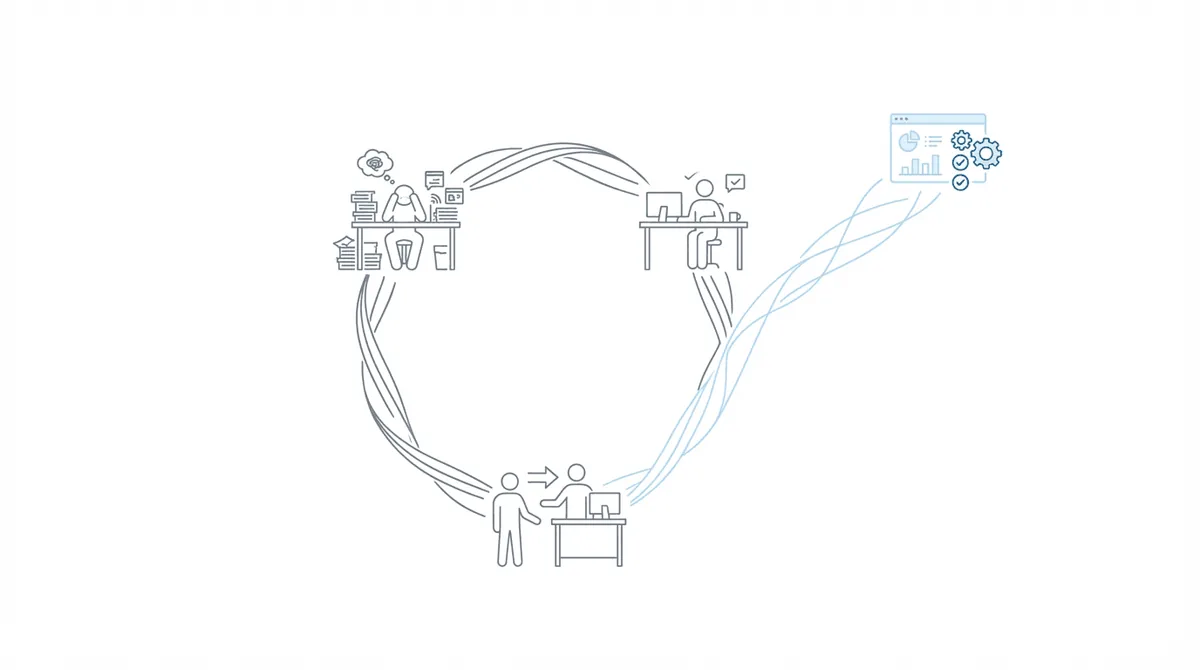
There’s a pattern that traps growing firms.
You do too much work with too few people. Quality suffers or people burn out. You hire someone to relieve the pressure. Things stabilize briefly. Then volume grows again and you’re back where you started.
At Disability Attorney Services, they named it directly: “We’re a bootstrap firm. We do too much, then add people in, then do too much again.”
This cycle feels inevitable. It isn’t.
The alternative is building capacity ahead of demand. Instead of hiring reactively when things break, invest in systems that create capacity without adding headcount. Then grow into that capacity deliberately, rather than scrambling to catch up.
The Disability Champions demonstrated this is achievable. When the current managing partner took over, the firm had 900 active cases. It now handles 3,000 active cases. During that growth, the firm eliminated three positions rather than adding them. Chronicle contributed two-thirds of that staff savings.
This isn’t about avoiding hires entirely. It’s about making hires count. When your systems handle data retrieval, your people can focus on judgment work. One well-supported paralegal creates more value than two paralegals drowning in admin tasks.
The mindset shift: technology is infrastructure, not expense. You don’t ask whether infrastructure costs money. You ask whether it creates capacity that justifies the investment.
What 600+ Cases Actually Looks Like
Firms operating at this scale have a different daily rhythm than smaller practices. The differences are concrete.
Morning status meetings become unnecessary. Dashboards show what happened overnight. Staff know which cases need attention today without someone reading through a list.
Client communication becomes proactive rather than reactive. When a decision posts, the firm can call the client before the SSA mails its official notice. This builds trust. Clients feel informed rather than surprised. That distinction matters more than most firms realize until they experience it.
Case quality doesn’t decline with volume. If anything, consistency improves because the same system applies to every case. Nothing depends on someone remembering to check something.
Staff handle judgment work: talking to clients, preparing for hearings, making strategic decisions. Systems handle data work: monitoring the ERE, routing documents, tracking deadlines.
What remains hard (and always will): hiring the right people, training them well, maintaining the culture that made the firm successful. Systems solve operational problems. They don’t solve people problems.
Your Growth Roadmap
Start by assessing which stage you’re in right now.
If you’re under 150 cases: - Do you know every case well enough to notice when something feels off? - Is ERE checking getting harder to keep up with? - Are you working weekends to catch up on admin work?
If you’re at 150-300 cases: - Are your first hires creating leverage or just absorbing overflow? - Do clients ever learn news about their cases before you do? - Is “how we do things” written down anywhere?
If you’re at 300-600 cases: - Is adding staff actually increasing capacity or just adding coordination overhead? - Can you know case status without asking anyone? - Are you stuck in the bootstrap cycle?
Immediate actions by stage:
Under 150: document your processes before you hire. Decide what you want preserved as you grow.
150-300: evaluate where staff time goes. If hours are disappearing into ERE checking, that’s the constraint to solve first. Consider ERE monitoring that checks cases daily so staff can focus elsewhere.
300+: audit your systems. If data still flows through people instead of dashboards, you’ll hit a ceiling no amount of hiring will break through.
The path from 150 to 600 cases isn’t mysterious. Each stage has predictable bottlenecks, and each transition requires letting go of what worked before. The firms that grow without breaking are the ones that prepare for the next stage before they’re forced into it.
Frequently Asked Questions
How do I grow my disability practice?
The short answer: match your operational model to your caseload stage. Under 150 cases, the owner-operator model works, but it has a shelf life. At 150 to 300 cases, first hires and process documentation become essential. Above 300, systems have to replace individual heroics or you’ll plateau. The bottlenecks are predictable at each stage: ERE checking time, client communication lag, deadline pressure, hearing prep capacity. Technology investments (particularly ERE monitoring) become essential around 150 cases if you want to maintain quality while growing.
What changes when you scale from 200 to 500 cases?
Almost everything operational. At 200 cases, manual processes still work with enough staff effort. At 500, coordination overhead means adding people no longer proportionally increases capacity. The shift requires moving from people-dependent to systems-driven operations. Case status should be visible through dashboards rather than asking around. ERE changes should surface automatically rather than requiring daily manual checks. Staff time should go to judgment work (client conversations, hearing prep) rather than data retrieval. The firms that make this transition smoothly tend to invest in systems before they’re drowning, not after.
How do high-volume disability firms operate?
Very differently from smaller practices. Firms running 600+ cases operate on data and workflows, not individual knowledge. Morning status meetings are unnecessary because dashboards show what happened overnight. Client communication is proactive because ERE monitoring catches changes the same day they post. Staff focus on judgment work while systems handle data retrieval and deadline tracking. The Disability Champions grew from 900 to 3,000 cases while eliminating positions by investing in operational infrastructure. That kind of growth doesn’t happen by hiring proportionally.
When should I invest in ERE monitoring software?
The tipping point is typically 100 to 150 active cases. Below that, manual ERE checking is tedious but survivable. Above it, staff hours spent logging into the ERE compound rapidly. Firms at 150+ cases often report paralegals spending 15 to 20 hours per week on ERE checking alone. ERE monitoring that checks cases daily eliminates this time sink and catches changes faster than manual checking can.
Can I grow my disability practice without hiring proportionally?
Yes, and there’s real evidence for it. The Disability Champions tripled their caseload (900 to 3,000 cases) while reducing staff by three positions. The key is investing in systems that create capacity without adding coordination overhead. ERE monitoring, workflow automation, and CMS integration allow existing staff to handle more cases by eliminating data retrieval work. The firms that avoid proportional hiring treat technology as infrastructure rather than expense.