
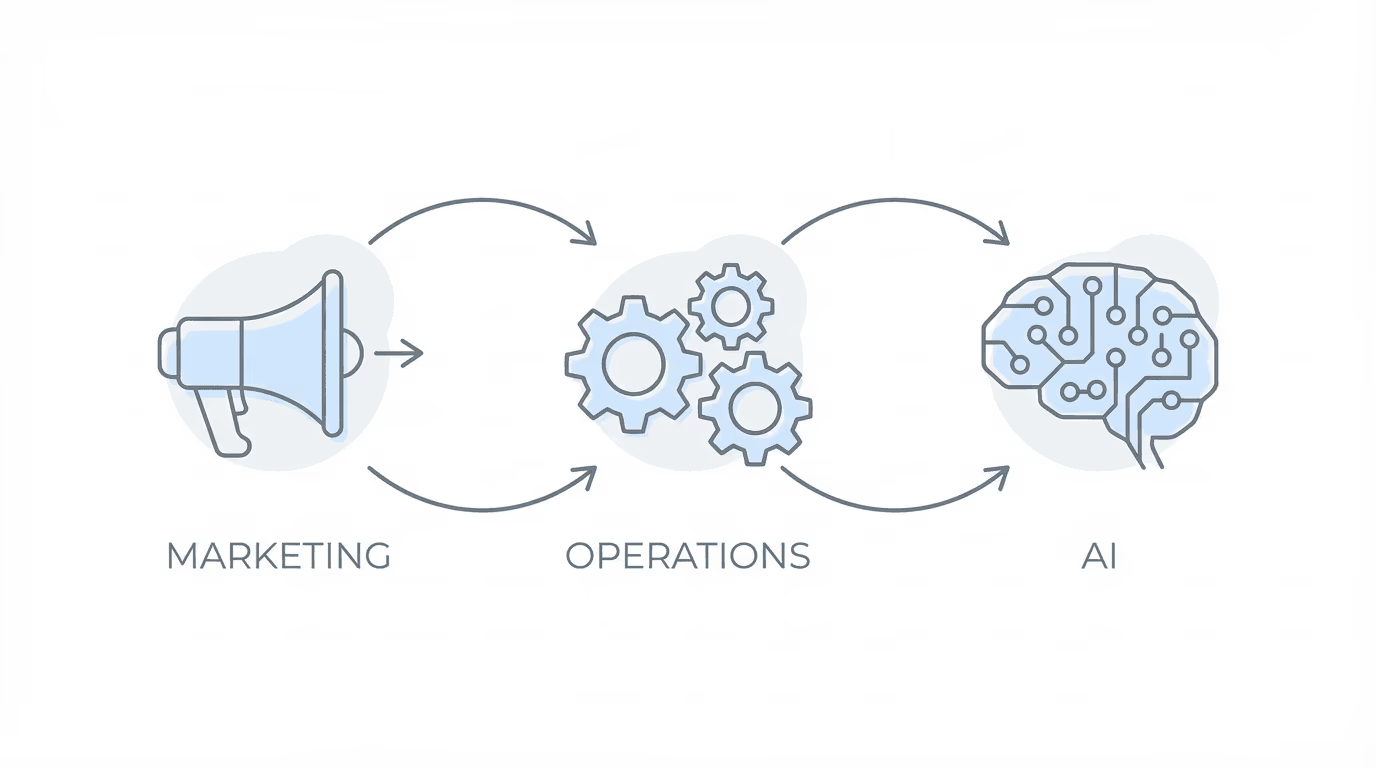
Scaling a disability law firm in 2026 requires removing operational friction, not spending more on marketing or hiring faster. That’s the consensus from the second session in Chronicle’s Advancing Technology in Disability Law series, a January 2026 panel where we brought together partners from across the disability ecosystem to share what’s actually working.
For this session, Chronicle invited two industry partners to join Nikhil Pai on the panel: Rodnie Silva from Ascenda, formerly DL Marketing (marketing and intake strategy), and Luke Connally from Superinsight (AI-powered medical record review). Together, they explored what’s working across disability firms nationwide, what’s quietly stopped producing results, and where leading firms are investing next.
Panelists: - Nikhil Pai, Founder of Chronicle: specializing in case tracking and ERE monitoring - Rodnie Silva, Director of Sales & Services at Ascenda: focused on channel performance and scaling strategy - Luke Connally, Co-Founder of Superinsight: building AI-powered medical record review tools
Key Takeaways
“Firms don’t overspend on marketing; they overspend on marketing their systems can’t support.” — Nikhil Pai, Chronicle
“Scaling breaks when volume outpaces structure.” — Rodnie Silva, Ascenda
“Medical record understanding is the highest-leverage constraint in scaling.” — Luke Connally, Superinsight
The five patterns that emerged:
- More leads don’t fix broken operations. Growth fails when marketing outpaces intake, evidence tracking, and case prep.
- Scale breaks in the gaps, not in headcount. Cases stall while teams wait on visibility, ownership, and timely evidence. The problem is waiting to notice things happened.
- AI’s value is speed to insight, not strategy. AI compresses review time and surfaces signal. It doesn’t replace judgment—it changes where judgment is applied.
- Complexity compounds faster than volume. What works at 500 cases breaks at 1,200. Coordination costs scale exponentially.
- Future-ready workflows feel boring. Intake flows into case prep. Evidence is tracked when it arrives. Staff move cases forward instead of chasing status.
Why Are Disability Firms Seeing Diminishing Marketing Returns?

Marketing channels aren’t failing—firms are spending on marketing their operations can’t support. When intake, evidence tracking, or case prep are brittle, more leads amplify the damage rather than accelerate growth.
What’s breaking
- Legacy channels showing diminishing returns. Linear TV and traditional media buys have lower ROI in many markets due to cord-cutting and streaming migration.
- Marketing evaluated in isolation. Firms still measure cost per lead instead of time-to-decision, staff load, or evidence readiness.
- Lead-only strategies without brand foundation. Buying leads without branded marketing creates short-term volume but long-term fragility.
What’s working instead
- Balanced strategies combining branded marketing with unbranded lead generation
- Marketing spend aligned with operational capacity, not growth ambition
- Viewing marketing as a multiplier of workflow quality, not a standalone lever
Rodnie Silva emphasized tracking cost per case by channel and campaign, not just cost per lead. “You have to look at how that case performs throughout its life cycle, by channel. How many move on to the next stage? What’s the drop-off rate? Certain channels perform better for case managers.”
Where Do Disability Firms Lose the Most Time?

Firms lose the most time between intake, case prep, and filing because of delayed awareness and not lack of effort. Evidence arrives but no one sees it in real time, creating last-minute scrambles that could have been avoided with earlier case status visibility.
The three biggest time drains
- Delayed awareness of ERE postings and medical records. Teams get reactionary. “We got this questionnaire a couple of days late. We now have one day to get it returned to the SSA.” — Nikhil Pai
- Manual record review under compressed deadlines. Case managers spend hours on synthesis that could happen in minutes with AI-powered chronologies.
- Intake stretched too thin. When intake teams also handle admin, reception, and case management, specialization suffers.
The staffing illusion
The question isn’t “Do we need more people?” It’s “Are our people waiting on information or moving cases forward?”
- Overstaffed firms: Teams chase status, duplicate work, fill gaps manually
- Understaffed firms: Miss follow-ups and deadlines despite clear ownership
- The real signal: Flow, not headcount
A simple monthly diagnostic
Pick 10 active cases and trace them end-to-end. Measure how long each stage sat idle. Where cases are “waiting” is your bottleneck. Most firms are shocked by how little time is real work and how much is waiting to notice something happened.
Where Is AI Actually Saving Time in Disability Practices?

AI saves the most time in disability practices where work is repetitive, structured, and already well understood, especially medical record review and chronology building. Tasks that took hours now take minutes.
High-value AI applications
- Medical record summarization. Surface key findings from thousands of pages automatically.
- Chronology building. Extract timelines without manual page-by-page review.
- First-pass appeal briefs. Draft structured arguments based on evidence.
Luke Connally introduced the concept of “speed to insight” over “speed to lead”: “The faster we can get to the meaningful insight of where your client is, the faster we can potentially circumvent the need for a full hearing through on-the-record decisions.”
Where AI should not be used
- Deciding which facts matter most
- Replacing legal judgment or case storytelling
- Setting strategy without human review
As Rodnie Silva put it: “Winning firms are using AI to reduce noise. But it doesn’t replace strategy or the human component.”
For more on how AI and human judgment work together in SSD practice, see why AI can’t replace a Social Security Disability lawyer.
What Do Firms Underestimate About Scaling?
Firms underestimate how quickly complexity compounds. What works at 500 cases breaks at 1,200—not because people are bad, but because systems were never designed for that volume. Coordination costs scale exponentially, not linearly.
Nikhil Pai used an F1 metaphor: “Everyone wants to be Brad Pitt driving the car, but you also need to be the mechanic in the back room, fine-tuning the engine. The firms that scale successfully balance both roles.”
Firms that scale well invest early in:
- Clear ownership at every stage
- Real-time visibility into evidence and deadlines
- Fewer tools doing more integrated work
- Role specialization and process clarity
For operations leaders managing this complexity, Chronicle’s operations management tools provide the firm-wide dashboard visibility these firms need.
How Can Firms Use Technology to Scale Without Adding Staff?
Firms scale without adding staff by using technology as a force multiplier—reducing time on repetitive tasks so the same team can handle more cases. If you can cut record review time in half, you’ve doubled your capacity without hiring.
The key is implementing technology that solves a relevant problem and integrates with existing workflows. Firms with well-structured operations use tech to augment their people, increasing case ratios per specialized role while keeping overhead controlled.
Chronicle is building integrations with Zapier, Litify, and Filevine to help firms automate workflows from ERE data. The ERE provides a live data feed on every case. However, the challenge is connecting it to existing systems.
Frequently Asked Questions
Is branding still valuable, or should firms focus on surgical, targeted marketing?
Branding remains valuable as part of a holistic marketing strategy. Programmatic advertising now allows smarter, more targeted branding that finds relevant audiences in relevant places. Ascenda’s data shows firms that do branding well see it complement their other marketing investments with better conversion and lower cost per case.
How can AI help the intake process without angering leads who don’t want to talk to bots?
AI shouldn’t replace human conversation at intake since that creates a poor client experience. The opportunity is in the paperwork after the call: summarizing conversations, filling out applications, starting medical record retrieval, and validating what clients said. AI handles the administrative burden while humans handle the relationship.
What’s an appropriate cost per client acquired?
It varies by channel. Some channels still produce cases at $200 or less; saturated channels run $300+. The key is looking at total cost per case across all channels, factoring in win rates, average fee, and overhead. Branded channels often have higher acquisition costs but lower client drop-off; it’s worth including in the mix.
How do firms connect case management software to automations based on case status changes?
This is still emerging in the SSD space. The ERE provides live data on every case, but connecting it to CMS workflows requires integrations. Chronicle offers connections via Zapier, Litify, and Filevine, though building the actual automations still requires some technical setup, or hiring contractors who specialize in workflow automation.
What’s the simplest way to identify workflow bottlenecks?
Pick 10 active cases and trace them end-to-end. Document what’s happening at each stage and measure how long each stage sits idle. Also watch for context switches—how often staff jump between cases or workflows in a day. Context switching is time lost in ways most firms don’t track.
Should firms hire more staff or invest in technology first?
Assess what current staff are actually doing before hiring. Watch them for a day or two. If they’re scrambling because they lack awareness of what they could be working on, that’s not a staffing problem—it’s a visibility problem. Fix the information flow first, then staff up on a clean operational foundation.
Watch the Full Recording
This panel occurred on January 22, 2026.
Special Offers for Attendees
- Chronicle: Import 14 cases free to experience live ERE monitoring. Book a demo →
- Ascenda (formerly DL Marketing): Receive free brand guidelines development. Book a call →
- Superinsight: Get $100 off your first month’s subscription. Book a demo →
Upcoming Events
From Intake to Hearing: Connecting Litify (Salesforce) and ChronicleLearn how Chronicle’s real-time SSA ERE data flows directly into Salesforce, eliminating manual data entry and keeping Litify workflows accurate.
📅 February 5, 2026Register now →
Full Transcript
The following is a cleaned and lightly edited transcript of the full panel discussion. DL Marketing, named throughout, has since rebranded as Ascenda.
Will Yang: Hello everyone and welcome to our panel on scaling a disability firm in 2026. What’s working, what’s not, and what’s next. This panel is part of Chronicle’s broader Advancing Technology in Disability Law series, where we bring together operators, marketers, and technologists to help disability firms modernize how they work. Today’s conversation is intentionally framed as an executive roundtable. We are not here to sell tactics in isolation. We’re here to unpack the trade-offs that firms are facing as case volumes grow, costs rise, and expectations around speed and quality collide.
This is the second session and you’ll see more from us in the next few months. Keep an eye out for future installments covering new Chronicle features, automation best practices, and other partner collaborations. Also important to note that you will receive a replay after today’s event. There is no need to worry about missing anything. We’ll be taking questions throughout in the Zoom chat and monitoring them to feed to the speakers at the end of our live discussion.
As a quick introduction from me, I’m Will. I focus on building educational partnerships and collaborations that help disability practices adopt better practices and tools for stronger operational standards. My work centers on bringing together the people and technology that are pushing the disability field forward and making sure that firms have clear practical pathways to how they implement what works.
Before we jump into today’s introductions, let’s go over what you’re going to learn by the end of this panel. We’re going to cover topics such as how to identify which marketing channels remain cost effective, spot bottlenecks in intake, follow-up and conversion, use AI automation to streamline medical record review for case prep, and decide where to allocate your 2026 budget for the highest leverage while also avoiding common mistakes that stall firms in growing their caseloads.
With that, we’re going to do a quick round of introductions and then jump right into the panel. We’re joined today by Nikhil Pai, founder of Chronicle. It’s the platform helping social security disability firms in automating case tracking, managing ERE access, and streamlining their hearing prep. Nikhil has worked with attorneys and advocates across the country to simplify complex workflows in the disability space, monitoring over a hundred thousand cases and 3.7 million disability documents.
We’re also joined by Rodnie Silva, director of sales and service at DL Marketing, where he works closely with disability firms on channel performance, intake efficiency, and scaling responsibly. He’s been in online marketing since 2007, previously helping scale one of the fastest growing digital agencies in the space. And now he’s taken all those experiences and brought a rev ops lens to disability marketing, which allows him to help connect acquisition, staffing, and systems so growth doesn’t outpace operations.
And we have Luke Connally, co-founder of Superinsight, a military veteran whose own recovery exposed how slow and fragmented medical record review can derail access to disability support. After experiencing firsthand how overwhelming medical documentation becomes during injury, he co-founded Superinsight to help disability and injury-focused law firms review records faster, surface what matters sooner, and reduce downstream case friction using AI without sacrificing accuracy or privacy.
Our discussion today is going to move through three themes. We are first going to explore what is working and not in disability marketing. We’ll then transition to talk about operational bottlenecks that quietly kill growth. And then we’ll talk about where AI and case prep is delivering ROI. We’re going to explore some intersections with some lightning round and final questions, and then we will wrap up with Q&A.
As we are exploring the first theme, let’s start with the top of the funnel. Growth conversations usually begin with marketing, but that’s often where assumptions linger the longest. I’m curious for the speakers and their experiences to share—from your vantage point, where do you see firms overspending with diminishing returns? Rodnie, maybe you can kick us off here.
Rodnie Silva: Hey everybody. Thanks for joining. In terms of overspending with diminishing returns, there are some channels that experience fluctuations. Everything is changing. TV is changing. SEO and the digital side of things are changing. So there’s not one medium in particular—it’s really just a question of what we’re seeing in tracking and attribution. It’s one of the biggest challenges: really honing in on what all of your marketing channels and campaigns are producing in terms of return on investment or cost per case.
When you can’t attribute to a particular campaign because of various reasons—some people are tracking with one phone number, multiple campaigns or sources of leads—when you can’t get down to the campaign in particular, that’s where we start to see diminishing returns. So really it’s important to stay on top of that cost per case by source or channel or campaign and adjust accordingly.
There’s always going to be changes with TV. There are changes there with cord cutting, but people are moving into other sources of entertainment. You’ve got CTV, you’ve got streaming, so you can adjust. And that’s always going to happen. Even in the digital space with AI and SEO and paid ads online, all of that’s also changing. But if you’re able to really track down to the source or channel or campaign, then you can make the right decisions to continue to see a good return on investment by source. The key is tracking and attribution, but it is really challenging. There’s a lot that needs to happen and adjust there. But then again, the other part of having success with marketing is how is your intake set up and what does that look like? But I’m sure we’ll dive into that in just a bit here.
Nikhil Pai: Just to build off of Rodnie’s last point there on intake—where we often see firms have diminishing returns on marketing spend is not really thinking through what the rest of the funnel looks like once you take that lead in. Are you able to operationalize it without any surprises and really have a clockwork lead-to-cash process? Because if you’re not doing that, your marketing spend isn’t really compounding in your business. You just have garbage in, garbage out. Your leads aren’t getting handled quickly enough and therefore you’re just spending money where it’s not converting to a retained case.
Will Yang: And when you think about it, Rodnie, you talked about some of the things that you’ve been seeing diminishing, and I’m curious—what do you think are some of those tactics that disability firms still rely on that now are potentially largely outdated?
Rodnie Silva: I think the biggest thing for us, what we find, is not having a holistic approach or strategy. Relying on one source or a particular type of lead or campaign. There are people, for example, that just rely on buying leads from all kinds of lead brokers. There’s inherent risk in that—to just rely on one source. Some people might just stick to old-fashioned stuff like TV or print. Believe it or not, it still works. But again, relying on one particular source to us is the biggest issue.
Really, the holistic approach—having a good blend and balance between branded marketing, whether traditional or digital, and then unbranded lead generation—really just diversifies that risk. You won’t run into a situation where, if you rely solely on just buying leads and there’s issues with compliance or entrance into the market, leads can sometimes all of a sudden not be the same quality. That’s a huge risk. But if you have a nice holistic approach, that typically leads to better success. So yeah, just relying on one source or just a couple is to us really outdated. You need to just have a proper strategy that blends the best and minimizes risk because you are not relying on just one source.
Nikhil Pai: And just think about that quality aspect that Rodnie was talking about. A lot of firms, the metrics they’re tracking are cost per lead or just lead volume. If you really want to get into those quality of leads, you have to really track it through the funnel and have that holistic approach of is this lead source actually converting to retained and won cases, not just “I’m paying a hundred bucks per lead or whatnot.” Because that’s where you just end up throwing money at a lead source that maybe gave you a lot of leads, but the quality just isn’t there.
Will Yang: On that topic of making sure you have a holistic approach, I’m sure there are also beliefs around marketing performance that firms need to let go of. Nikhil, maybe you spoke to some of those around the emphasis of cost per lead, but what else comes to mind? Or what do you all see at DL Marketing, Rodnie, in terms of potential beliefs that you have to work through with your clients—things that people are still stuck on from earlier versions of assessing marketing performance?
Rodnie Silva: It’s just a different way of thinking. Because when you go with a holistic approach, you also got to look at—you can’t stick to just hard cost per case. That cost per case, of course, is critical. That’s to us how we talk, the language we use with our clients. It’s what’s the cost per case per channel, per campaign, et cetera.
But that alone cannot be the metric. You also have to look at how that case performs throughout its life cycle, by channel. So you want to take it further through the SSDI application process—for example, how many of these move on to the next stage or become winners or losers. There’s evidence as well that certain channels perform better in terms of client services or for case managers. There might be lower drop-off or people just disappearing. So you’ve got to look all the way through the funnel really, and the life cycle of that claimant as well, not just what the cost per case is. All of those metrics are important. It takes some smart tech and just reporting and focusing on the right things. But not nitpicking one thing.
Will Yang: Awesome. Thanks so much for those. I know that we have a couple questions coming in. Just to wrap up this first theme, what I’m hearing is that across the board, the issue isn’t necessarily that marketing stopped working—it’s that marketing performance is no longer separable from operations. We’ve heard that some legacy channels are potentially delivering diminishing returns, but more importantly, even good leads collapse in value when intake, follow-up, and evidence readiness can’t keep pace. And then the real takeaway is that firms aren’t necessarily overspending in marketing. They’re overspending on marketing their systems can’t support.
And that leads us to a really good segue, because when the growth starts breaking, it rarely breaks at just the top of the funnel. It starts breaking downstream. Let’s explore the second theme, which is operational bottlenecks that quietly kill growth. I want to shift gears here where the growth doesn’t necessarily fail loudly. It’s more so quietly inside the operations of firms.
To kick us off here, I’d love for us to explore—where do disability firms lose the most time between intake, case prep, and filing? And why does it go unnoticed for so long?
Nikhil Pai: For sure. From our vantage point, the way we always think about it is case awareness. If you’re running tens of cases to thousands of cases at any point in time, your cases may be changing status. It may be moving from the field office to the DDS, from DDS to the OHO. So really staying on top of what’s happening with every case at any point of time is where, honestly, a lot of time is lost.
This is where teams get very reactionary. You often hear the story about, “We got this notice or this questionnaire a couple of days late. We now have one day to actually get it returned to the SSA. We have to call the client. We have to walk them through filling it out. They’re panicked.” And so it’s really this situational awareness across every case where had you just known a couple of days earlier, you wouldn’t be caught on the back foot and really scrambling to make up lost time.
So this is where we really think firms are just losing a lot of time just waiting around, not realizing, “Hey, we could be moving this case forward.” We just didn’t know if we had the case status awareness across all of our cases at any point in time.
Luke Connally: I think to follow up on that—where we hear and see the two main areas consistently with clients who are in this space is obviously going to be the intake side of it and the case review side of it. That’s where a majority of time goes into the process. And if it’s not done well upfront, then it impacts the middle. And if the middle’s not done well and prepared for, then it obviously impacts the outcome.
And with the increasing volume of case sizes in the process and the length of time that goes through between intake and hearing, there’s sometimes a need—and you’ll hear this theme throughout this conversation, I think—we’ll go back and forth to the idea of context switching. That’s going to continually be an issue as you’re serving one client to the next and then moving from one phase of that process operationally constantly back and forth. So yeah, those things have to get ironed out. You have to have a really quality solution upfront as well as in the middle to have a better outcome for the end client ultimately, which is the goal.
Rodnie Silva: Yeah, I agree with all of that. One of the things that we see is a lack of specialization on the support side of things. Whether it’s intake—ideally you want to have that to be its own team that’s completely separate from other teams or departments, and maybe even get as granular as having maybe a pre-intake person who does all the chasing, and then another person that completes the intake and does the initial application.
But then throughout the entire operation, having highly specialized roles and tools are critical to minimize that time to prep and to get all the work done. That’s to us just having highly specialized roles at every step, from intake all the way to attorney fee collection. Having just dedicated people to all of that will streamline the work and minimize the time lost.
Will Yang: When it comes to making sure there’s enough specialization within your firms, I’m curious with all the different firms that you all work with—what are some signs that firms can use to assess whether or not they are overstaffed or understaffed, or just some general benchmarks or ways that you’ve seen people think about this problem?
Nikhil Pai: I think understaffed is probably the easier one to assess. You guys are all probably there where everyone’s scrambling, that you always feel like there’s too much work, deadlines are being missed. But I think before you go to the immediate jump, which a lot of times is “we just need more people,” it’s really important to actually assess what are those people doing. Really watch them closely for a day or two and just understand where is time being lost? How much of it is, to my previous point, just lack of awareness that they could be doing work and so they’re scrambling, they’re always scrambling, they can’t get ahead of things.
And that way, when you are starting to staff up, you’re really building a clean operational system. Specialization is very important, but you want to make sure you’re not adding additional complexity where you’re just compounding the existing problems.
As you staff up and if you’re questioning whether you’re overstaffing, I think that’s where you need to really watch your team. Just make sure that they are actually being proactive, have the ability to actually get things done in a timely manner rather than “I’m sitting around all day and suddenly it’s 9 a.m. on a Friday and plenty pieces of mail just came in and now I’m scrambling to get everything done and I have to work through the weekend.” They’re going to complain that they feel like they’re overworked, but really there was a lot of time prior where they could have been doing things—they just didn’t have the information. And so that’s not really a staffing problem. It’s an awareness problem of what they could be working on.
Luke Connally: I think there’s a couple of different ways to look at this, of course. Pre-AI, we see a lot more of the problem being understaffing, for sure. And that’s most of what I see—when I see where there’s issues, understaffing is typically one of the key things. But now we are starting to see—and like it, love it, hate it, however you want to look at it—at some point we have to face it. When we have staffing and we’re looking at now how can we multiply efficiency, AI becomes one of those force multipliers that then also causes us to have to ask the question, “Are we now overstaffed?” And that can be an ugly aspect of it as well. That’s going to depend on the scenario, of course.
But operational efficiency is something that we now are trying to understand—how we can leverage one person and take them further in that role. So it’s definitely an interesting conversation to begin to deal with as we unpack it.
Rodnie Silva: Yeah, for sure. Efficiency is key. You can’t just add people because you feel you need to add more people. You’ve got to get really granular with it. And look at, aside from titles and headcount, you want to look at really the unit economics and the throughput per role. Really, you want to know how many cases should each specialization be handling and how does this relate to your OPEX or operational expenditures per case.
You obviously know what your average return is going to be per case won. If you factor in the winners, the losers, all of it, it’s probably going to be between $2,400 to $4,000 on average, especially if you’re in a scaling state. These are just numbers to use that can help you really understand if you’re on the right path. And you want to get those ratios up in terms of how many cases per specialization, and you want to eliminate, make sure that people aren’t doing repetitive things. That’s where tech can come in and really help them.
But you want to just again drive up that ratio of cases per role and making sure that they’re moving the cases along. So it’s not about people, it’s about how many cases are you moving forward per full-time equivalent compared to your financial goals—per case, what you want to keep that cost at, operational expenditures at.
When you have a person—like for example, we see this all the time where there’s a case manager or a paralegal who’s doing multiple roles—then the whole formula is just out of whack. So you really got to examine this very carefully and try to define these business drivers or financial drivers beforehand, so that you know exactly what the ratio should be per specialization. Because again, efficiency is the key. But tech is a big part of the equation here to help you achieve that.
Will Yang: Now on that topic of identifying those drivers, to wrap up this section, I’m curious if we can do a rapid fire across the three panelists. Is there a simple monthly diagnostic that would help catch some of these workflow failures earlier?
Nikhil Pai: I think for sure just pick 10 cases, pick 10 active cases and trace them end to end. Just really watch them, document what’s happening. And there are clearly things that will pop out to you—where you’re waiting around for something to happen or you’re scrambling.
Something I do want to point out that is something probably a diagnostic people aren’t thinking about as much is—for that person who’s working that case, how many context switches are they making in any given time? I think that’s really where you lose a lot. And that, whether you’re a solo practitioner, which means you’re switching workflows—you’re going from running a brief to doing a metachronology—that’s a context switch. And that really compounds when you do too many in a given day. You probably know that feeling.
Or if you’re a larger team and you have one person who’s handling metachronologies, but because of deadlines, you need to quickly switch between cases. So watch them and also watch out for those context switches, because those are actually time lost in a way you’re not really thinking about.
Luke Connally: I don’t have a whole lot to add on that. I think everybody is probably keenly aware of where their bottlenecks exist. And so the time it takes to accomplish those tasks—especially, I sit mostly in the middle of the conversation from an operational standpoint. So where we see most of the time saved would be on the case prep file review side of it. And how much time, measure of time is always going to be a factor. How much time does it take to get through one case? How many more clients do we need to get to? How many more clients can we help? Those are all factors that are measurable from the standpoint of time.
Rodnie Silva: Yeah, just to build on what the guys here mentioned. This is definitely a system—starting from marketing all the way until final decision. And so you really got to implement some of those lean practices. Not to get super techie with it like Six Sigma or anything like that. But you definitely want to be able to see what’s going on, and sometimes just sitting there, like Nikhil mentioned, and just observing how long each step takes, and you’ll start to surface some of those issues.
But we recommend embedding a reminder system inside of your case management system, and it should be backed by monthly stage-based reports. It’s important to have both your CRM and case management system tracking all these metrics—whether it’s conversion on the marketing side of things, but also tasks completed along with how much time the case is at each stage. And when you can see where they’re stuck and which checklist, which tasks, which items are open and for how long, then workflow problems become obvious.
So it’s really important to keep, aside from that, an eye on things such as your win rate, how many cases are lost due to client drop-off, case attrition, and keep a log of any critical errors that might’ve been missed by your staff. But over time, when you spend some time on it, observe it, pick one, do a spot test or QA check on, but also have a way of capturing this with data, this will definitely start to reveal patterns that will help you fix bottlenecks.
Will Yang: I love you bringing all that rev ops knowledge in the context of the reporting, Rodnie. So to wrap up this section, some patterns that I’m hearing that are emerging—what slows firms down isn’t necessarily effort or even headcount. It’s the waiting. Waiting to see evidence, waiting to notice deadlines, or waiting for context to surface.
We also talked about teams chasing status, duplicating work, and confusing busy with forward progress. And by the time that firms feel the pain, the cost is actually already baked in. And then the through line is visibility. When firms can’t see what matters early, everything else downstream becomes reactive and expensive.
This teases up perfectly for us to then transition into the AI part of the conversation, because AI not only can help us create leverage if it shows firms the right information sooner, but also help in alleviating some of the chaos. So as we start talking about AI, not as a headline, but more so as a tool that firms are actively betting on in 2026—my first question is, where is AI meaningfully saving time today in disability practices, and where are potentially expectations still outpacing reality?
Luke Connally: Yeah, so obviously a big area of AI use is always going to be when you deal with a large corpus of information and knowledge. So whether it’s navigating a knowledge base or whether it’s dealing with the organization, chronologizing, or breakdown of and extracting medical information—which is where most of the folks on this call are going to be dealing with the need for something like that—for sure, that’s where we see AI have a highly meaningful impact.
Being able to—what we have coined the idea of, instead of “speed to lead” from a lead generation standpoint, we try to get to a place where we’re at “speed to insight.” So the faster we can get to the meaningful insight of where your client is, the faster we can even maybe even circumvent the need for going all the way to hearing. Maybe we can increase the OTR and maximize that side of it to where we’re getting favorable decisions earlier in the process even.
So that’s ultimately—if we’re going to be able to help more people, and that’s what everybody on this call signed up for, and we’re going to be able to do that in a meaningful way—we do have to start to look at how we can scale that. And AI has proven itself to be an excellent tool for that process. Still definitely needs guardrails, still definitely needs continued tuning, and that’s a continuous process improvement in and of itself. But that’s where we definitely see a meaningful impact, and that’s something that is fun to be a part of, honestly.
Nikhil Pai: Yeah, for sure. Where we’re kind of seeing on the Chronicle side is where practitioners really know what work is being done. It’s very repetitive and structured well. So repeatable processes—whether it’s chronologies, appeals briefs—these things are known quantities. And really the goal of AI then is get that first pass done and really bring it to the attorney so they can start seeing, “OK, from this, what can we do with it? How do we add that extra thing that’s going to win the case?”
So it’s really saving attorney’s time in pinpointing, to Luke’s point, insights—things that will actually move the case forward in a meaningful way rather than having to do that initial leg work of just sifting through thousands and thousands of pages of evidence.
Rodnie Silva: Yeah, I concur. It’s definitely, I think, having an impact where firms have typically relied on manual review—anything that’s repetitive or memory. So yeah, things like medical record summarizations, ERE, document organization, training. There’s a lot of great uses for it.
But what we see as an issue here, and just as a word of caution, is of course you’ve got to be careful of not going overboard with a bunch of tools and not having a clear vision and plan on how to implement it. And how does that really integrate with your other systems? But then also, how are you ensuring that it’s really backed by the right people?
So you got to have an optimized operation of people, processes, and systems, and then a plan of how to implement these tools correctly and balancing and complementing one another. Everything should really be working in harmony. I hate to keep using the word, but this also is a holistic approach on the operational side, not just the marketing side. Yeah, because you got to be careful with things—there’s so many little areas that you got to really just have a trained eye working with tech like this, and then it can be a home run for you.
Will Yang: Speaking of the trained eye, it leads us to our next question, which is—what pieces of information actually matter most in disability cases and how should firms be thinking about prioritizing them? Luke, you probably see the most on this side. Maybe you can lead us off here.
Luke Connally: Yeah, so obviously building chronologies—or medical summaries using AIs—is almost like the discussion of last year. And what we see moving forward is really being able to, in a much more meaningful way, develop out what are the actual things that matter on top of that.
Being able to review a chronology is great. We’re getting to a place where—a very scary place where sometimes we trust that chronology more than needing to verify where it’s coming from. That is a scary thought, sometimes. But we’re moving into a much more accurate place of information being able to be pulled and extracted.
So now the conversation moves to, well, why can’t we just quickly do the analysis where we look at from an SSA standpoint, where those RFCs meet the job work requirements and go straight to the step five in an analysis using the most current regs that SSA has put out and what that process looks like.
And so that’s something—not just trying to bring listings to the front so we can cut the hearing process off and get straight to the on-the-record review. But also, if we’re going to have to go to hearing, let’s make sure that we’re able to bring that knowledge that we have to take with us to hearing where we’re going to be challenged at the hearing from a job employment standpoint and vocational standpoint. Let’s have the ammunition we need to win that case and to do business right in that sense. So that’s where I’m seeing it move and we’re moving with it. So that’s an exciting place to be.
Nikhil Pai: Yeah, for sure. Kind of build on that then—relevance and clarity is definitely some of the most important things you want to see out of your AI outputs. We’ve all seen some companies that give you a thousand page medical record and condense it to a hundred pages, which isn’t that helpful.
And so you really want an AI system that can, to Luke’s point, pinpoint the key information so that way you can make decisions. You don’t want to invert that where the AI is making decisions for you. That’s where you guys really add value and gain time—by making sure your AI system is really servicing those key points, like what are the pieces of evidence backing up that listing and so on. So that way you can really pinpoint and take it to the next level.
Will Yang: So on that thread of pinpointing, I’m curious—where does AI potentially stop being helpful? And then the human judgment is absolutely critical.
Luke Connally: Well, I think human judgment is always going to be necessary in the last mile aspect of it. That could change in 10 years. I don’t know. I’m not here to make that determination. But today, I think you’re still going to need a human in that process of verifying the information is accurate and correct, and then moving forward with that proper analysis of how we use that information to win the case.
Because you’re still going to have to—last time I checked, you guys are still going into the hearing and it’s not some AI stepping in for you. So we’re still in that place, and that’s still where we have to have the advocate with the tools they need and the information they need at that time to argue those points. Hopefully that doesn’t change for you guys anytime soon, but who knows what’s going to happen in the next decade.
Rodnie Silva: No, yeah, I was just going to second everything that the guys were talking about. Really, it’s just about surfacing the information that impacts approvals—the things that everybody here knows, medical eligibility, vocational limitations, et cetera. But yeah, it’s still important to use the trained eye or human judgment for auditing and correctness, prioritization. And winning firms are using AI to reduce noise. But it doesn’t replace strategy or the human component.
Will Yang: Awesome. So as we start wrapping up this AI section, to take a moment and zoom out for a moment—what we’ve heard is that AI is most valuable when the work is repetitive, structured, and already well understood, especially when it comes to medical record review and synthesis. But ultimately AI isn’t replacing judgment. It’s changing where the judgment is applied.
And the firms that are benefiting aren’t necessarily “using AI.” They’re the ones that are knowing exactly where AI stops and humans need to step in. And then when AI is giving earlier clarity, firms are able to better prepare for their cases, avoid weak investments, and reduce downstream repetitive work. And when it’s misapplied, it just makes bad workflows faster.
So that brings us to the bigger question of how all this plays out when firms try to scale. So we’re going to go into a lightning round. Let’s wrap up with some questions that span across all the themes that we’ve talked about today.
To kick us off, I think the first question that comes to mind is—what do firms underestimate about scaling their practice? Rodnie, maybe you can kick us off here.
Rodnie Silva: Yeah, it’s a classic management issue, which is that as you start to add more people, and in this case, people and cases, the complexity just grows exponentially. And so what worked at 500 cases breaks down at 1,200 cases. 1,200, 5,000—that’s really something that needs to be anticipated. It’s normal.
And so you have to go to the drawing board, so to speak, and make sure you design systems for that scale. So you really want to look ahead and anticipate that and build the systems that you think will help you address that complexity. And then just, you’ve got to really try to implement some of these formulas and lean management principles—to have your financial drivers down, business drivers down, be able to measure and see everything.
If you want to, of course, scale responsibly and make sure you can handle all your cases and then also still make a living out of it, you really gotta look at things at that level of granularity, really.
Nikhil Pai: Yeah, just to give my take on that—when you’re scaling a firm, this might be a bit of a strange metaphor. You’re an F1 team. If you guys watched the F1 movie recently, everyone thinks they’re Brad Pitt. They just want to be the driver focused on getting all the latest information, getting really good at that aspect.
You need your mechanic also. You need to have that hat on where you’re really thinking about operations and how you fine tune that engine and what data you’re putting into your optimizations—whether it’s from the ERE, it’s from the mail, it’s from your reporting dashboards, you need to make sure you have full insight.
So as much as you want to be the best Brad Pitt F1 driver, make sure you’re also—I think it’s Jürgen Klopp who is the mechanic in the movie—and really thinking about what changes can I be making? What can I be tweaking to make sure that my machine is running as smoothly as possible?
Or you might have to hire someone who has that mindset. There’s no shame in that where you want to be really good at the hearing and in front of the judge. You need that mechanic in the back room, making sure that your firm’s growing and scaling properly.
Will Yang: Yeah, I really can’t argue with that F1 reference. Nice. I like it. And another question that I have is, how do you see firms using technology to scale without simply adding more staff? What does a more efficient or future-ready workflow look like for disability firms?
Luke Connally: Yeah, I think one of the big things that we talked about is when obviously one person—maybe a solo practitioner, maybe a small firm—you have so much limitation or so much time in the day to review files. And then so we can all do math. If we can reduce that time by half, well, now we just doubled our ability to help clients as one person.
In terms of AI being a force multiplier, that’s the way we see it being applied in firms. And I think that allows them to do more with the same volume of workers or themselves even. So I’m happy to see people being able to operate in that way. Because I think that’s ultimately—that’s the aim. That’s what we’re all going for.
Rodnie Silva: Yeah, I think what we see is that for teams that have a well-structured operations—people, processes, and systems—and they have their financials down, they know what the limit of their overhead per case is, then they implement technology that actually solves a relevant problem and they implement it correctly.
And so they use that technology to augment their people, to increase maybe ratios or case ratios per specialized role. But it’s, again, them working in harmony with existing operations and people.
Nikhil Pai: Yeah, very similar from my side where it’s just making sure that your systems give you enough situational awareness, whether it’s about the case or the workflow or what your folks are working on in terms of reporting. So that way you can leverage these other tools like AI and client communications. If you don’t have the insight on what’s going on, you can’t really know if your tools are working and saving you time.
Will Yang: Awesome. With that, we’ve got some audience questions that I want to make sure we’re starting to tackle through. In the case where we aren’t able to get to your question today, we’re going to try to have the panelists follow up as well via email.
The first question we’ve got from Michael Sullivan is—do you still value branding and continuous presence-of-mind spots? Think sheer volume of spots, or do you prefer a more surgical and granular approach when it comes to marketing?
Rodnie Silva: Yeah, I think there’s really cool tools nowadays. They’ve been around for a while in the digital space, but I think firms in the SSD world, some of the more forward thinking, are starting to utilize these tools. You’ve got programmatic advertising, so you can still do branding, but there’s definitely a smarter way of doing it that’s much more targeted where it’s going to do its job of trying to find the most relevant audience for you in the most relevant places.
So yeah, branding is still valuable. It is part of that holistic marketing strategy. You want to make sure people know who you are and what your values are, what you represent. We find, we have data on that, that those who do branding in a smart way, it really just complements all of their other marketing investments. It strengthens that and we find slightly better conversion and cost per case.
Will Yang: And then in the case prep side of things, Bonds had a question, which is—how can AI help the intake process? They’re having a hard time visualizing how that would work and save time while not angering potential leads who don’t want to speak with AI.
Nikhil Pai: Yeah, it’s something we’ve actually been taking a look at a little bit, and there’s a company called Benny which is tackling this problem. And I don’t think it’s about having them talk to an AI agent. If you’re picking up the phone and you’re talking to some bot, no one’s ever happy. It’s a really poor client experience, especially where reputation is everything in this industry.
So I think the things to think about in terms of the intake process is all the paperwork and things you do after that call—whether it’s summarizing that call and getting a transcript, actually filling out the application, starting the medical record retrieval process and starting to actually get some insights about that client’s medical history to validate what they said on the call. So I think the AI intake process is definitely a paperwork side, not a client communication side.
Will Yang: Got it. And then a question from Travis was, from a practical standpoint, how are you seeing folks create connections between a case management software and changes in a case status that then can result in potentially automations being set up? The main issue that he’s referring to is having way too many employee dependencies where input’s being required along the way.
Nikhil Pai: Yeah, I can also take this one, which is I think we’re still in the nascent stages of this in the SSD space where, at least from Chronicle standpoint, there is actually a live data feed. The ERE is this amazing tool where you get live data on every single case if you have a tool that can actually keep track of what’s going on in there. Otherwise, you’re kind of reliant on the mail.
And so what we’re really focused on is building those connections. We have a suite of integrations coming out, whether it’s Zapier, Litify, Filevine, and so on. So that way you can build automations. But obviously that means you have to go do that automating yourself. And that’s something we’re hoping to tackle in the long run.
But there’s also a whole slew of freelancers and contractors who know how to use these tools to build automations. I know some folks here are like Salesforce admins, for example, and they really know how to build those workflows. So there are ways to do it. It’s just a little more technical than I would like right now. But yeah.
Will Yang: Awesome. In terms of another question we’ve got on the marketing side—in your opinion, what is an appropriate cost per client acquired based on marketing channels? And this is also from Bonds.
Rodnie Silva: Yeah, so each channel is going to perform slightly different. Some, we’re still seeing—like the old days, I’m told—that you can get cases really at a low cost, like $200 or maybe even less than that. But really there’s some channels that are just more saturated. So you’re going to experience a different cost per case, say $300 or so.
But again, that’s why you also want to look at how those perform in terms of cases afterwards, because on the branded side of things, those we find tend to drop less—those clients. And so even though the cost per case might be a little bit higher, it’s still worth having as a part of the mix.
And then ultimately you want to look at the total—your total cost per case. And so if that’s, let’s say, $300 to $350, like that’s what you’re averaging, let’s say. And if you know your win rates and you know your average fee per case and you know that you’ve got a controlled cost or overhead per case, then that’s really how you want to try to make sense of it.
Will Yang: Awesome. I know we’re coming up on time, so I’m going to start sharing my screen to do some wrap up. I’m going to share a couple of key takeaways.
The first one is we discussed today how more leads don’t necessarily fix broken operations. Growth fails when marketing outpaces intake, evidence tracking, and case prep.
The second thing that we explored was how scale breaks in the gaps and not necessarily in the headcount. Cases stall while teams are waiting on visibility, ownership, and timely evidence.
And then we also explored how AI’s value is really speed to insight and not strategy. So it should compress review time and surface signal, not necessarily replace judgment.
I’d love to hear from folks in the Zoom chat. If you were to freeze headcount in 2026, what would most limit your ability to grow? Maybe it’s A, we don’t reliably generate qualified disability cases month to month. B, we lose too many cases between intake, follow-up, and filing. C, we spend too much time reviewing records and reacting to deadlines. Or maybe there’s an other.
I’m seeing some Cs and As coming up, so leads, as well as too much time responding to things.
As we are wrapping up, we’ve got a couple of special offers for attendees today. For new customers of any of the three providers, the panelists, feel free to book a demo with them. We will provide contact information in the Zoom chat.
For Chronicle, you can import your first 14 cases for free to try ERE monitoring for yourself, some of those operational trends. For DL Marketing, they are providing free brand guidelines development if you book a call with them. And then from Superinsight, they’re giving $100 off your first month subscription in the case where you want to test out some of their medical review resources.
After this workshop, you will receive a short feedback request. If you submit that feedback form, it’s a Google form, it should send you back the key takeaways of the five-pager of everything that we talked about today in case you want to review anything.
I wanted to thank Rodnie, Nikhil, and Luke for the open discussion in terms of today. And in terms of any other questions, I know there are a couple of Chronicle-specific questions. Nikhil and I will try to follow up on that side individually with folks there.
And as a reminder, that feedback form is in the Zoom chat. It’ll also be sent in the post follow-up. And once you do that, you will get this five-page takeaway with all the core questions we explored today, as well as key takeaways from the speakers. And I believe there’s also some special other additional free trainings and things like that from the Superinsight team. So be sure to check that out as well coming out soon.
Finally, our next event is on February 5th. We’re really excited about this one. It’s around From Intake to Hearing—Connecting Litify to Salesforce and Chronicle. You can register using the link in the Zoom chat, which I will get up. Otherwise I will shoot you over an invite later today. Just feel free to shoot me an email at will@chroniclelegal.com.
Reminder, you will get a final replay of this. So feel free to share it with your team or colleagues or any listeners that you may find useful. And otherwise, thank you so much to everybody for joining us at this panel. We are at the top of the hour. So thank you so much for joining us and we will see you next time in our series. All right. Thanks everybody.
This was the second session in Chronicle’s Advancing Technology in Disability Law series, where we bring together operators, marketers, and technologists to help disability firms modernize how they work. Keep an eye out for future installments covering new Chronicle features, automation best practices, and partner collaborations. For questions or to learn more about Chronicle’s ERE monitoring and case tracking platform, visit chroniclelegal.com.