
This is a guest post by Michelle Sun from the Superinsight team, a partner of Chronicle.
Forward-thinking firms have turned to ERE monitoring to solve a critical piece of the puzzle: visibility. With real-time insight into every upload and submission, they’ve closed the gap between uncertainty and control, solving one of disability law’s most persistent operational challenges.
But visibility alone no longer defines efficiency. The real bottleneck in disability case management isn’t knowing when records are received. That’s only half the battle. It’s what happens next, when thousands of pages land on your desk and the clock starts ticking to turn them into meaningful, defensible evidence.
The Bottleneck After ERE Monitoring
Accurate medical record review is the cornerstone of every disability determination. Each decision depends on the evidence it reveals, and a single missed date or overlooked report can determine whether a client receives the support they need to live with dignity.
Disability cases often include thousands of pages across medical, CE, and vocational records. Manual review becomes a race against time as staff comb through files line by line, with varying formats, inconsistent terminology, and handwritten notes making careful review both essential and labor-intensive.
| Before (Manual Review) | After (Using Superinsight) | |
|---|---|---|
| Time Spent | Hours or days manually reviewing lengthy PDFs | Minutes to generate summaries, timelines, and key facts |
| Consistency | Output varies by reviewer, fatigue, and time pressure | Consistent, structured analysis every time |
| Accuracy | Risk of missing details, especially in large files | High recall of key information, cross-document extraction |
| Workflow | Requires jumping between PDFs, notes, and case systems | Centralized, formatted insights ready for upload or sharing |
| Cognitive Load | Heavy mental effort to track details and chronology | Automated chronology and issue spotting reduces cognitive strain |
| Cost of Errors | Missed facts can lead to weaker cases or re-review | Lower risk of oversight through automated extraction |
| Scalability | Difficult to scale without more staff or longer hours | Scales instantly, allowing more cases without burnout |
| Use of Attorney Time | Spent on admin-heavy tasks instead of legal strategy | Freed to focus on hearings, strategy, and client care |
| Team Collaboration | Requires manual summaries or long emails to staff | Instant structured outputs, with external collaborator access |
| Overall Efficiency | Slow, variable, and labor-intensive | Fast, reliable, and dramatically more efficient |
Technology now makes it possible to close that gap. AI-powered tools can scan thousands of pages in minutes and identify patterns across providers and timelines. With the burden of manual review lifted, attorneys can now focus on strategy, credibility, and building stronger cases.
Yet for many professionals, the idea of using AI in medical or legal review still raises concern. Accuracy and accountability matter too much to risk mistakes from a black-box system. The goal of automation is not to replace human expertise but to enhance it. Modern AI tools are built to work alongside reviewers, not instead of them. They surface critical details, organize complex information, and make it easier for attorneys to verify every finding against the original record. The result is a faster, more transparent process that keeps human judgment exactly where it belongs, at the center of every decision.
What to Look for in Emerging Tools
As AI gains traction in disability case management, firms must be selective about the tools they adopt. Not every platform delivers the precision or transparency these cases require. The best solutions combine automation with verifiable sourcing, contextual understanding, and alignment with SSA standards. When evaluating new technologies, prioritize systems that boost accuracy, maintain auditability, and integrate smoothly into existing workflows.
Here are key capabilities to focus on:
1. Contextual Understanding + Cross-Record SummariesChoose platforms that interpret the story across all records. They should recognize patterns and summarize multiple sources into a single, clear view, highlighting key insights and trends.
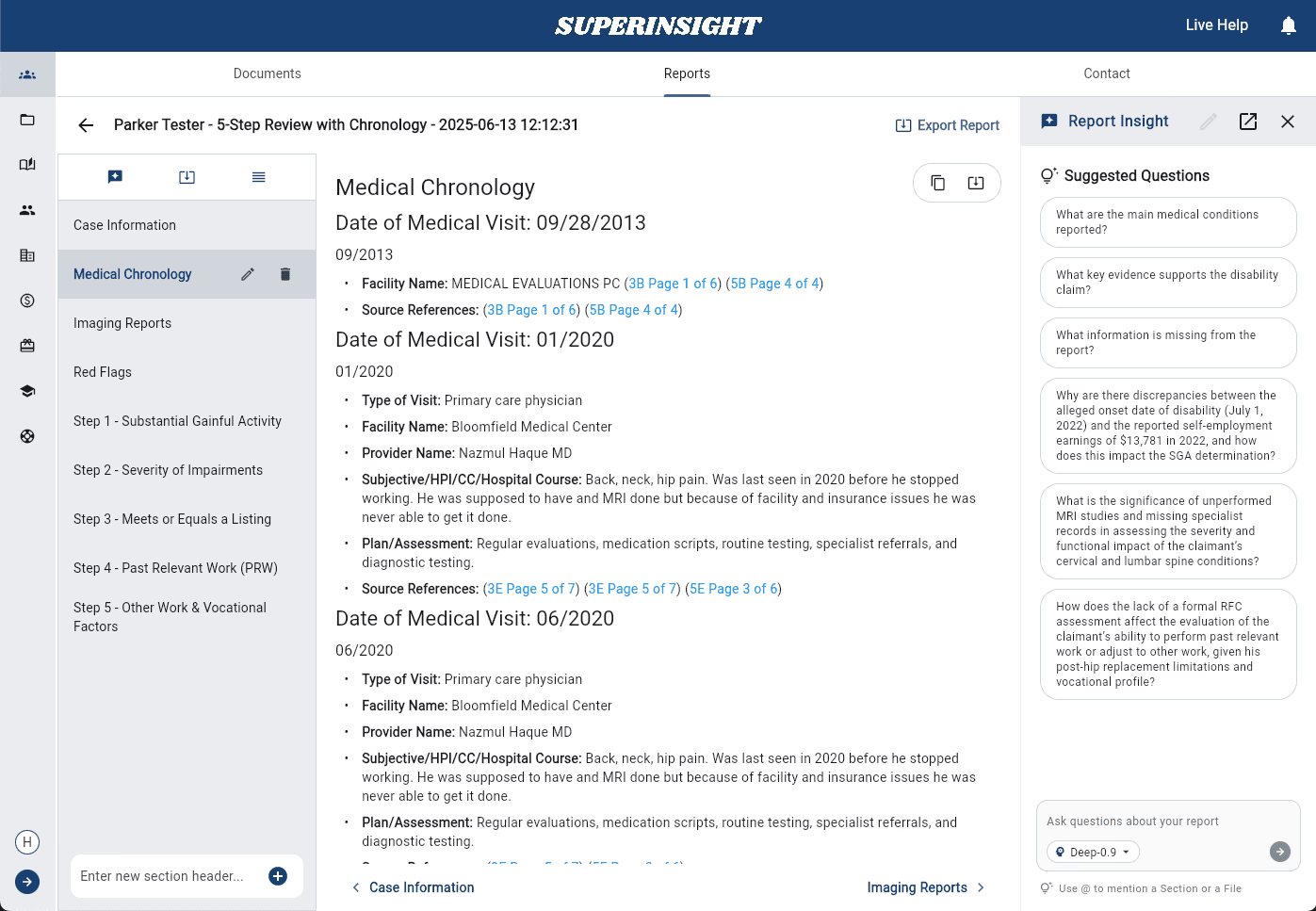
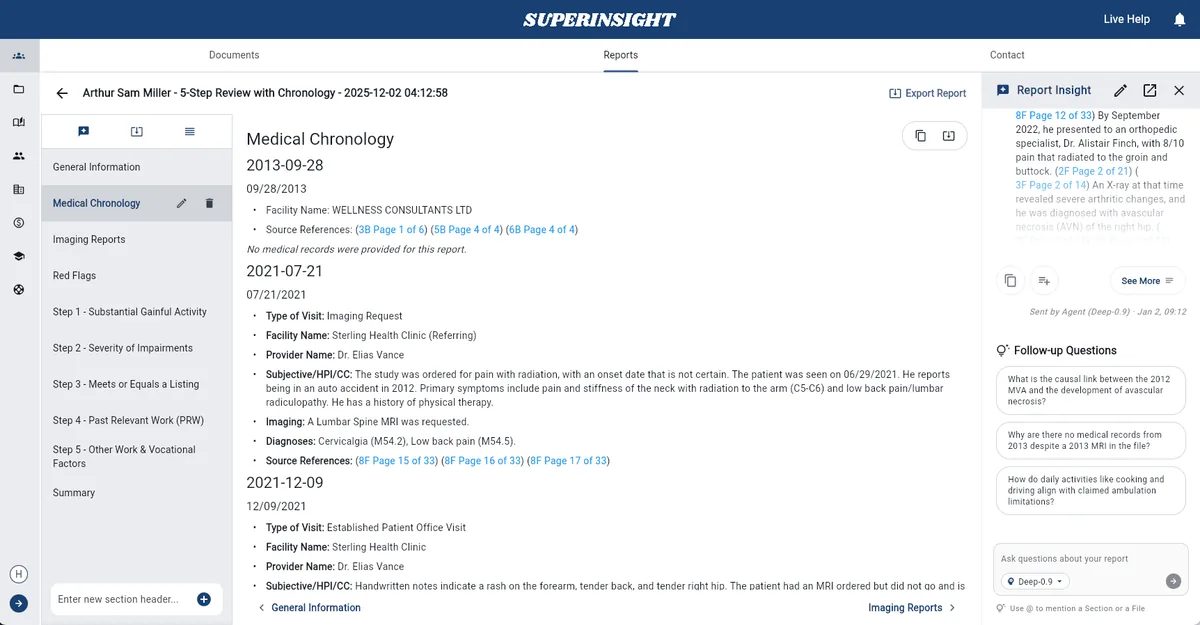
2. Medical Chronology and OrganizationStrong systems automatically build timelines by time and body system, mirroring SSA’s evaluation framework. This helps reviewers trace diagnoses and treatment outcomes across years of documentation.
**3. Workflow Integration + Audit-Ready and Transparent Outputs **Look for tools that fit seamlessly into existing workflows and provide transparent, verifiable outputs linked directly to exhibits, pages, dates, and providers, reducing manual work and ensuring audit-ability.
4. Advanced AnalyticsModern platforms should surface treatment gaps, flag inconsistent provider opinions, and highlight evidence supporting or challenging SSA criteria, turning raw data into actionable insights.
5. Security and Compliance
Ensure the platform is HIPAA-compliant and maintains clear audit trails to protect sensitive medical and legal records.
How Superinsight and Chronicle Lead the Way
Chronicle gives firms visibility, tracking every medical record with its ERE monitoring as it arrives so no file is missed. Superinsight takes those records further, transforming them into actionable insights with SSA-aligned organization, verified sourcing, and deep contextual understanding.
The integration allows firms to directly import Chronicle exhibits into Superinsight, eliminating manual uploads and streamlining the workflow from receipt to analysis. This saves staff days of effort while reducing the risk of missed details.
By combining Chronicle’s precise tracking with Superinsight’s capabilities, firms can:
- Generate audit-ready medical chronologies linked to the original source document
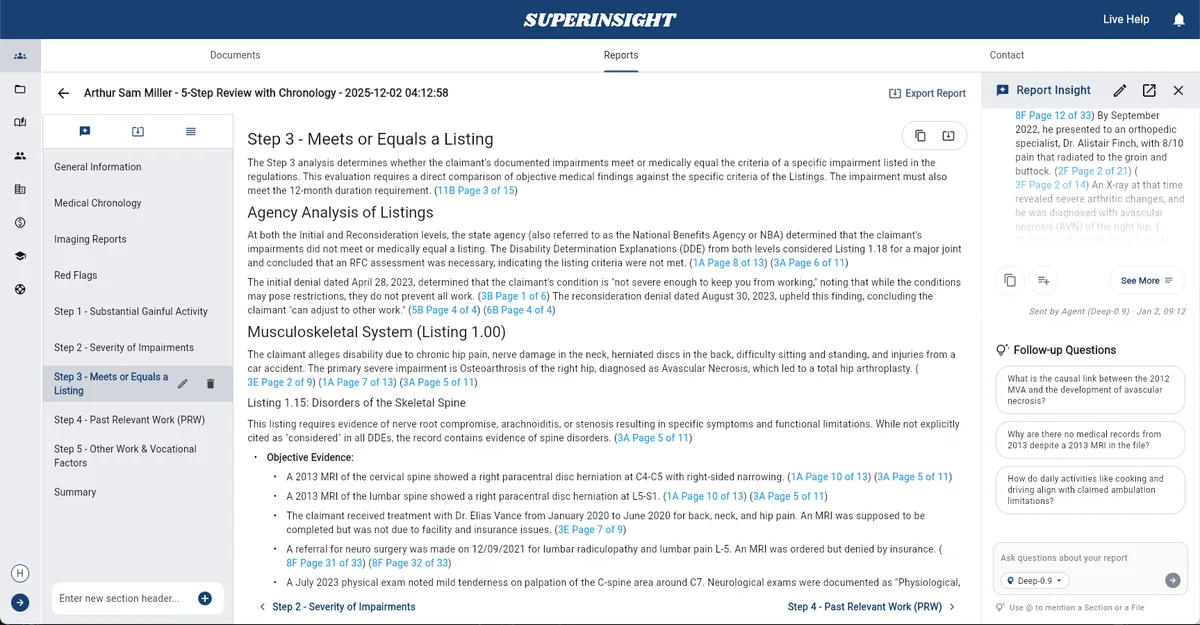
- Map findings to SSA RFC forms and Blue Book listing criteria
- Detect treatment gaps, inconsistent provider opinions, and critical patterns across providers and timelines
- Maintain secure, verifiable workflows with human judgment at the center
Key Superinsight Advantages
- Organized for SSA Standards & Verified AI Findings: Automatically structures records to SSA’s framework for faster hearing preparation and instant retrieval. Insights include clickable source links to validate every conclusion immediately
- Functional Capacity Evidence Mapping: Identifies RFC relevant medical findings, including exertional, postural, and environmental limitations
- Instant Hearing Access: Locate any record in seconds during testimony
- Deep Contextual Understanding: Detects patterns, relationships, and subtle links across reports, reducing missed details
- Data Privacy: Superinsight is HIPAA compliant and ISO42001 certified.
Why This Matters Strategically for Disability Firms
Efficiency and accuracy directly affect case outcomes, staff workload, and profitability. As hearing volumes rise and evidence files grow, manual review can limit the number of cases a team can handle.
Context-aware automation changes that equation. Systems that organize evidence automatically, interpret medical context, and link findings to verifiable sources allow teams to process cases faster without compromising accuracy. Attorneys and analysts can spend less time on data management and more on legal strategy.
The strategic advantage is clear: teams that embrace automation early can scale faster, manage higher case volumes, and maintain stronger quality control. Superinsight gives disability firms that edge by turning unstructured records into organized, validated insights ready for hearing preparation from day one.
5 Practical Takeaways for SSD Firms
- Prioritize context-aware automation. Choose systems that understand relationships between diagnoses, treatments, and provider notes to generate accurate, defensible insights.
- Demand transparency and validation. Ensure every AI-generated finding links to source exhibits, pages, and document dates for instant verification.
- Leverage structured medical chronologies. Adopt platforms that automatically organize records chronologically and by body system, mirroring SSA review processes.
- Use analytics for quality and insight. Modern systems should highlight treatment gaps, inconsistencies, and trends that strengthen case strategy.
- Train teams to work alongside AI. Build review protocols that combine human judgment with automated insights to ensure consistent, accurate results.
Closing the Loop with Superinsight
Disability law is evolving. Success is no longer just about tracking records. It’s about turning data into actionable intelligence. Superinsight reviews and organizes records instantly, transforming tasks that once took days into hours. The result is faster, more accurate insights that directly support case outcomes.
Want to see how Superinsight can streamline your record review process? Visit superinsight.ai to learn more or schedule a demo.
About the Author

Michelle Sun, Growth at Superinsight. Harvard graduate focused on building AI-driven tools that help legal and medical professionals streamline workflows and make smarter, faster decisions. Passionate about creating integrated solutions across the disability and healthcare ecosystem. Learn more by clicking the button below.