
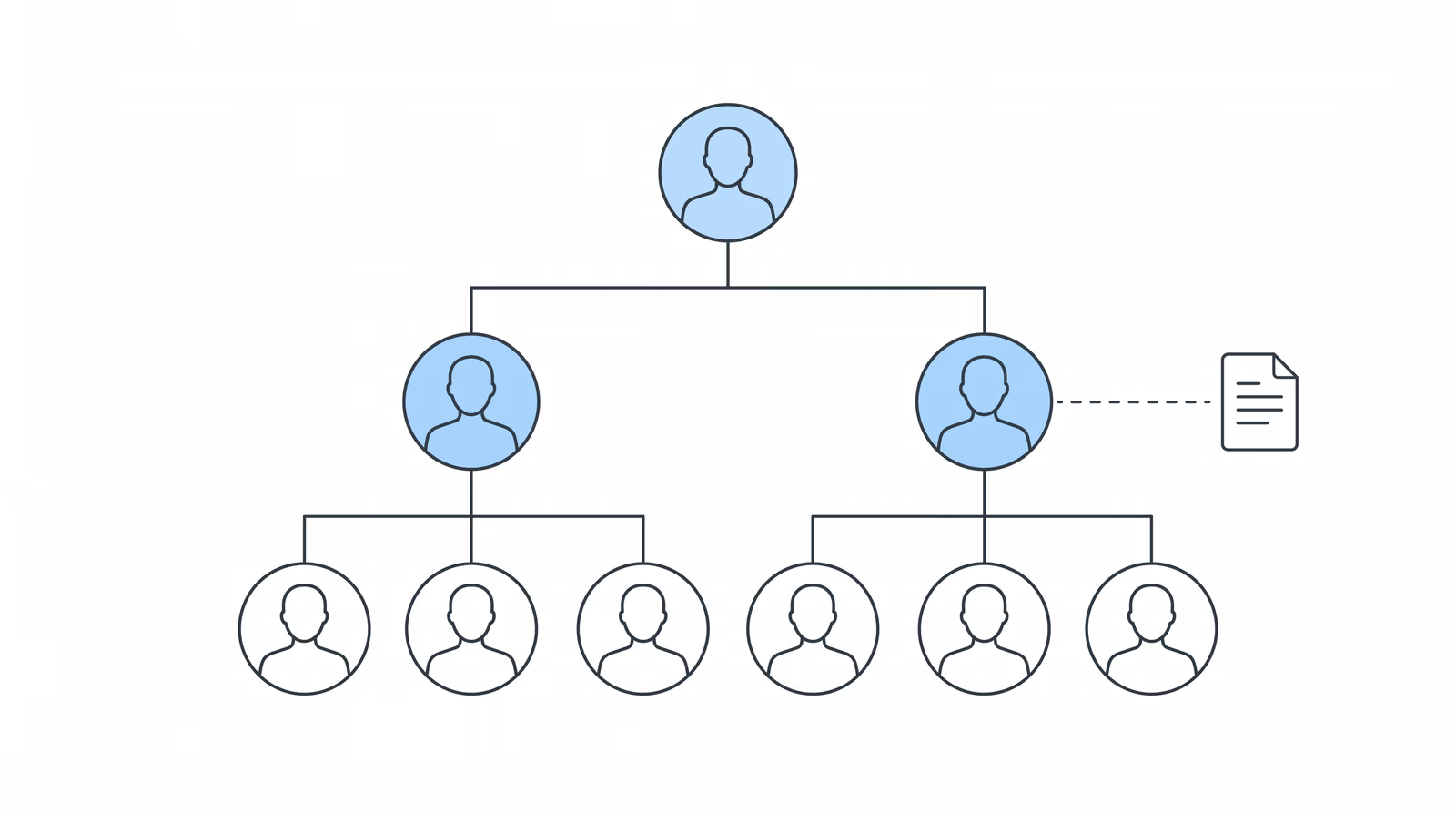
In August 2026, two rooms of larger Social Security disability practices joined Disability Peers in Practice, Chronicle’s monthly peer community where SSD practitioners work through real operational problems together. The topic: hiring, training, and trusting the team behind the practice.
The session was designed around who you hire and how you find them. Two of the first three firms to speak in the afternoon room opened by saying their goal this year is to stop.
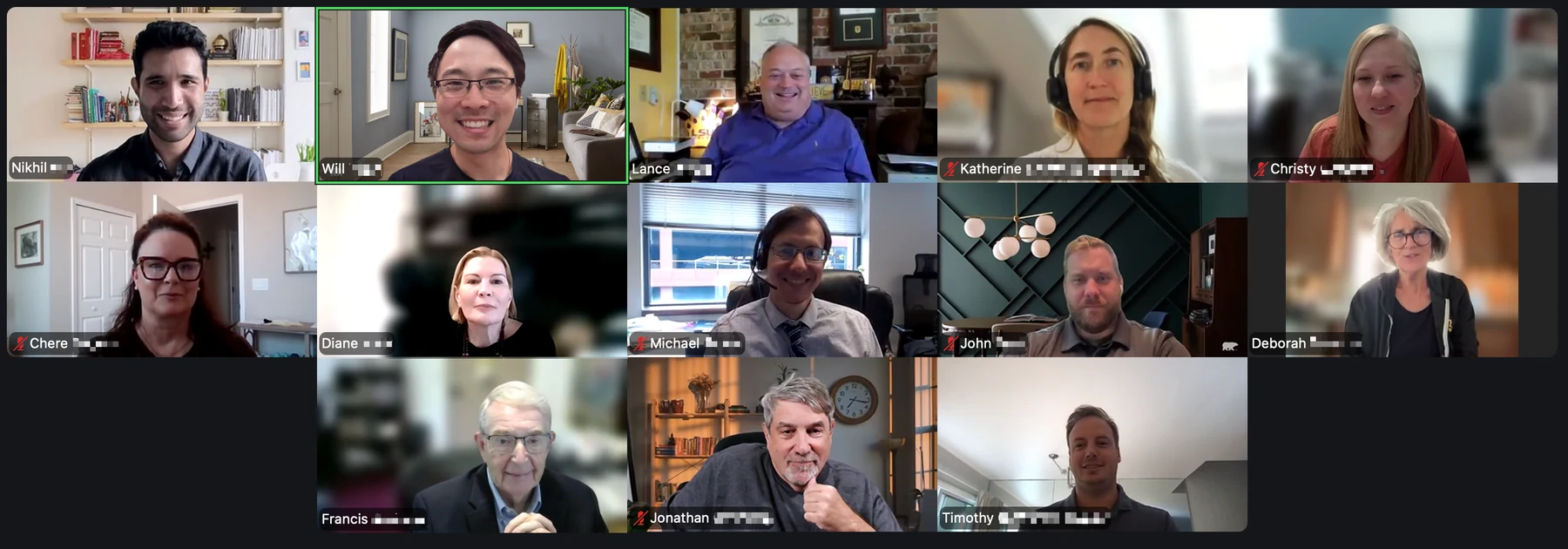
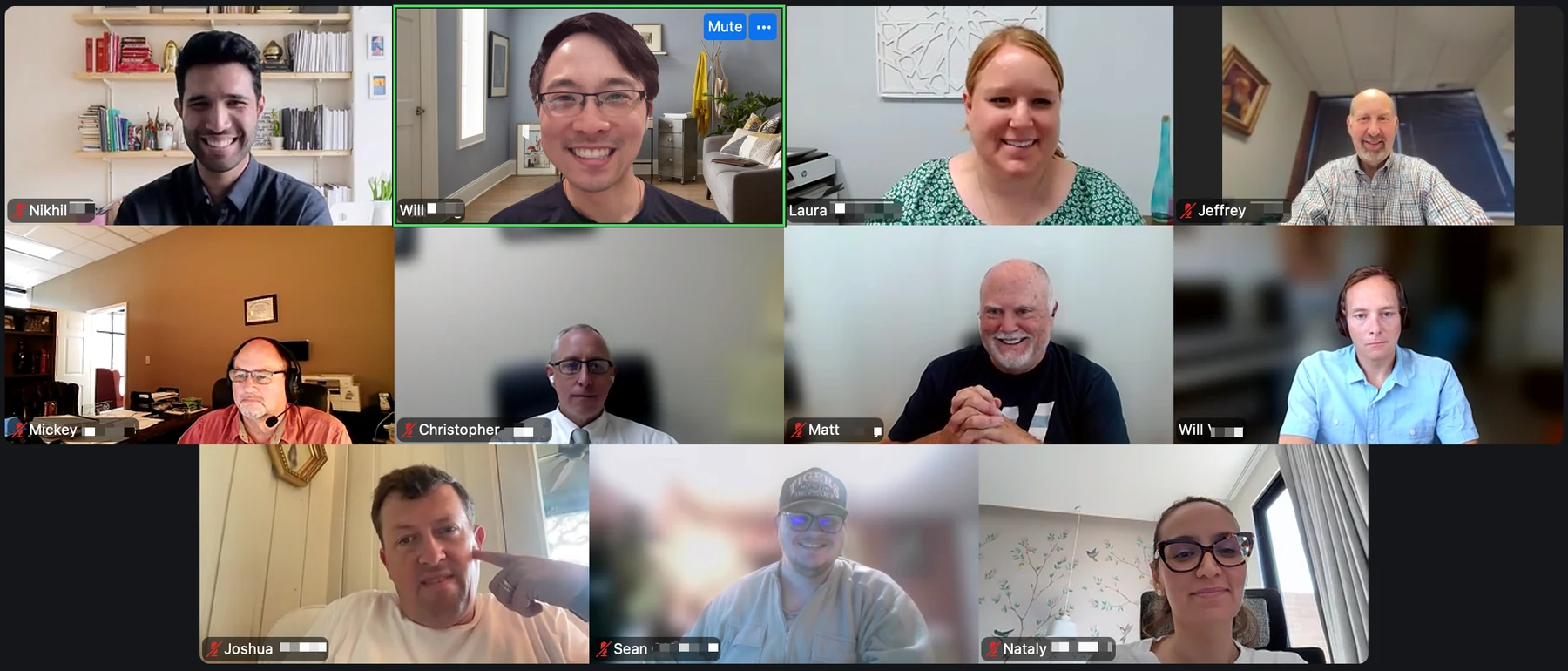
The room ran from single-representative practices scaling into their first management layer up to firms carrying several thousand active cases across eleven states. Nine states were represented, plus staff in Colombia, the Philippines, Spain, and Belize. Roughly half the practitioners in the room run operations or manage people as their primary job rather than carrying a caseload. What they had in common was that all of them have already made the hires that solve the obvious problems, and are now working on the ones that don’t have an obvious hire attached.
The Goal Has Shifted From Making the Next Hire to Not Needing It
- Two firms named “how to stop hiring” as their current objective, unprompted
- The forcing function is capability, not payroll cost
- One firm’s re-audit of a tool they already owned removed the bottleneck they were about to hire into
- Both are simultaneously rewriting SOPs, on the theory that systems have to absorb the growth
This is a reversal from earlier sessions in the series, where the framing was almost entirely about when the next hire becomes affordable.
Our biggest thing with hiring right now is how to stop doing it. We need to be able to grow without constantly just throwing more people at the problems that we’re experiencing.
— Sean
The most concrete version came from a Chicago firm that had written off their case management system’s built-in AI after a bad early experience, then went back to it.
We just did one prompt on one task which will enable us to almost double the number of hearings we’re going to do without adding on another trial paralegal to outline and get files ready for the attorneys.
— Jeff
He was blunt that they had ignored the feature for a long time on the strength of one disappointing experiment. The bottleneck it relieved sat on his two longest-tenured and highest-paid people in that role, which is exactly where added efficiency is worth the most and where burnout is most expensive.
What this means: before writing the job description, re-audit the tools you already pay for: the capability that was not there eighteen months ago may be there now.
Case Manager Ratios Range From 180 to 300, and the Number Depends Entirely on What Sits Underneath It
- Two practitioners asked the room directly for a caseload number
- Answers ranged from 180 to 300 active cases per case manager
- The spread is explained by how much of the work is carved out to other roles
- At least one firm rejects the ratio question and decomposes stages into task sets instead
They generally can’t handle more than 300 cases in the way that we want the case to be handled.
— TC
We’ve been setting 180 to 200 cases per case manager as a top limit. But again, using more of the communication tools, we’ve added the portal and messages through that. We’re trying to automate some messages and some procedures to make it simpler. So I doubt we’d go much over 200 per case manager, because we don’t want to totally burn them out.
— Jeff
Those two numbers are not in conflict. The 300 assumes virtual assistants handling a defined slice of the work. The 180 to 200 covers initial and reconsideration, with separate assistants doing 3441s and confirming consultative exam appointments, and a separate hearing team downstream. One firm bifurcates staff into intake, pre-request-for-hearing case management, and hearing prep, and identified the middle tier as where the ratio question actually bites.
The most interesting answer refused the premise:
We haven’t really looked at ratios so much. We’ve broken the big stages, initial and reconsideration, into sets of tasks, and so we’ve got a person that handles the first few tasks that need to be done early on at that stage, and then it goes to somebody else who has a set of tasks.
— Mickey
That firm watches for individual overload rather than a threshold, and responds either by adding a person to the same task set or by re-cutting the process.
What this means: a ratio borrowed from another firm is only useful alongside a description of what that firm’s case managers do not have to do.
The Operations Hire Is the One Nobody Has Solved
- Three firms described failed attempts to hire an operations leader from outside
- All three failures traced to the same gap: law firm experience without Social Security knowledge
- The consensus in the morning room was to promote from within, and accept that it is slower
- A firm in the afternoon room had the opposite experience with a fractional COO, because it was a different job
This was the longest thread of the month.
We tried hiring a managing attorney from outside, with the thought that that would replace me. That turned out to be a disaster, so we ended up splitting the roles… I’m not sure that I would ever do that again.
— Francis
I really struggled finding anybody with Social Security disability experience at all. So I got somebody with law firm experience, but their lack of Social Security disability knowledge really made them kind of ineffective for process and procedures.
— Travis
The room’s conclusion was structural rather than personal.
I’m convinced that for Social Security or VA, you have to hire them and train them from within and promote them from within. I just don’t think you can find people.
— Francis
One firm is a year into doing exactly that: a case manager who was put through EDPNA certification and management training now supervises the case managers, with two senior case managers being promoted beneath him to keep scorecards so he can move up into legal operations. The same practitioner named the general error:
I think we all try to go a little bit too high level, a little too fast. It’s like an operations manager first.
— TC
Then the afternoon room produced the dissent. A Denver firm (600 clients, four staff, one attorney) hired a fractional chief operating officer through a matching service and described it as the best decision of the year.
I took a week off in July, and I came back, and it was wonderful. I didn’t have any emails to deal with, I just had tasks to do on my calendar and just worked through them.
— Will V.
The engagement runs about ten hours a week at roughly $5,000 to $5,500 a month, and the COO is tied into the firm’s systems directly. What she does is telling: she pulled him off the internal chat threads and routes only what matters, chases pipeline that nobody has touched, onboards new virtual assistants so he doesn’t have to build the welcome materials, and holds a weekly status call against stated goals. She is not answering questions about work comp offsets.
That is the reconciliation. The three failed hires were searches for someone who could run operations and answer Social Security questions. The successful one was hired to run the business, not the casework.
The saying that I’ve always been taught since I started my practice in the ’80s was, get to the point where you can work on your business instead of in your business.
— Jeff
What this means: separate the two jobs before you hire for either: the program knowledge almost certainly has to be grown internally, but the business operations role may not.
Every Firm in the Room Is Building the Same Thing: A Place to Put What Senior People Know
- Every firm is somewhere on the project of turning institutional knowledge into something queryable
- The tooling varies widely; the motivation is identical everywhere
- The versions with a feedback loop are pulling ahead of the versions that are just documentation
- Two firms independently landed on quizzes and completion checkpoints as the comprehension test
My goal and big project has been dumping all of my knowledge into a brain — a brain for the company.
— John
His build has a loop in it. Firm processes go into Confluence, alongside copied-in Social Security rulings and HALLEX material. A Slack agent searches that space so staff can ask questions without interrupting a senior person. And the questions people actually ask, pulled from Slack and email and scrubbed of protected health information, get fed back to AI to generate the next set of pages.
That last step is what makes it compound. The knowledge base grows toward the gaps that exist rather than the gaps someone guessed at. He offered it directly to a practitioner in the room who had just described her succession problem as an inventory of arcane questions only she can answer.
A Michigan firm arrived at the same property from the other direction:
One thing that’s worked for us is moving away from what you might call tribal knowledge or institutional knowledge, and really documenting all of our processes.
— Sean
Their in-house learning platform carries quizzes, completion checkpoints, and benchmarks, and what got documented first was decided by pulling historical data on which tasks most affect a file’s progress through its lifecycle. The payoff he named was not speed:
Rather than feeling like they need to go to their direct supervisor or another employee, we feel that that’s empowered our employees to really take things into their own hands, because they’ve been educated on what they need to do rather than being thrown into the deep end and figuring it out as they go.
— Sean
Elsewhere in the room the same job is being done with Trainual, with Whale, with a plain in-house intranet, and with a detailed written SOP used as a training syllabus. One practical warning surfaced: one SOP platform’s API limits mean it cannot be connected to an AI assistant directly, so the workaround is exporting PDFs that immediately start going stale.
What this means: documentation that is only written once decays; the versions that survive are the ones where real questions from real staff decide what gets written next.
Offshore Staffing Has Split Into Two Camps, and Both Can Show Their Work
- Six firms in the room have offshore or nearshore staff
- The disagreement is direct employment versus agency, and it is substantive
- One firm ran the experiment both ways and went back to agencies
- The deciding variable is whether someone at the firm will own the HR mechanics
Direct. A North Carolina firm sources in the Philippines through OnlineJobs.ph and in Colombia, and once they had a foothold in each country switched to referral networks.
We don’t use staffing agencies. We work direct with people overseas. So in the Philippines, we find people through OnlineJobs.ph typically, but now, after we’ve kind of got a beachhead there, we’re using referral networks.
— Joshua
His colleague, herself based in Colombia, described what changed as the offshore team grew:
We’ve learned that we can’t necessarily approach compensation or recruiting the same way in every country. So we try to understand what is competitive locally, while still making sure that we’re attracting really strong candidates.
— Natalie
The middle path. A Michigan firm running a blend of direct hires and agency staff, and trying to move everyone onto its own team, put the employment risk on its payroll provider instead:
We worked with our payroll company, and they had an option where they could be the employer of record and absorb that risk for us. And it ended up being maybe fifteen bucks a month per person.
— Sean
They hire overseas staff as contractors, with the payroll provider acting as employer of record and carrying, in his words, 99.9% of the risk.
Through an agency. The counter-argument was made on risk, and then on arithmetic.
I didn’t want them to be employees, because I didn’t want to worry about liability, or all the issues of hiring international employees, which I don’t even understand. So it’s been easier to just go through an agency. You pay a little more, but it becomes their problem.
— Jeff
The most useful data point came from a firm that tried it both ways, expecting to capture the agency’s margin:
We were taken aback by how little of what we pay to the agencies actually trickles down to the employee’s pocket, in both the Philippines and Colombia. So we decided to hire probably a handful in the Philippines directly… But we were taken aback by, at least under Philippine law, what costs are incurred if you let somebody go. It’s pretty staggering. To the point that it didn’t seem like it was a whole lot less expensive for us than using an agency, and it was certainly fewer headaches to use an agency.
— Matt
The two agencies that firm named are RemoteLegalStaff, which recruits and manages US law firm staff remotely, and Solvo, a Medellín-based nearshore provider. Elsewhere in the room, Legal Soft came up twice as the source for virtual case managers, legal assistants, and intake.
A third structure also surfaced: an agency that supplies a managed team rather than named individuals. The firm trains the agency’s supervisors once, the agency handles day-to-day management and covers absences without the firm having to redistribute that day’s tasks. The practitioner using it had moved to that model after watching recruit quality decline at two prior agencies.
What this means: the direct-versus-agency question is really a question about who absorbs statutory employment risk in the destination country, and an employer-of-record arrangement is a third option that sits between the two.
What Actually Predicts a Good Hire Is How Someone Reasons When They Don’t Know the Answer
- The two highest-signal interview techniques both refuse to reward preparation
- Formal pre-employment testing produced the only measured hit rate anyone brought
- Most firms will take non-Social-Security backgrounds for intake and records roles
- One firm cannot screen for experience at all and screens for local fluency instead
The best-loved story of the month was a hiring question with no right answer in it. Interviewing for a hearing lawyer, one practitioner asked every candidate: you’re at a hearing, the vocational expert is testifying, you ask for the basis of her testimony and her methodology, and she says it’s privileged. What do you say?
Only one guy said, whose privilege is it? And I said, fine, you’re hired. You know nothing about what we do, I know nothing about you, but this is your job, you’re a real lawyer.
— Deborah
The case management equivalent tests the same instinct:
I’ll usually have them tell me, walk me through a case, start to finish. Initial, reconsideration, request for hearing. What happens? What do you do? What are the responsibilities? And I can tell within probably three minutes of that explanation how technically sound they are.
— Travis
The systematized version came from a Georgia firm that ran comprehensive pre-employment test batteries (six to eight tests covering computer skills, customer service, and English proficiency) on every applicant before anyone got an interview.
We only interviewed the top quartile, certainly the top third, of that group… Our batting ratio probably rose to 80 or 90% of what I would consider hiring success by using that.
— Matt
He has since stopped, because at roughly $2,500 a year and one to two hires annually the cost no longer clears, and he asked the room whether anyone had a cheaper equivalent. Nobody did.
On experience, the room divided by geography rather than by size. Several firms take intake and medical records staff with no Social Security background at all, looking for the underlying skill (one described hiring from doctors’ offices, where the phone work and clerical habits transfer), and look for workers’ comp or immigration crossover on case management. A Hawaii firm cannot apply the filter at all:
I’m looking for people who speak pidgin, who have an accent from here… We need people who are from here, because that’s what forms the relationship. So, no one has experience.
— Diane
What this means: design at least one question a prepared candidate cannot prepare for, because most of what a resume screens for can be trained and the reasoning cannot.
Two Problems the Room Could Not Solve
- Zombie files: to-do loops that complete correctly for months while the client stays unreachable
- District offices that can no longer be reached by phone
- Both were raised independently by more than one firm in the same hour
- Neither had a working answer in the room
One firm described a contact protocol that had been executing faithfully for eighteen months. Staff reach out, leave a voicemail, send a text, and set the next task ninety days out. The task always gets completed. The client is never reached.
Then tell them to set the task for a week. And if they haven’t gotten an answer, keep doing it for a week, and not for 90 days.
— Jeff
His own firm runs 60-day file reviews and still arrives at hearings having missed that a client vanished or stopped treating six months earlier. The line that ended the thread was the sharpest thing said in either session:
And they may be the most viable, because they may be the most sick.
— Jeff
Separately, one practitioner had spent the entire morning of the session working with staff on what to do now that district offices cannot be reached by phone. His firm’s answer is a form letter staff can generate and fax every two or three days until someone confirms whether the 1696 is on file, whether the case went to DDS, whether a PERC is set up, whether a notice of award is available. Another firm had come out of a meeting on the identical problem half an hour earlier.
What this means: if your case management system’s follow-up tasks can be completed without the underlying goal being met, the report you need is not “was the task done” but “how long since anyone actually reached this person.”
Also in This Series
The small-firm cohort met the same day and covered different ground: how to size a first hire against fully loaded cost in full fee cases, why splitting an existing job in two creates office politics a small firm has no HR function to absorb, and what to do when the whole caseload is sitting at DDS at once. Read the small-firm recap.
About This Series
The SSD community has been missing a regular virtual space where practitioners in similar situations talk through real operational problems together. Chronicle built Disability Peers in Practice to be that space.
Sessions run monthly, segmented by firm size, free and capped to keep them small. The format is peer-led and practitioner-first: structured conversation focused on what’s actually working in the room.
Register for the next session →
About Chronicle
Chronicle is an ERE monitoring and analysis platform built for Social Security disability practices. It checks the SSA’s ERE and e-file daily across your firm’s cases, surfacing status changes, new documents, and upcoming deadlines before they become problems. Chronicle is CMS-agnostic: it works with any CMS with an API, or with no CMS at all. Disability Peers in Practice is one of the ways Chronicle brings the SSD community together outside of conference season.