

"A security blanket": How the Law Office of Katherine Siegfried reclaimed 10 hours a week and built peace of mind into every case
Client Snapshot

Firm Name
Law Office of Katherine Siegfried
Location
Oakland, California
Case Load
~300
Firm Size
1 principal attorney, 1 senior EDPNA advocate, 1 EDPNA advocate, 1 paralegal, 3 administrative contractors
Start Your
Free Trial Now
Get faster hearings, cleaner files, and less stress. Chronicle keeps your SSD casework moving, without the ERE headaches.
Book a Demo“Having Chronicle versus pre-Chronicle, it is saving me easily probably ten hours of work a week.”
Mika Aoyama, Senior Legal Advocate
The Challenge
At the Law Office of Katherine Siegfried, thoroughness is not aspiration. It is firm policy. The practice intentionally caps its caseload around 300 open matters so that each client receives sustained attention from the person who will represent them long-term, not just at the hearing, but throughout the life of the case.
That commitment had a cost. Every working day, it was paid in hours of manual effort that had nothing to do with legal work.
The firm's legal assistant processed physical mail each morning, flagging incoming SSA notices. Each notice then had to be scanned, named, dated, and saved so the responsible team member could follow up. Staying current with SSA activity beyond the mailbox meant logging into the ERE portal, requesting an access code, pulling up status sheets, downloading them. The portal screen view alone was was not enough; the useful detail lived in the downloads.
"It was constantly logging into ERE, getting the access code, checking the status sheets, downloading the status sheets because not everything's available when you look just online."
What made the process particularly wearing was how rarely it yielded anything new. Checks happened anyway, because they had to. Something could have changed, and not knowing was not an option across 300 active cases. The cross-referencing that work demanded was its own mental tax: is today's status reading different from yesterday's, or does it just look different?
"A lot of manual labor and very time intensive, oftentimes just to learn that nothing has changed, but of course wanting to stay on top of things, needing to be checking that on a regular basis."
The burden fell unevenly on the team. The firm's less senior advocate absorbed administrative duties that pulled her away from the legal analysis the role existed to produce. The inefficiency was not dramatic; it accumulated.
“It was constantly logging into ERE, getting the access code, checking the status sheets, downloading the status sheets because not everything's available when you look just online.”
The Tipping Point
The pandemic clarified something the firm had been working around for years. When operations shifted toward remote work, the mail-dependent workflow did not shift with them. Someone still had to come into the office to open the mail. The firm's physical address was a single point of vulnerability built into every case on the docket.
"A tipping point in kind of dealing with all of this was related to the pandemic. If you need to be checking the mail, then someone still has to be going into the office, someone still needs to be filing those documents. And so being able to utilize Chronicle to facilitate an easier transition to the team being more remote has been really helpful."
The firm had heard about Chronicle at one of the national SSD conferences they attend and started with a trial. Conviction came fast.
“There was never any question. It was apparent to all of us essentially immediately that this was a tool with unquestionable utility, and one that was relieving so much of the burden in terms of administrative and manual work that we needed to be doing.”
“A tipping point in kind of dealing with all of this was related to the pandemic. If you need to be checking the mail, then someone still has to be going into the office.”
Why Chronicle: From Pain to Progress
~10 hrs
saved per week
The shift Mika noticed first was not a feature. It was a morning routine.
She no longer started the day at the ERE portal. She started at email, which she was already opening anyway, and sorted through Chronicle alerts to identify which cases had new activity and which ones needed a response.
"I start my day not by opening ERE, but by opening my email, which is something that I need to be doing anyway, and sorting through which alerts I need to take action on and which ones are just for my information. I really use the alerts from Chronicle as a way to structure my work."
The mental load shifted almost immediately. The old workflow had required perpetual vigilance: logging in, comparing status readings, trying to hold yesterday's status in memory alongside today's. Chronicle reduced that to a clear signal.
"The benefit of being able to get all of these notices in my email when something changes versus needing to constantly be logging into the website to check for those things and cross-referencing to see if this is a change or is it not a change. All of that went away."
Mika describes Chronicle's value in terms that come directly from a decade inside SSA systems: "It does all of the things that ERE should do and doesn't." For staff who needed access to the basics, orientation took fifteen to thirty minutes, a fraction of the ramp time the firm's other tools typically required.
Transformation & Results
The direct time savings run to roughly ten hours per week for Mika alone. Those hours go toward maintaining stronger contact with clients, writing higher-quality briefs by spending more time in each file, and responding faster when SSA requests information.
There is also a less visible protection that Chronicle provides, one that surfaces when response windows are involved. When an exhibit is added to a file, a firm relying on physical mail delivery can lose several days of a ten-day window before the notice even arrives. Chronicle eliminates that drain.
"Rather than not only needing to open the mail but manage the delays that come with the postal service, everything is just there immediately as soon as it goes out. You go from losing days of your 10-day window to having that entire 10-day window because you know right away when that notice has gone out."
The Clio integration deepened these gains in a different direction. Before, every change in case status required someone to remember to manually update Clio's matter stage field. It was easy to forget, and easy forgetting meant Clio's data drifted from reality, which made the system harder to trust and harder to use as a reliable source of case state.
Now those updates happen automatically: Chronicle detects the change; Clio reflects it. Hearing dates populate without manual entry. Judge assignments appear. The step between SSA event and internal record is gone.
"It is very nice to feel like you can really trust the data that's in Clio because you've removed the human element of that data entry."
The firm is building toward the next layer: automated document generation triggered by Chronicle-driven status changes. When a hearing is scheduled, Chronicle updates Clio, and Clio generates the client notification letter, the testimony advice document, and the preparatory tasks, without anyone manually initiating the sequence.
Mika calls it a security blanket, and the word is accurate. Chronicle does not just save time. It removes a particular variety of background anxiety: the awareness that something could slip through if no one catches it in time.
“It provides me with just the relief of knowing that if the legal advocate doesn't get to the office to pick up the mail that day, the Chronicle notices are still coming in to tell us about anything that's gone out.”
When the firm relocated and Social Security was slow to update address records across its cases, Chronicle kept delivering notices electronically, including ones being mailed to the old office address. The coverage held without any additional effort from the team.
“I think of it kind of as a security blanket. It provides me with just the relief of knowing that if the legal advocate doesn't get to the office to pick up the mail that day, the Chronicle notices are still coming in to tell us about anything that's gone out.”
The Takeaway
The Law Office of Katherine Siegfried was not looking to scale. They were looking for a way to serve 300 clients well without the administrative process consuming the hours that belong to actual legal work. Chronicle delivered on that directly, and the Clio integration is compounding those gains by making the firm's internal data trustworthy enough to build automation on top of.
For Mika, the lasting change is not operational.
"The biggest impact that Chronicle has had for me personally is the peace of mind of feeling consistently up to date with my cases, coupled with the mental relief of not needing to be constantly performing manual checks in order to make sure that that's the case."
Her description of Chronicle to someone unfamiliar is the plainest summary in any conversation about the platform:
"It has all the things that ERE does and probably 90 to 95% of the additional features that you could possibly imagine. ERE on steroids is the best way I can describe it."
To firms still processing mail by hand and checking the ERE multiple times a day:
“Check out Chronicle and stop wasting your time. There is so much potential there, even in using the very basic features, it is a huge time saver. And once you get into the additional integrations and features and options, it just really opens up a whole new world of possibilities.”
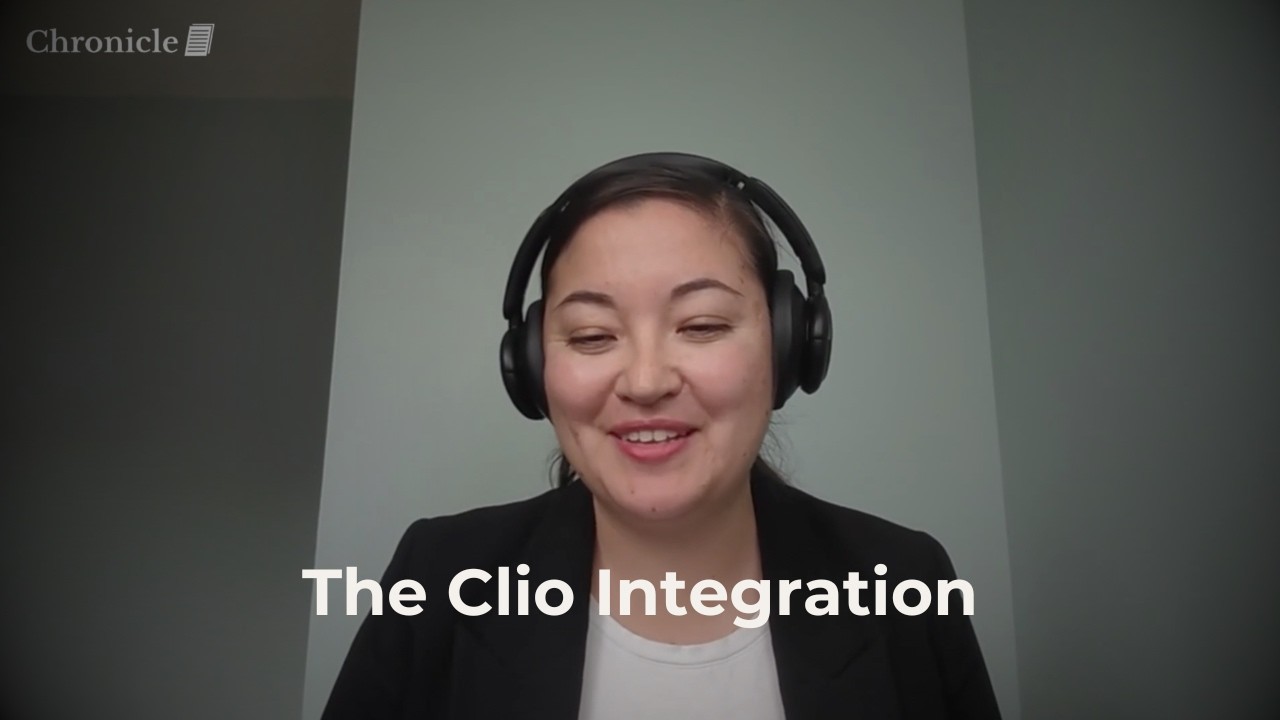
“You can really trust the data that's in Clio because you've removed the human element of that data entry.”
Start Your
Free Trial Now
Get faster hearings, cleaner files, and less stress. Chronicle keeps your SSD casework moving, without the ERE headaches.
Book a DemoYour virtual SSA mailroom
Join the Firms Saving Hours Every Week
See how Chronicle can help your firm reclaim time and peace of mind.
More Customer Stories

"Without that awareness, that client absolutely would have been denied": How Desert Disability catches critical case details before they become denials
Managing attorney, case managers (field office + hearing levels), 1 non-attorney rep, 1 paralegal
Read more
"It just unlocked so many doors": How Garza Law scaled from 400 to 1,000 active cases in one year
2 Social Security Disability attorneys, approximately 12 support staff
Read more
"Chronicle is a backbone of my firm these days": How Hawaii Disability Legal Services serves 500 Pacific Island cases with a team of five
Founding attorney Diane Haar + team of five
Read more