

If a client has ever called your office to tell you they were approved or denied before you knew it yourself, you already understand the problem. It’s not a communication failure. It’s a visibility gap, and it has a structural fix.
The Call No Firm Wants to Get
William Viner of Viner Disability Law described it bluntly: “We would receive calls from our clients telling us they’d been approved or denied. That doesn’t look very good professionally.”
It doesn’t. And it happens more often than most firms admit.
The client receives a decision letter from SSA. They call their attorney, excited or upset, expecting guidance on what comes next. The attorney (or more likely, the paralegal who answers) didn’t know. They have to check the file, find the document, read it, and then respond in real time to a client who’s already had hours to process the news on their own.
The dynamic is bad in both directions. A favorable decision should be the firm’s best moment: the call where you deliver good news. An unfavorable one requires careful framing of next steps and appeal timelines. In both cases, the firm should be the one initiating the conversation. When the client beats you to it, you’re playing catch-up on your own case.
Why It Happens: The Timing Gap
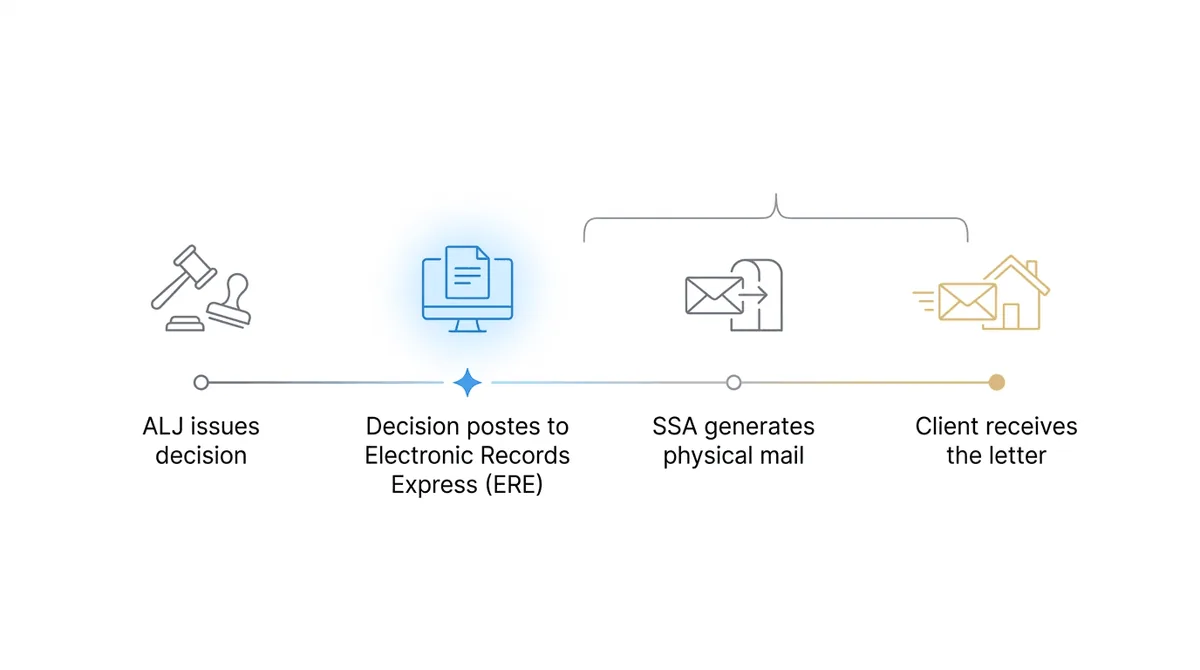
The SSA doesn’t hide this information from representatives. Decisions, notices, and correspondence are posted to the ERE: the SSA’s Electronic Records Express portal that representatives can access. In most cases, documents appear in the ERE before the physical letter reaches the client’s mailbox.
The gap works like this:
- ALJ issues a decision.
- The decision is posted to the case’s electronic record in the ERE.
- SSA generates a physical notice and mails it to the claimant.
- The claimant receives the letter, typically 3–7 business days later.
If the firm checks the ERE daily, they see the decision at step 2. If they check weekly, or only when they think to, the client’s letter arrives at step 4 first.
Jonathan Heeps of Martin, Jones & Piemonte described the downstream version: “We’d get a 10-day notice on day 9 or a 25-day letter on day 24. That made things a lot more challenging.”
The problem isn’t just embarrassment. It’s operational. A 10-day response window that starts when SSA mails the notice gives the firm barely any time to act if they don’t see it until the letter arrives. And if the client gets the letter before the firm even knows it exists, the firm is reacting to a deadline it didn’t see coming.
What It Costs You

Beyond the professional embarrassment, letting clients find out first has real consequences:
Trust erosion. The client hired you to be on top of their case. When they know something you don’t, the implicit message is that you weren’t paying attention. That impression is hard to undo, even if the outcome is favorable.
Slower response to unfavorable decisions. Denials come with appeal deadlines. If you find out about the denial when the client calls (potentially days after the notice was mailed), you’ve already lost part of your response window.
Missed opportunities for proactive guidance. A favorable decision still requires next steps: fee petition timing, explaining the payment process, setting expectations on back pay timing. A denial requires explaining appeal options clearly and quickly. Both conversations go better when you initiate them with preparation, not when you’re reacting to a distressed phone call.
Staff disruption. The paralegal who fields an unexpected “I got my decision” call has to drop what they’re doing, pull up the case, find the document, read it, and formulate a response, all while the client is on the line. That’s a 15–20 minute interruption that cascades through the rest of their day.
The Fix: Close the Timing Gap
The solution is straightforward: check the ERE daily, for every active case.
If a decision posts on Monday morning, your team should know Monday morning. Not Thursday, when the client’s letter arrives. Not the following Monday, when someone gets around to checking that case.
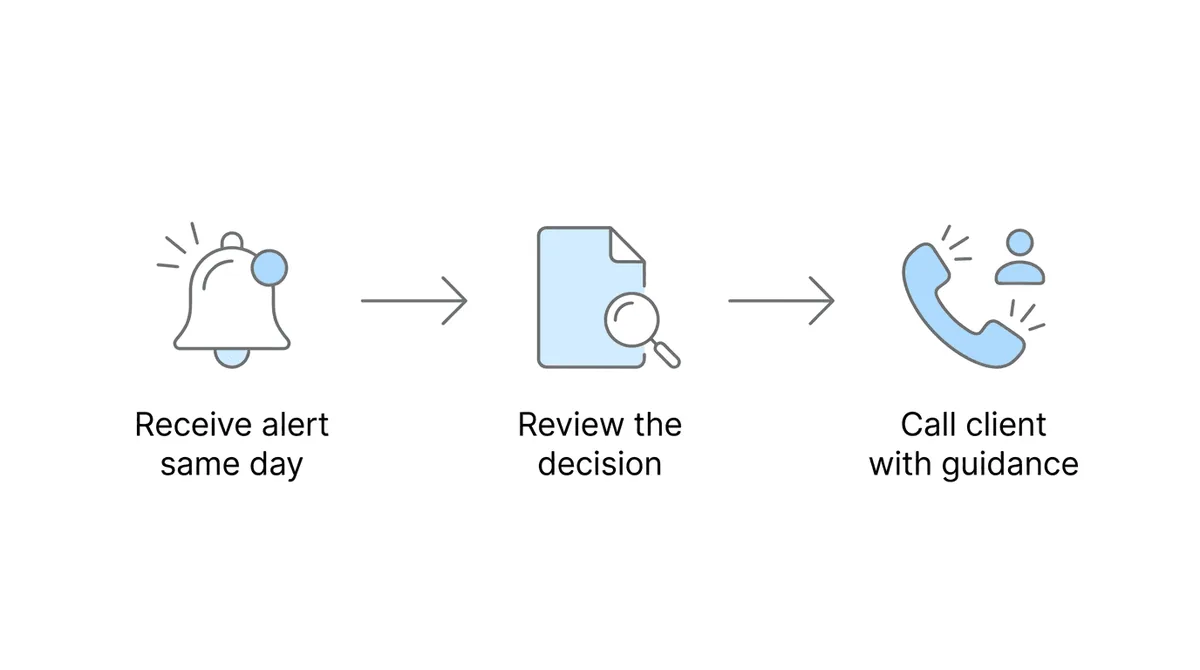
Daily monitoring closes the timing gap entirely. The firm sees what SSA does before the mail carrier does. That gives you time to:
- Review the decision or notice
- Prepare the appropriate response or next steps
- Call the client proactively with the news and guidance
- File any time-sensitive responses with margin instead of urgency
For a small firm (under 50 cases), manual daily ERE checks might be feasible, though tedious. But for firms handling 100+ cases, manual ERE checking doesn’t scale. Each case requires its own login session, and there’s no batch-check option. At volume, you either automate the monitoring or accept that clients will sometimes know before you do.
What to Do When You Know First
Closing the gap is only half the fix. The other half is what you do with the information.
**For favorable decisions:**Call the client that day. This is the highest-value phone call your firm makes. The client has been waiting months, sometimes years. Being the one to deliver the good news (before they get the letter) cements the relationship and demonstrates the value of having representation.
Walk them through next steps: when to expect the written notice, how the fee process works, what the timeline for payment looks like. Give them something concrete, not just congratulations.
**For unfavorable decisions:**Call the client before the letter arrives. Frame the conversation around next steps, not just the bad news. “Your case was denied at this level. Here’s what we recommend as the next step, and here’s the timeline.” The client’s emotional reaction is easier to manage when they hear it from their attorney in context, rather than reading a government letter alone.
**For notices with deadlines:**CE appointments, questionnaire requests, evidence deadlines: anything with a response window. Call the client immediately to confirm they understand what’s needed and by when. If you’ve already seen the document in the ERE, you can provide specific guidance instead of waiting for the client to forward a letter they may not fully understand.
How ERE Monitoring Makes This Automatic
Chronicle checks the ERE and e-file daily for each monitored case. When a decision posts, a notice appears, or a status changes, your firm is alerted, typically the same day it hits the electronic record.
That daily check is what closes the timing gap. Your team sees the decision at step 2, not step 4. The client never beats you to the news.
Krysti Monaco of the Law Office of Nancy L. Cavey described the operational shift: Chronicle “freed up our paralegals’ time so much so that they’re able to call clients more, give updates, upload documents while on the phone with the client.”
The result isn’t just better client communication. It’s a fundamentally different relationship with information. Instead of reacting to what clients tell you about your own cases, you’re proactively managing every stage of the case lifecycle with the SSA’s own data, before anyone else sees it.